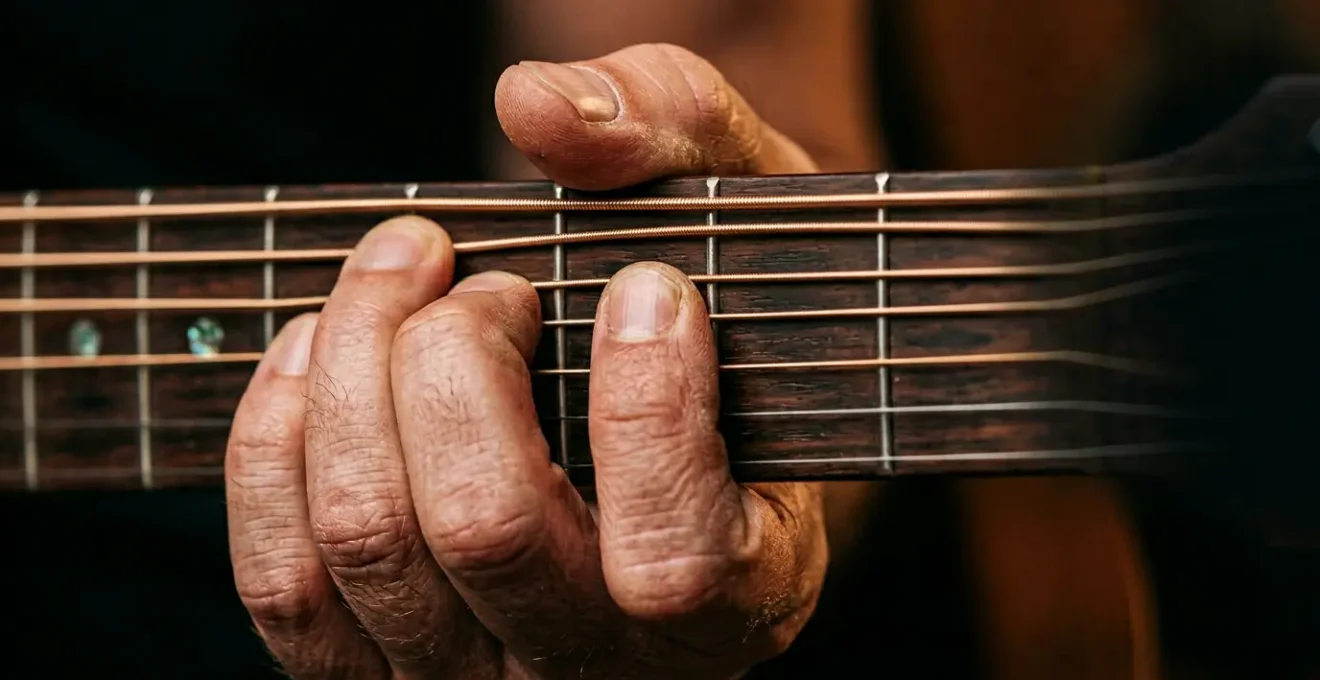
Achieving elite finger dexterity is not a matter of muscle strength, but of neuromuscular efficiency and targeted motor control.
- Speed is a byproduct of relaxation; excess tension in antagonist muscles is the primary limiter of velocity.
- True finger independence is a neurological skill, developed by isolating motor pathways in the brain, not just by strengthening individual fingers.
Recommendation: Shift your practice from brute-force repetition to mindful, biomechanically-informed drills that prioritize tension release and precise motor unit recruitment.
For any dedicated pianist or guitarist, the « lazy pinky » or a non-compliant ring finger is a source of profound frustration. It’s the weak link that collapses during a fast scale, the digit that refuses to articulate a clean hammer-on, or the source of unevenness in an otherwise perfect arpeggio. The conventional wisdom is to attack the problem with brute force: endless repetitions of Hanon exercises, squeezing grip strengtheners, and pushing through the burn. This approach is not only inefficient; it’s fundamentally misguided and often leads to injury.
The common advice to simply « practice more » or « strengthen your fingers » ignores the complex reality of motor control. The issue is rarely a lack of raw muscle power. Your fingers possess more than enough strength to depress a key or fret a string. The true bottleneck lies in the brain’s ability to send clean, isolated, and perfectly timed signals to the correct muscle groups. It’s a problem of software, not hardware.
This article reframes the challenge entirely. Instead of treating your hand like a set of independent pistons to be hammered into submission, we will approach it as a sophisticated neurological system to be trained with precision. The key is not building more muscle, but rewiring neuromuscular pathways for maximum efficiency. We will move beyond mindless drills and delve into the biomechanics of why tension kills speed, how the brain learns movement, and how to use targeted exercises to achieve true finger independence and accuracy.
This guide provides a rigorous, drill-focused framework to deconstruct your technique and rebuild it on a foundation of control and relaxation. We will explore the science of motor learning, providing you with the tools to diagnose your own inefficiencies and systematically eliminate them.
Summary: Unlocking Advanced Finger Dexterity Through Biomechanical Principles
- Are They Outdated? The Debate on Pure Finger Drills
- Rubbing Tummy Patting Head: Drills to Separate Left and Right Brain
- Chromatic Crawls: Waking Up the Weak Fingers on the Fretboard
- Why Relaxing Your Grip Makes You Play Faster
- Crossing the Thumb: Smoothing Out Scale Runs
- Why Feeling the Burn is Actually Destroying Your Technique
- Bends, Slides, Hammer-ons: Decoding the Squiggles
- Guitar Tablature: The Pros, Cons, and How to Use It Effectively
Are They Outdated? The Debate on Pure Finger Drills
The world of music pedagogy is divided on the utility of pure mechanical exercises like Hanon or Czerny. Critics argue they are unmusical, promote robotic playing, and can even instill tension habits if performed incorrectly. Proponents swear by their effectiveness in building foundational strength and evenness. The truth, from a biomechanical perspective, is that the value of a drill lies not in the exercise itself, but in the intention and awareness with which it is executed. A drill is a diagnostic tool.
Its purpose is to isolate a specific technical challenge—such as finger-lifting, evenness of attack, or rhythmic precision—in a controlled, non-musical context. This allows the brain to focus its entire cognitive bandwidth on solving a single motor problem without the added complexity of harmony, rhythm, and expression. When you perform a simple five-finger exercise, you are not just « strengthening » your fingers; you are calibrating the neuromuscular signals for attack, release, and timing.
The key is to perform these drills with hyper-awareness of physical sensation. Are you using excess force? Is there sympathetic tension in your shoulder or forearm? Is each finger moving with an economy of motion? Approached this way, drills become a form of moving meditation. As the MuseFlow AI Research Team notes in its analysis on motor learning, this mindful approach has profound neurological benefits. In their paper, « How the Brain Learns Music, » they state:
Slow, deliberate practice allows for deeper encoding in procedural memory, which leads to more stable, long-term retention.
– MuseFlow AI Research Team, How the Brain Learns Music (And How to Practice Smarter)
Therefore, finger drills are not outdated; the mindless, brute-force application of them is. When used as a tool for targeted, mindful problem-solving, they are an indispensable part of a rigorous technique-building regimen.
Rubbing Tummy Patting Head: Drills to Separate Left and Right Brain
The difficulty of playing different rhythms or melodic lines in each hand simultaneously is a classic example of a bimanual coordination challenge. This isn’t a failure of your hands; it’s a traffic jam in your brain. When you perform a complex action requiring both hands to do different things, you are placing a high demand on the corpus callosum, the neural bridge that connects the brain’s left and right hemispheres. The signals effectively interfere with each other, leading to one hand defaulting to mirroring the other.
To develop true independence, you must practice exercises that explicitly force the two hemispheres to work independently and then communicate efficiently. This is about building more robust and distinct interhemispheric neural pathways. Think of it as upgrading from a single-lane country road to a multi-lane highway between the two sides of your brain.
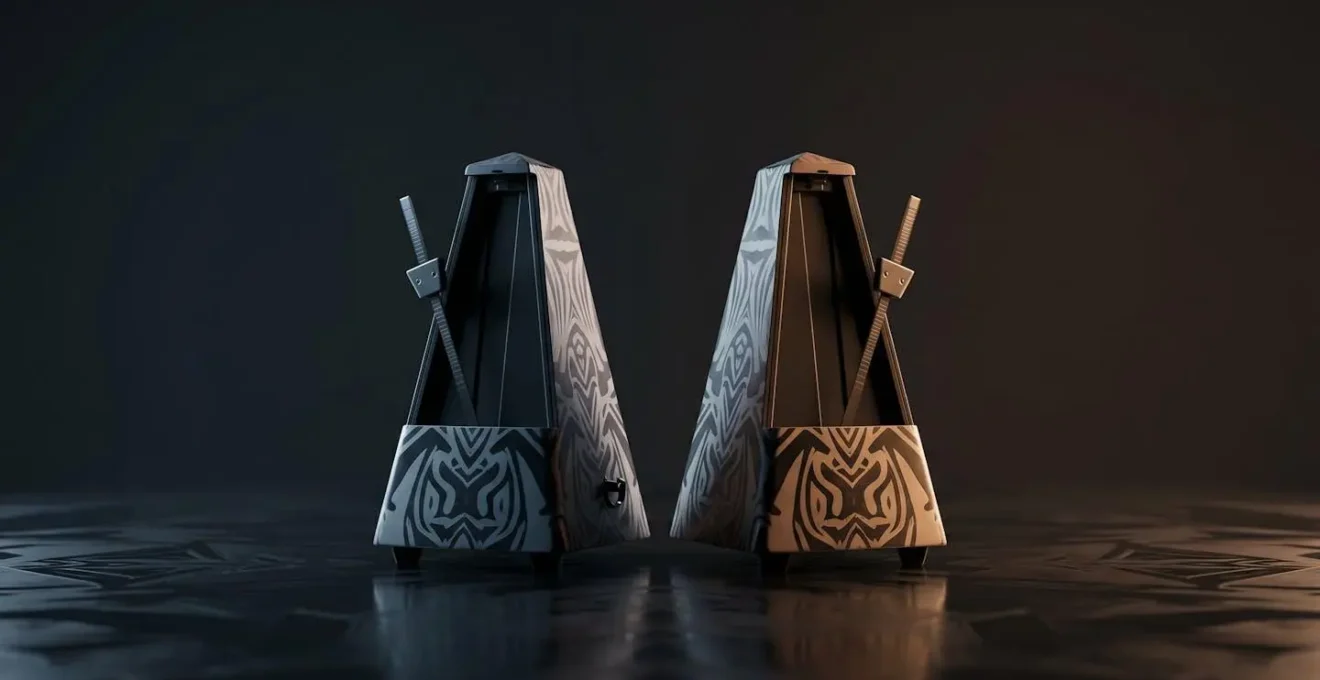
As the image suggests, the goal is synchronized yet distinct action. Simple exercises are remarkably effective. For pianists, this could involve playing a five-finger scale in the right hand while the left hand plays block chords on every beat. For guitarists, it could mean fingerpicking a steady arpeggio pattern while simultaneously tapping a complex rhythm on the body of the guitar. The key is to start with a very simple, automated pattern in one hand and introduce a slightly more complex, conflicting task in the other. The goal is not to « feel » the two parts as separate, but to eventually integrate them into a single, unified motor command.
Chromatic Crawls: Waking Up the Weak Fingers on the Fretboard
The so-called « weak » fingers, typically the ring finger (4th) and pinky (5th), are not weak in terms of muscle; they are neurologically underdeveloped for isolated movement. The tendons and nerve bundles for these digits have less differentiation in the brain’s motor cortex. Chromatic exercises are the most direct way to address this by forcing each finger to work in a sequential, isolated, and uniform manner. The goal is to create a perfectly even « caterpillar » crawling up and down the fretboard or keyboard, with no change in volume, timing, or attack between any of the fingers.
This is not a speed exercise; it is a motor control and sensory awareness drill. You must focus intently on the physical sensation of each finger. Pay attention to the lifting motion as much as the pressing motion. A common fault is leaving « lazy » fingers resting on the strings or keys, creating drag and sympathetic tension. Each finger should lift cleanly and immediately after its job is done, preparing for its next action. This develops proprioceptive awareness—the brain’s map of where your fingers are in space.
By executing these crawls with meticulous attention to detail, you are sending a clear message to your brain: « This finger is an independent entity. » Over time, the brain responds by dedicating more refined neural real estate to that digit, a process known as cortical remapping. This is how you « wake up » a lazy finger.
Action plan: Chromatic Exercise Progression System
- Begin chromatic scales using all four fingers, ensuring each note is clear and evenly spaced at a slow tempo (e.g., 60-70 bpm).
- Practice various finger permutations (e.g., 1-2-3-4, 1-3-2-4, 4-3-2-1) to directly target and eliminate weak links in the chain.
- Maintain a completely relaxed hand position with fingers naturally curved and all excess movement eliminated. Focus on minimum necessary force.
- Increase tempo by only 3-5 bpm once you can execute the pattern flawlessly and without tension at the current speed.
- Extend the exercises across the entire range of the instrument to ensure the hand is comfortable and competent in all positions.
Why Relaxing Your Grip Makes You Play Faster
The single greatest inhibitor of speed on any instrument is muscular tension. Many players mistakenly believe that playing faster requires more effort and a stronger grip. The opposite is true. Speed is a direct result of relaxation and efficiency. Every movement your finger makes is controlled by two opposing muscle groups: an agonist muscle that performs the action (e.g., flexing the finger to press a string) and an antagonist muscle that performs the opposite action (e.g., extending the finger to lift it).
Tension arises when the antagonist muscle fails to relax completely while the agonist is working. In this state, your muscles are actively fighting each other. This « co-contraction » requires enormous amounts of energy, leads to rapid fatigue, and acts as a physical brake on your movement. Playing with tension is like trying to drive a car with the handbrake on. To play fast, you must train your antagonist muscles to release instantly and completely, allowing the agonist to move freely and without resistance. This is the secret to an effortless and fluid technique.
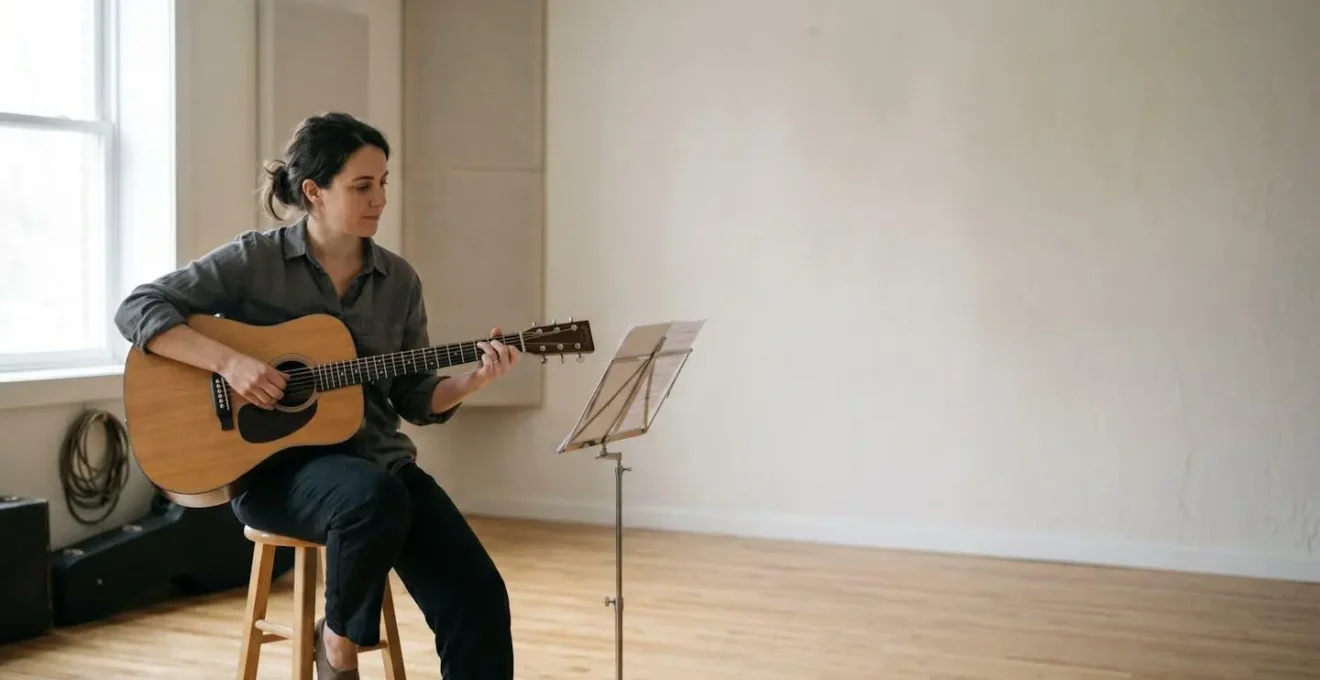
The concept of minimal force is not just a theory; it is a measurable biomechanical reality. Expert musicians have mastered this economy of motion. As biomechanical studies on pianists confirm, elite performers consistently apply significantly less and shorter force to the keys to achieve the same tempo and volume compared to amateurs. They have trained their neuromuscular system to recruit only the necessary motor units for the task, resulting in a technique that is both powerful and incredibly efficient. The goal of your practice should be to find the absolute minimum amount of pressure and effort required to produce a clean note.
Crossing the Thumb: Smoothing Out Scale Runs
The thumb-cross (for pianists) or position shift (for guitarists) is a critical moment in any scale or arpeggio run. It is a point where fluidity is often lost, resulting in an audible « hiccup » or accent. This break in momentum is caused by inefficient movement planning in the brain. The thumb-cross should not be a sudden, jerky motion but a smooth, prepared, and early rotation of the forearm and hand. The thumb should travel under the hand in a flat, horizontal arc, arriving at its destination key or string just before it is needed.
Practicing this movement in isolation is key. One effective method is to use « blocked » practice. Play the note just before the thumb-cross, then freeze. In this frozen position, consciously and slowly move your thumb under your hand to its target note without playing it. Feel the stretch and the rotation in your wrist and forearm. Then, release and play the two notes (the note before the cross and the thumb note) as a smooth, connected pair. This breaks the complex sequence down into a manageable motor problem.
This type of segmented practice, where one component of a larger movement is isolated, is a well-documented principle in motor learning science. It improves the brain’s ability to plan and execute complex sequences. A similar principle was observed in a study on marimba players, highlighting how breaking down movements enhances learning.
Case Study: Motor Learning in Bimanual Coordination
A 2026 motor learning study on marimba players examined the impact of different practice methods on accuracy and retention. Researchers found that musicians who combined physical practice with observational practice (watching a correct model) showed significantly improved motor performance. This suggests that creating a clear mental model of the desired movement—like a smooth thumb-cross—before and during physical execution enhances the brain’s ability to coordinate and control the action, a principle directly applicable to mastering scale runs on piano or guitar.
Why Feeling the Burn is Actually Destroying Your Technique
In athletics, « feeling the burn » is often a sign of a productive workout, indicating muscle fatigue that will lead to growth. In the context of developing fine-motor skills for a musical instrument, it is a red alert. That burning sensation in your forearm or hand is a signal of excessive static tension and oxygen debt in the muscles. It means you are holding on to tension for too long, likely due to the co-contraction of agonist and antagonist muscle groups. Persisting through this sensation does not build useful « strength »; it trains your brain to accept tension as the default state for playing.
This is a fast track to developing a focal dystonia or other playing-related musculoskeletal disorders (PRMDs), which are alarmingly common. In fact, occupational health research shows that up to 93% of professional musicians are affected by PRMDs at some point in their careers, with sustained muscle fatigue being a primary risk factor. The « no pain, no gain » philosophy is not just wrong; it’s dangerous.
The moment you feel that burn, you should stop immediately. Shake out your hand, take a deep breath, and re-evaluate your physical approach. Where is the tension coming from? Is your wrist locked? Is your shoulder creeping up toward your ear? Is your grip too tight? This sensation is your body’s feedback system telling you that your current technique is inefficient and unsustainable. A core reason musicians fall into this trap is a lack of body awareness, as noted by experts in the Alexander Technique:
Musicians are trained to attend to aural and visual senses, to the detriment of kinesthetic awareness, which often results in unnecessary muscle tension.
– Alexander Technique Study Authors, Effect of the Alexander Technique on Muscle Activation in Collegiate Violinists
True technical mastery is characterized by a feeling of ease and effortlessness, not a struggle. Your goal is to build stamina through efficiency, not to increase your tolerance for pain.
Bends, Slides, Hammer-ons: Decoding the Squiggles
Guitar tablature often represents expressive articulations like bends, slides, hammer-ons, and pull-offs with a series of symbols—curves, lines, and slurs. While these « squiggles » tell you *what* to do, they don’t teach you *how* to do it with control and musicality. Each of these techniques is a micro-motor skill that requires its own dedicated, rigorous practice to master. A sloppy bend or a weak hammer-on can ruin an otherwise powerful musical phrase.
The key to mastering these articulations is to break them down into their fundamental components: pitch accuracy, rhythmic precision, and dynamic control. For example, a string bend is not just about pushing the string up; it’s about pushing it to a precise target pitch in a rhythmically accurate way. A common error is to bend sharp or flat, or to have an inconsistent bending speed. Practicing bends with a tuner is non-negotiable for developing pitch control.
Similarly, hammer-ons and pull-offs are about explosive, clean force, not brute strength. The goal is to produce a note that is as loud and clear as a picked note. This requires precise finger placement and a quick, « snapping » motion. Practice these in isolation, focusing on the evenness of volume between the initial note and the articulated note. By treating each articulation as a serious technical exercise, you transform them from sloppy gestures into powerful tools of musical expression.
- Play the Target Note: First, cleanly play the note you want to bend to (e.g., the A note at the 7th fret of the D-string). Memorize this pitch.
- Play the Starting Note: Now, play the note you will bend from (e.g., the G note at the 5th fret of the D-string).
- Execute and Hold: Bend the string from the starting note and hold it at the peak of the bend. Is the pitch you are holding the same as the target note you memorized?
- Adjust and Refine: Use your ear and a tuner to adjust the pressure and distance of your bend until it consistently and perfectly matches the target pitch.
- Integrate Rhythm: Practice the bend with a metronome, ensuring the arrival at the target pitch happens precisely on the beat.
Key takeaways
- Technique is a neurological skill, not a strength issue. Focus on motor control and efficiency.
- Speed is a byproduct of relaxation. Tension is the primary enemy of velocity.
- Practice should be mindful and diagnostic, aimed at solving specific motor problems, not mindless repetition.
Guitar Tablature: The Pros, Cons, and How to Use It Effectively
Guitar tablature is a beautifully intuitive system for non-sight-readers. It provides a direct physical map, showing which string and which fret to play. This makes it incredibly accessible and allows beginners to play songs quickly. However, this strength is also its greatest weakness. Because it tells you the « what » and « where » so easily, it often discourages the development of two critical musicianship skills: ear training and rhythmic understanding.
Over-reliance on tablature can lead to a « paint-by-numbers » approach to music, where a player can execute a song perfectly from the tab but is unable to figure out a simple melody by ear or understand the underlying rhythmic structure of a piece. Furthermore, standard tablature provides no information on rhythm, forcing players to already know the song or guess the timing, which can ingrain rhythmic inaccuracies. Good tablature will include rhythmic notation alongside the fret numbers, but this is often overlooked.
To use tablature effectively, it must be treated as a starting point, not a final destination. Use it as a tool to learn the basic « geography » of a piece, but then immediately begin working to internalize the music. This means listening intently to the original recording and trying to connect the sounds you hear with the shapes you see on the page. Use the tab to figure out a difficult passage, then put the tab away and try to play it from memory, relying on your ear. The most effective method is active, not passive, reading.
- Print It Out: Work from a physical copy that you can mark up.
- Mark the Structure: Use highlighters to color-code repeated sections like verses, choruses, and bridges. This reveals the song’s form.
- Add Picking Directions: Write in downstroke and upstroke symbols (or your own shorthand) above the notes to pre-plan your picking-hand technique for efficiency.
- Circle Problem Spots: Identify and circle difficult fingerings or fast passages that will require isolated, focused practice.
- Decode the Rhythm: If rhythmic notation is absent, listen to the song and add your own counting marks (« 1 & 2 &… ») or rhythmic slashes above the fret numbers.
By shifting your focus from brute force to intelligent, biomechanically-sound practice, you are not just learning to play notes faster; you are mastering the science of movement. This rigorous approach builds a technique that is not only fast and accurate but also sustainable and injury-free for a lifetime of playing. Start by identifying the single biggest point of tension in your playing and apply these principles to eliminate it.