
A weak or inconsistent tone is not a fault of your instrument or embouchure; it’s a direct result of an undeveloped physical « core engine » for your air.
- True breath support is a 360-degree expansion of the torso, not just « belly breathing. »
- Posture directly impacts lung capacity; slouching physically chokes your sound.
Recommendation: Shift your focus from your face to your core. Your first step is to master a still-shouldered, deep diaphragmatic breath to build a stable column of air.
For so many dedicated flutists, saxophonists, and brass players, the greatest source of frustration is a tone that feels weak, wavers unexpectedly, or simply doesn’t have the richness you hear in your head. You spend hours on your embouchure, experiment with different reeds or mouthpieces, and diligently practice scales, yet the sound remains thin and you find yourself running out of air mid-phrase. The common advice— »use more support » or « breathe from the diaphragm »—often feels abstract and unhelpful, leaving you to wonder what you’re physically supposed to be doing.
We’ve been taught to think of tone production as an action of the face and lips. We obsess over the minute details of our embouchure, the angle of the instrument, and the shape of our oral cavity. While these elements are important, they are not the source of power. They are the shapers and refiners of a power that is generated much deeper within the body. The conventional wisdom has us focusing on the finish line, while completely ignoring the engine.
What if the key to unlocking your true sound lies not in adding more tension to your face, but in developing your core as a powerful and responsive athletic system? This is the fundamental shift in perspective. Breath support is not a passive act of inhaling; it is the active, physical discipline of managing pressurized air from your core. It is the stable, unwavering foundation upon which all other aspects of your playing—tone, articulation, dynamics, and phrasing—are built. Without this foundation, everything else is unstable.
This guide will walk you through the physical mechanics of building that foundation. We will treat your respiratory system not as a mystery, but as a set of muscles to be trained. By focusing on the tangible sensations of power and release, you will learn to build a column of air so solid and reliable that your embouchure has no choice but to produce a vibrant, resonant tone.
Contents: The Physical Training Plan for Your True Sound
- The Belly Breath: Why Shoulders Should Never Move When You Inhale
- The Boring Truth: Why Holding One Note for 20 Seconds Fixes Everything
- The Tired Face: building Muscle Around the Mouth Without Tension
- Standing Tall: How Slouching Compresses Your Lungs and Kills Your Sound
- The Didgeridoo Trick: Keeping the Sound Going While Sniffing Air
- Sitting or Standing: Which Posture Minimizes Back Pain for Guitarists?
- The « Gagaku Face »: The Physical Demands of the Loose Embouchure
- Mastering airflow control to shape phrases and dynamics on wind instruments
The Belly Breath: Why Shoulders Should Never Move When You Inhale
The first command every musician hears is « breathe from your diaphragm. » But what does that actually feel like? The most common mistake is to simply push the stomach out, which is only part of the equation. The biggest indicator of an incorrect, shallow breath is movement in the shoulders. If your shoulders rise when you inhale, you are engaging the small, inefficient muscles of your upper chest, filling only the top of your lungs. This creates a weak, unsupported airstream and introduces tension right where you don’t want it: your neck and throat.
True diaphragmatic breathing is a 360-degree expansion of your lower torso. As the diaphragm muscle contracts downwards, it displaces the organs below it, causing the abdomen to expand forward, the sides to widen, and even the lower back to press outwards. Imagine an inflatable ring around your waist—a full breath inflates it in all directions simultaneously. This action draws air deep into the largest, most efficient part of your lungs, creating a massive reservoir of potential energy for your sound.
The goal is to isolate this lower-body movement completely. Your shoulders, chest, and neck should remain perfectly still and relaxed, acting as a passive conduit for the air, not as the engine for breathing. This isolates the work to your body’s core, building the foundational strength required for a stable, powerful tone. Mastering this sensation is the non-negotiable first step. It is the difference between sipping air with a straw and opening a fire hydrant.
Action Plan: The 360-Degree Breath Exercise
- Sit comfortably on the edge of a chair with feet flat on the ground, maintaining an upright but relaxed spine.
- Place one hand on your chest and the other on your belly to monitor movement during breathing.
- Inhale deeply through your nose, ensuring only your belly rises while your chest remains still.
- Simultaneously feel expansion in your lower back and sides by placing hands on these areas during subsequent breaths.
- Exhale slowly through pursed lips, feeling your belly contract toward your spine while maintaining torso stability.
The Boring Truth: Why Holding One Note for 20 Seconds Fixes Everything
Long tones are the weightlifting of the wind-playing world. They can feel monotonous and unmusical, yet they are the single most effective exercise for transforming your sound. Why? Because holding a single, unwavering note for an extended period forces you to confront the reality of your breath support. It’s impossible to « fake it » for 20 seconds. Any instability in your air column, any fluctuation in your support, any unnecessary tension in your embouchure will be immediately exposed as a waver, a change in timbre, or a drop in pitch.
Think of this exercise as a « plank » for your airstream. Your job is not just to make a sound, but to create a perfectly cylindrical, laser-focused column of air that travels from your core, through the instrument, and to the other side of the room. The note you choose is irrelevant. The goal is absolute consistency in three areas: pitch (use a tuner), volume (keep it at a steady mezzo-forte), and timbre (the quality of the sound). Your embouchure’s role is simply to be a stable gasket; its job is to hold firm against the pressure of the air, not to create the pressure itself.
When you practice long tones, you are training your core muscles to deliver a perfectly steady stream of pressurized air. You are training your kinesthetic awareness to feel the connection between your abdominal engagement and the sound that emerges. It is in the last 5 seconds of a 20-second hold, when your body wants to give up, that the real training happens. This is where you build the endurance to support long, lyrical phrases with a tone that is full, rich, and absolutely reliable from beginning to end.
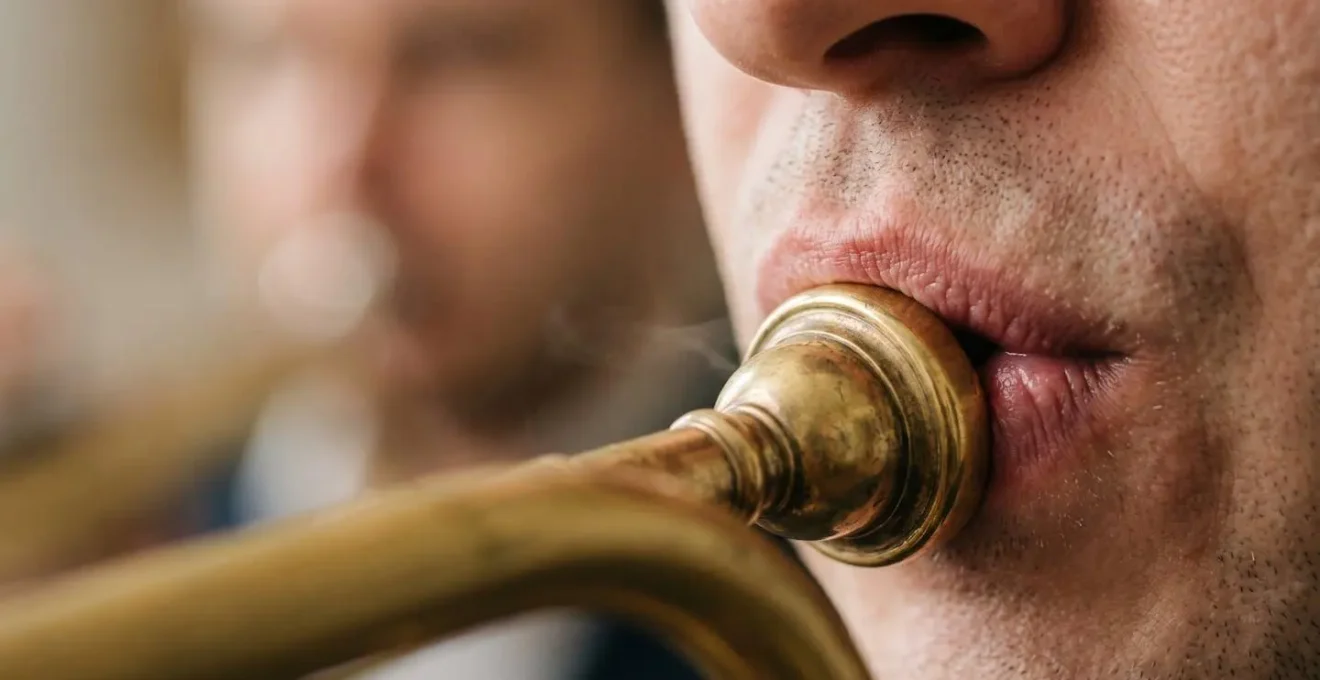
As this image details, the focus is on a stable, consistent point of contact. The real work is happening in the core, providing an unwavering air stream that allows the embouchure to remain steady, not pinched or overly tense. This is the secret to a tone that is both powerful and beautiful.
The Tired Face: building Muscle Around the Mouth Without Tension
The feeling of a « tired face » after playing is a red flag. It signifies that you are using the small, delicate muscles of your lips and cheeks to do the work that your powerful core muscles should be doing. This is a common and dangerous path, as it leads to excessive tension, a pinched sound, and limited endurance. In fact, a comprehensive survey revealed that 59% of professional brass players have experienced embouchure problems that affect their performance. The root cause is often a misunderstanding of the embouchure’s true role.
Your embouchure is not the engine of the sound; it is the nozzle. Its job is to channel and shape the powerful, steady airstream provided by your breath support. As researchers Boschma et al. define it, the embouchure is the process that adjusts the « air flow (generated by the breath support) » by using the tongue, jaws, cheeks, and lips. The power comes from the support system, not the face. Therefore, the goal is not to « get a stronger embouchure » by squeezing harder, but to build supportive muscle engagement without creating destructive tension.
Think of the corners of your mouth firming inwards, like a drawstring bag being gently tightened, while the center of your lips remains soft and responsive to the air. The muscles you want to feel working are at the corners, creating a stable frame. You should not feel tension in your chin (which should be flat and pointed down) or excessive pressure against your teeth. The « tiredness » should be a deep ache in your abdominal muscles from supporting the air, not a sharp pain in your lip muscles from pinching.
Standing Tall: How Slouching Compresses Your Lungs and Kills Your Sound
You can have the strongest core muscles in the world, but if your posture is compromised, you are physically cutting off your own power supply. Slouching, whether sitting or standing, is the equivalent of putting a major kink in a garden hose. The water pressure (your air) might be high at the source, but the flow is choked off before it can ever reach the nozzle. Poor posture directly compresses your thoracic cavity, restricting the very space your lungs need to expand for a full, diaphragmatic breath.
The ideal posture for a wind player is one of an elongated, open torso. Think of your head floating effortlessly upwards, creating space between each vertebra of your spine. Your shoulders should be released downwards and backwards, not pulled back with tension, but simply hanging freely, widening your collarbones. This alignment creates the maximum possible volume for your lungs and allows the diaphragm to move without obstruction. It’s a state of dynamic alignment, not rigid stiffness. Unfortunately, the physical demands of playing an instrument often lead to chronic postural issues; one survey found that an astonishing 76% of orchestral musicians reported medical problems that affected their performance ability, many of which are posture-related.

Observe the alignment in the image above. The spine is long, the chest is open, and the instrument is brought to the body, not the body collapsing around the instrument. This open framework is essential. When you slouch, you force your body to work exponentially harder for a fraction of the result. When you stand or sit tall, you allow your breath support system to function with maximum efficiency, delivering a full, unobstructed column of air to the instrument.
The Didgeridoo Trick: Keeping the Sound Going While Sniffing Air
While not a foundational technique for beginners, understanding circular breathing is the ultimate test of separating your breathing mechanics from your embouchure. This advanced skill, famously used by didgeridoo players and many wind instrumentalists like Kenny G, involves inhaling through the nose while simultaneously expelling air stored in the cheeks to maintain an unbroken sound. It may seem like a magic trick, but it is a learnable, physical coordination that dramatically underscores the principle of breath support.
The process forces you to dissociate the action of your lungs from the action of your mouth. The core steps involve:
- Puffing your cheeks with air while playing a note.
- Using your cheek muscles to push that stored air through the instrument to continue the sound.
- While the cheeks are pushing air out, taking a quick « sniff » of air in through your nose to refill your lungs.
- Seamlessly switching back to expelling air from your lungs before the cheek reservoir runs out.
The coordination is complex, but it physically proves that the embouchure can maintain a tone with air from a source other than the lungs. The physical benefits of such advanced breath training are surprisingly potent.
Case Study: The Didgeridoo and Sleep Apnea
The power of this type of breath control extends beyond music. A University of Zurich study published by the American Lung Association investigated the effects of didgeridoo playing on patients with obstructive sleep apnea. After four months of regular practice, participants showed significant improvement. While their overall sleep quality didn’t change, they reported being much less tired during the day, and their partners reported less disturbance from snoring. This demonstrates that advanced breathing techniques like circular breathing physically strengthen the muscles of the upper airway, a benefit directly transferable to the endurance and control needed for wind instruments.
Learning this technique, even just the initial exercises, trains your body to understand that the lungs, the mouth, and the embouchure are all separate parts of a coordinated system, with the core support being the central, driving force.
Sitting or Standing: Which Posture Minimizes Back Pain for Guitarists?
While this question is often debated among guitarists, the principles of posture are even more critical for wind players, whose entire sound production relies on an uncompressed respiratory system. The choice between sitting and standing is less important than the quality of the posture you maintain in either position. Both can provide a powerful foundation for your sound, and both can be detrimental if done incorrectly. The goal is to find your power position—the stance that allows for the longest spine and the most open ribcage.
When standing, your feet should be shoulder-width apart, with your weight balanced evenly. Your knees should be soft, not locked, and your pelvis should be in a neutral position, not tilted forward or backward. This creates a stable, grounded base from which your spine can lengthen upwards. When sitting, the biggest danger is collapsing into the back of the chair. This rounds the lower back and compresses the diaphragm. The solution is active sitting.
- Perch on the Edge: Sit on the front third of your chair, using your « sit bones » as the main points of contact.
- Align Your Spine: Maintain the same long, tall spinal alignment you would have when standing.
- Ground Your Feet: Keep both feet flat on the floor to create a stable, three-point base (two feet, one seat).
- Maintain Symmetry: Ensure your torso is balanced and not twisted, allowing the ribcage to expand freely in all directions.
The best way to decide which is better for you is to experiment. Play a simple long tone and scale both sitting (actively) and standing. Where does your breath feel deeper and more effortless? Where is your tone more stable and resonant? Often, players find standing gives them a greater sense of freedom and power, but proper active sitting in an ensemble setting can be just as effective.
The « Gagaku Face »: The Physical Demands of the Loose Embouchure
In the ancient Japanese court music of Gagaku, players of the hichiriki (a type of oboe) cultivate a notoriously difficult embouchure that is exceptionally loose and relaxed, yet capable of incredible pitch flexibility and control. This concept of the « Gagaku Face, » or a highly relaxed embouchure, seems counterintuitive to Western players taught to maintain a firm « smile. » However, it perfectly illustrates the ultimate goal: generating all power and control from the breath, with the lips acting as a minimal, responsive valve.
A tense, pinching embouchure is a sign that the player is trying to create air pressure with their face. A relaxed embouchure is only possible when it is supported by a powerful, fast-moving column of air from the core. As woodwind expert Bret Pimentel states, « Breath support is the engagement of the abdominal muscles (including the sides and lower back) during exhalation. » This engagement creates the air pressure, and the embouchure simply channels it. The « Flapping Lips » exercise is a perfect way to feel this relationship:
- Stand or sit with excellent posture and take a full, 360-degree breath.
- Blow a powerful, steady stream of air, allowing your lips to flap freely and loosely like a horse. Do not try to form an embouchure.
- Focus 100% of your mental energy on the strength and speed of the air coming from your abdomen.
- While the air is still flowing and your lips are flapping, slowly bring your mouthpiece to your face until it « catches » the airstream and a tone begins.
Notice how the tone is generated almost entirely by the force of the air, not by lip tension. This teaches your body the correct division of labor: the core creates power, and the lips shape it with minimal effort.
Key takeaways
- Your true sound is generated in your core, not your face. Treat your breath support system as an athletic engine.
- Effective breathing is a 360-degree expansion of the lower torso; your shoulders must remain still and relaxed.
- Posture is non-negotiable. Slouching physically compresses your lungs and chokes your airflow, regardless of how hard you support.
Mastering airflow control to shape phrases and dynamics on wind instruments
Once you have built the foundational pillars—a deep, expansive breath, a stable core, and an aligned posture—you can begin to use your airflow not just to create a sound, but to shape music itself. Dynamics and phrasing are not achieved by pinching your embouchure for soft passages or blowing chaotically for loud ones. They are the result of precise, muscular control of your air column’s speed and volume, managed entirely from your core.
A crescendo is a gradual, controlled increase in the engagement of your abdominal muscles, speeding up the air. A diminuendo is a slow, managed release of that engagement, maintaining support even as the air speed decreases to nothing. The ultimate exercise for this is the *Messa di Voce*: taking a single long tone and swelling from silence (niente) to your loudest controlled volume (fff) and back down to silence, all while maintaining perfect pitch and a beautiful tone. This demands immense control and reveals that the greatest test of support is in the last few seconds of a note, where most players’ systems collapse.
Case Study: The Modern Messa di Voce
Modern pedagogy transforms this ancient exercise into a powerful diagnostic tool. By practicing the Messa di Voce with a tuner app to monitor pitch stability, a decibel meter app to visualize the smoothness of the dynamic arc, and a recording app to analyze timbre, the player gets objective feedback. This method demands that the breath support starts before the note even sounds and continues through to absolute silence. It trains the musician’s body to associate dynamics with specific levels of core engagement, turning an abstract musical concept into a concrete physical action.
This level of control has profound physiological benefits. For instance, a controlled respiratory study showed that training on a wind instrument led to a 10.58% increase in Maximum Voluntary Ventilation, a key measure of respiratory function. By mastering your airflow, you are not only becoming a more expressive musician; you are literally becoming a stronger breather. Your breath becomes your paintbrush, allowing you to shape phrases with intention, color, and emotion, all powered by a stable and powerful core.
Start your physical training today. Choose one of these core exercises and dedicate just five minutes to it. Feel the connection between your core and your sound. This is the first step toward building the powerful, reliable, and expressive tone you’ve always wanted.