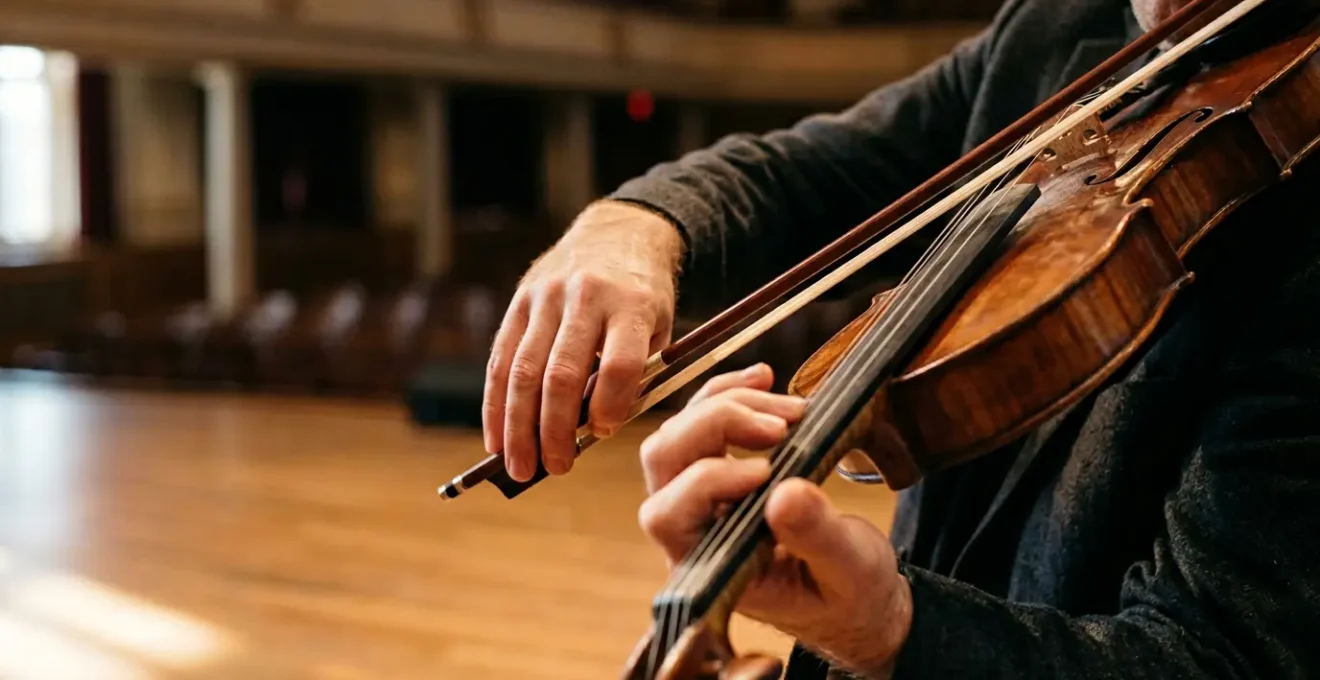
Contrary to common belief, emotional playing isn’t about ‘feeling more’; it’s about mastering a physical vocabulary that translates human expression directly into sound.
- True expressivity comes from treating your instrument as an extension of your voice, using bowing and fretting to mimic sighs, consonants, and slides.
- Techniques like varying vibrato width, controlling bow weight, and studying vocal traditions like Flamenco provide a concrete blueprint for emotional articulation.
Recommendation: Stop trying to ‘inject’ emotion and start ‘speaking’ through your instrument by focusing on one vocal-inspired technique at a time.
You have the technique. Your scales are flawless, your intonation precise, your command of the instrument undeniable. Yet, when you listen back to a recording, something is missing. The sound is clean, correct, but ultimately… cold. It is the frustration of every serious musician: the gap between the profound emotion you feel and the sterile sound that emerges. It’s the difference between a technically perfect recitation and a soul-stirring story.
The common advice feels hollow. « Play with more feeling, » they say. « Use more vibrato. » « Think about the composer’s intent. » These are the destinations, not the directions. They tell you *what* to achieve, but offer no map for *how* to get there. For the player who has already mastered the mechanics, this abstract guidance is the very source of the problem. It suggests that emotion is a mystical force you must somehow channel, rather than a craft you can learn and control.
But what if the key was not more abstract feeling, but more concrete physicality? The secret to profound emotional expression lies not in trying to *feel* more, but in learning to *speak*. It requires a fundamental shift in perspective: to treat your instrument not as a tool to be played, but as a corporeal voice to be used. This voice has its own phonetics—its consonants, its vowels, its breaths, and its cries—all of which can be mapped directly to the nuances of your bowing and fretting.
This guide will deconstruct that vocal blueprint. We will move beyond generic advice to explore the granular, physical techniques that transform notes into words and phrases into sentences. We will learn how to make the instrument sigh, whisper, and cry, building a true vocabulary of emotion that is both authentic and entirely within your control.
To navigate this journey from technical precision to emotional profundity, we will explore the specific ‘phonetics’ of musical speech. This article breaks down the physical actions that give your playing a human voice, from the color of a single note to the raw power of a vocal cry.
Table of Contents: The Vocabulary of Musical Emotion
- Fast and Narrow vs Slow and Wide: Coloring the Note for Sadness or Joy
- The « Sigh » Technique: Using Bow Weight to Create Breath in Phrases
- Martelé vs Legato: Choosing the Consonant for Your Musical Word
- The Vocal Slide: connecting Notes Like a Singer for Emotional Impact
- The Bloom: Swelling into a Note After the Attack
- The Power of Whisper: Using Volume to Tell a Story
- Between the Notes: The « Ay » That Breaks Your Heart
- The raw power of Cante Jondo: Understanding the voice of Flamenco
Fast and Narrow vs Slow and Wide: Coloring the Note for Sadness or Joy
Vibrato is the first and most obvious tool for emotional coloring, but simply « using vibrato » is like a painter only acknowledging the existence of « blue. » The expressive power lies in the infinite shades you can create. The two primary variables are speed and width, and they have a direct psychological impact on the listener. Think of them as the primary colors of your emotional palette, which you can mix and blend.
A fast, narrow vibrato creates tension and urgency. It’s the quiver in a voice filled with anxiety, excitement, or intense passion. It tightens the sound, making it more brilliant and penetrating. Use this to build to a climax or to convey a sense of restlessness. Conversely, a slow, wide vibrato opens up the sound, giving it warmth, breadth, and a sense of calm. It’s the relaxed, resonant quality of a contented sigh or a lyrical declaration. This type of vibrato is your tool for creating moments of profound sadness, longing, or serene beauty. As a foundational analysis of finger vibrato explains, a faster vibrato often adds stress, while a slower one produces a more lyrical sound.
Coleman Hawkins’ Inability to Play Without Vibrato
The depth to which vibrato becomes a core part of a musician’s voice is perfectly illustrated by an anecdote about the legendary jazz tenor saxophonist Coleman Hawkins. When asked by Leonard Bernstein to demonstrate a passage without his signature vibrato, Hawkins found he simply couldn’t do it. This wasn’t a failure of technique, but a testament to how completely the vibrato had fused with his personal sound. For him, as it should be for us, vibrato was not an optional ornament; it was an intrinsic, inseparable part of his musical voice, as natural and necessary as the breath in his lungs.
Mastering this is about conscious choice. Instead of letting your fingers fall into a default, one-size-fits-all vibrato, you must actively decide the emotional color each note requires. Is this moment a frantic heartbeat or a deep, slow breath?
The « Sigh » Technique: Using Bow Weight to Create Breath in Phrases
Emotion in music is often found not in the notes themselves, but in the spaces between them. A truly vocal performance is defined by its breath, and for a string player, the bow is your lung. The « Sigh » is a fundamental technique for creating this sense of breath and release. It is a small, natural decrescendo at the end of a note or a short phrase, created simply by relaxing the weight of your bow arm and letting the sound taper off, just as a singer’s voice fades at the end of an exhaled breath.
This technique is the antidote to the « mechanical » sound of playing where every note ends as abruptly as it begins. It requires a profound connection to the physical sensation of gravity. Instead of *lifting* the bow to stop the sound, you simply *release* the downward pressure from your index finger and let the bow’s own momentum and the natural decay of the string do the work. The result is a taper that sounds organic, vulnerable, and deeply human.
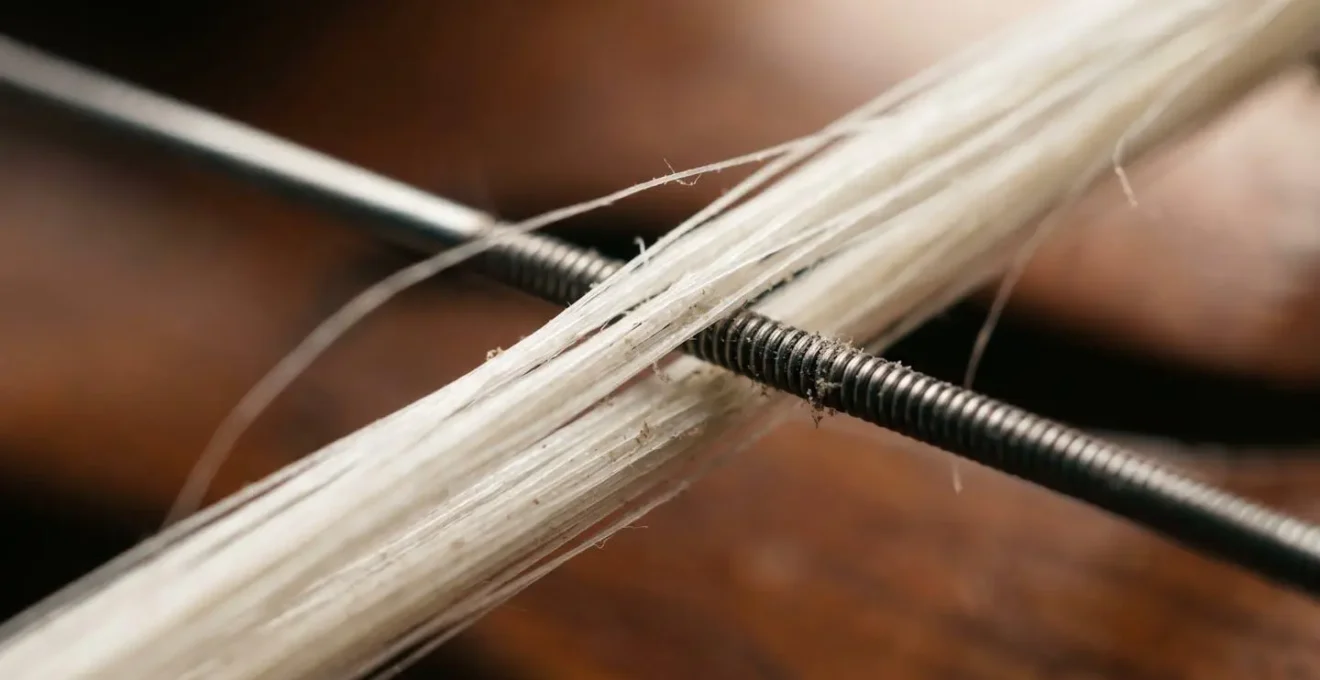
As you can see in the subtle interaction between bow and string, the release of weight is a physical event. Practicing this involves feeling the balance point of your arm. Start a long, slow down-bow, and halfway through, consciously think of your arm becoming heavier, letting the sound bloom. Then, as you approach the tip, think of your arm becoming lighter, as if a balloon were tied to your elbow, and feel the sound naturally recede into silence. This is not just a dynamic change; it is the physical act of exhaling through the bow.
Martelé vs Legato: Choosing the Consonant for Your Musical Word
If legato is the smooth, connected vowel sound of your instrument’s voice, then articulated bow strokes like martelé are the consonants that give your musical sentences clarity and impact. Thinking of bowing in these phonetic terms moves you from a player who connects notes to a speaker who forms words. A legato phrase, with its seamless connection, is like singing « ahhh, » while a series of martelé notes is like speaking « Ta-Ta-Ta. » One is a pure, emotive wash of sound; the other is a rhythmic, percussive statement.
Martelé, meaning « hammered, » is defined by its sharp, accented beginning. This is not a scratchy or forced sound, but a clean, instantaneous « bite » at the start of the note. As violinist Laurie Niles explains for Strings Magazine, this attack creates a consonant sound, like a ‘K’, rather than a vowel-like ‘Wah’. This « consonant » is created by setting the bow on the string with pressure *before* moving it, then releasing that energy in a burst of speed. The note is then held, and the bow stops dead on the string, creating a silence before the next attack. This separation is crucial; it’s the space between words.
Choosing between these articulations is like choosing your words carefully. Do you want this phrase to be a smooth, lyrical declaration of love (legato), or a series of pointed, emphatic questions (martelé)? Do you want to soothe the listener with a seamless vocal line, or grab their attention with a series of rhythmic punches?
Your Action Plan: Auditing Your Emotional Palette
- Points of Contact: Listen to your own playing and identify three musical phrases where your expression feels generic or automatic.
- Collecte: Record yourself playing these phrases. Inventory your current expressive habits (e.g., « my vibrato is always the same speed, » « I don’t use silence between notes »).
- Cohérence: Confront your playing with the music’s intended emotion. Does your interpretation of a « lullaby » sound frantic? Does your « march » lack crispness?
- Mémorabilité/émotion: Identify moments that lack a unique ‘vocal’ character. Are you speaking, or just reciting notes? Pinpoint exactly where a ‘sigh’ (bow release) or ‘consonant’ (martelé attack) could be added to give the phrase meaning.
- Plan d’intégration: Choose one new technique from this article. Apply it to just one of the phrases you identified. Re-record and compare the « before » and « after. » Master one new « word » before adding another to your vocabulary.
The Vocal Slide: connecting Notes Like a Singer for Emotional Impact
The portamento, or « vocal slide, » is one of the most direct and powerful ways to emulate the human voice. It is the expressive slide between two notes, a technique that, when used with taste, can infuse your playing with a sense of longing, passion, or unbearable sadness. It is the audible trace of the journey from one emotional state to another. While overuse can sound sentimental or dated, a well-placed portamento is the mark of a master storyteller who understands how to connect ideas with a silken thread of sound.
The key is to think of it not as a « smear » but as a deliberate, controlled gesture. It should have a clear direction and speed. A slow, languid slide can convey a deep sense of yearning, while a quick, almost imperceptible slide can add a touch of warmth and elegance. The technique is intimately tied to the left hand, but its impulse comes from the same place as a singer’s: the desire to connect two emotional points without a break in the sound. The violinist Aaron Rosand noted that Nathan Milstein’s signature was a downward portamento giving his playing a sighing effect that was uniquely expressive.
Historical Portamento Styles of Great Violinists
The portamento is not a single technique but a deeply personal form of expression, as shown by the signature styles of past masters. Fritz Kreisler was known for his « hook-slide, » dragging his index finger before pouncing with another. Jascha Heifetz startled the world with a subtle, lightning-fast upward slide using a single finger. Nathan Milstein perfected a warm, « sighing » downward portamento. And Yehudi Menuhin used a variety of slides, sometimes dragging a finger with vibrato already engaged to create an intensely appealing effect. These distinct approaches demonstrate how the same physical action—the slide—can be a unique emotional signature, proving that it is a fundamental part of the instrument’s vocal capability.
Experiment with this in your own playing. On a simple, lyrical phrase, try connecting two notes with an almost inaudible slide on the same finger. Then try a more obvious slide as you shift positions. Listen to how it changes the emotional meaning of the phrase. Is it a cry? A sigh? A caress? You are the director of this emotional narrative.
The Bloom: Swelling into a Note After the Attack
Many players are taught to attack a note at its full volume, but one of the most intimate and expressive techniques is to do the opposite: to let a note « bloom » into existence. This is a swell, or *messa di voce*, that begins softly—almost from nothing—grows to a point of fullness, and then can either be sustained or allowed to decay. It is the sound of a thought dawning, an emotion welling up, or a secret being whispered before it is spoken aloud.
This technique is a masterful exercise in bow control, combining speed, pressure, and contact point. To create a bloom, you must start the note with a relatively fast but very light bow, often closer to the fingerboard (*sul tasto*). As the note begins to sound, you simultaneously add weight (pressure) from your arm and index finger while often moving the bow’s contact point slightly closer to the bridge (*sul ponticello*) to increase the sound’s focus and intensity. It is a complex choreography that feels like pouring sound into the string, rather than pulling it out.
The Physics of Dynamic Control in Bowing
The ability to move from a whisper to a roar on a single bow stroke is a hallmark of virtuosity, perfectly exemplified by cellist Yo-Yo Ma. His dynamic control is a physical lesson in purpose-driven movement. This control is achieved through a precise synchronization of bow speed, pressure, and contact point. A note might begin with very light pressure but ample bow speed; then, as he gradually adds the full weight of his arm, he subtly shifts the bow’s contact point nearer to the bridge. This choreography transforms the bow from a simple tool into a narrator. As a breakdown of bow techniques explains, bowing is like a language where tone is everything, and the bow’s physics ensure the correct tone is produced.
The bloom gives you incredible storytelling power. You can use it on a single, long-held note to create a hypnotic, suspended moment. You can apply it to the peak note of a phrase to make it feel like the emotional apex of a sentence. This control over the *shape* of a single note is a micro-dynamic skill that separates good players from true artists.
The Power of Whisper: Using Volume to Tell a Story
In a world that often rewards the loud and the brilliant, we forget that the most powerful moment in a story is often the whisper. An audience that is leaning in, holding its breath to catch a sound, is an audience you completely own. As a musician, your dynamic range is your primary tool for narrative pacing, and the quiet end of the spectrum—the *piano* and *pianissimo*—is where true intimacy is born. Playing softly is not about a lack of energy; it is about focused, concentrated intensity.
To play with a beautiful soft tone requires more, not less, bow control. It demands a light arm, but the bow must still be drawn with sufficient speed to keep the string vibrating and alive. A slow, hesitant bow in *pianissimo* will result in a scratchy, dead sound. The ideal is a « breathy » whisper, a tone that has air and life in it. This is achieved by using more bow speed with almost no pressure, often with the contact point moving over the fingerboard to get the softest, most flute-like tone.
Your bowing technique is the most important tool of expression in violin playing. It’s like the breath, mouth and voice of a singer or the brush of a painter.
– Zlata Brouwer, Violin Lounge
Think of your dynamics as storytelling. A sudden drop from *forte* to *pianissimo* can be a moment of shocking revelation or sudden introspection. A long, gradual crescendo from a whisper to a roar builds unbearable tension. Don’t just play the dynamics written on the page; ask yourself *why* they are there. What is happening in the story at this moment? Is it a secret? A memory? A moment of fragile hope?
The silence of a hall waiting for the next note is a powerful canvas. By mastering the whisper, you learn to control not just the sound, but the silence that surrounds it. This is where the deepest emotional connection with your audience is forged.
Between the Notes: The « Ay » That Breaks Your Heart
To truly understand raw, unfiltered vocal emotion, we must look to one of its most powerful traditions: the *cante jondo* (« deep song ») of Flamenco. Here, emotion is not an abstract concept; it is a guttural, physical event. The most iconic of these is the *quejío*—a lamenting cry, often on the word « ¡Ay! ». This is not merely a note; it is the sound of a soul breaking. For a string player, understanding the anatomy of this cry provides a blueprint for an entirely new level of expression.
As an analysis of the cante flamenco technique highlights, the ‘quejío’ is essential for setting the emotional tone. It is a micro-melisma, a cascade of notes that often descends, cracking with pain and texture. How do we translate this onto a string instrument? It is not a simple glissando. It is a gesture filled with friction and weight. It could be a rapid downward slide that ends not in a clean note, but in a sudden, heavy stop of the bow, choked with pressure. It could be a left-hand finger slap against the fingerboard to mimic the percussive grief of a fist hitting a table.
The Quejío in Cante Jondo: Vocal Cry as Instrumental Blueprint
In cante jondo, the song is a dialogue between the singer and guitarist, and the singer’s emotional cries provide the core material. This structure offers a direct model for instrumentalists. The singer’s obsessive repetition of a single note, filled with dynamic swells, can be mirrored on the instrument. The ‘quejíos’ (laments) that interrupt the melody are not random; they are structural. The guitarist often responds during the singer’s breath breaks, creating an intimate call-and-response. For a string player, this translates into concrete actions: a rapid downward slide ending in a sudden, heavy bow stop to mimic the choked-off cry; or using percussive left-hand finger taps to emulate the rhythmic punctuation of the *palmas* (hand claps) that accompany the singer’s pain.
This is not about making your violin sound « Spanish. » It is about borrowing the emotional honesty and physical vocabulary of a tradition that has perfected the art of expressing suffering. Find a moment in a somber piece—a descending passage, a moment of resolution. Instead of playing it cleanly, try to imbue it with the « ay. » Let the slide have grit. Let the final note have a weight that feels final, like the end of a breath. This is the sound that exists between the notes, where the real story is told.
Key Takeaways
- True musical emotion is not an abstract feeling but a learnable, physical skill based on translating vocal expression into instrumental technique.
- Your bow is your breath and your articulation is your diction; mastering techniques like the « sigh » (weight release) and « consonants » (martelé) builds a speaking voice.
- Studying raw vocal traditions like Flamenco’s cante jondo provides a blueprint for expressing profound emotions like anguish and despair with authenticity.
The raw power of Cante Jondo: Understanding the voice of Flamenco
To complete our journey, we must go to the source. *Cante jondo* is not just a style of music; it is a philosophy of expression. It is the historical and emotional core of Flamenco, a form of music intrinsically linked to the suffering and marginalization of its creators. It deals with the deepest themes of life: anguish, despair, and death. For a classical musician trained in the pursuit of beauty and perfection, studying *cante jondo* is a revolutionary act. It teaches that emotional truth is more important than a pretty sound.
The entire tradition is built on raw authenticity. As a commentary on the legendary singer José Menese states, « If there is one style to which the singer has to give everything, it is the siguiriya. » This philosophy of total emotional commitment is a powerful antidote to « mechanical » playing. It demands that you leave a piece of your soul in every phrase.
The 1922 Concurso de Cante Jondo: Preserving Authentic Expression
In 1922, the composer Manuel de Falla and the poet Federico García Lorca, fearing that this raw « deep song » was being diluted by lighter, more commercial forms of flamenco, organized a historic competition in Granada. The *Concurso de Cante Jondo* was a deliberate effort to preserve and codify what they saw as the authentic soul of Andalusian music. The event canonized the idea that true *cante jondo* deals with life’s heaviest themes and that its power often comes from its rawest form, sometimes sung *a palo seco* (without any accompaniment at all). The universal lesson from this historic moment, as documented in the history of flamenco song, is a principle for all artists: authenticity over prettiness, and emotional truth over mere technical perfection.
This does not mean you must make your Bach sonata sound like a flamenco lament. It means you must approach it with the same searing honesty. Find the moments of tension, of pain, of release in the music. Dare to produce a sound that is not perfectly beautiful but is perfectly true. Use a hint of grit in your tone, let a high note crack with intensity, allow a phrase to end in a choked whisper. You are not just a performer of notes; you are a conduit for the human experience in all its flawed, heartbreaking, and beautiful complexity.
You now possess the vocabulary. The next step is to begin the conversation. Begin today by choosing one phrase in your music and asking not « How should this sound? » but « What does this want to say? » Listen for the sighs, the consonants, and the cries in the world around you, and translate them, with courage and honesty, through your instrument.