Many musicians see percussion as a simple time-keeping utility. This article shatters that myth, reframing the percussionist’s role from a metronome to an artist. We explore the idea that percussion is not about marking time but about sculpting sound. By mastering micro-timing, tuning, and dynamics, you can paint with a rich timbral palette, transforming a flat groove into a vibrant, three-dimensional sonic tapestry that defines a song’s emotional core.
For any drummer or producer, the instruction is painfully familiar: « just keep it simple, » « lock into the grid, » « don’t get in the way. » We’re often seen as the rhythmic scaffolding, the human metronome whose only job is to provide a steady pulse for the « real » music to happen. The common advice reinforces this: practice your rudiments to a click, quantize everything, and serve the song by being predictable. This view reduces the vast, expressive world of percussion to a single function: keeping time.
But what if this entire premise is wrong? What if the true role of percussion has little to do with the robotic precision of a clock and everything to do with the evocative power of a painter’s brush? The real art isn’t just hitting things on time; it’s about what happens between the beats. It’s about texture, color, and the creation of a rhythmic narrative that gives music its depth, its breath, and its soul. It’s about moving from being a time-keeper to a sound-sculptor.
This is a fundamental shift in perspective. It’s the difference between a sterile, quantized beat and a groove that makes you move. It’s the understanding that every percussive sound carries its own unique color and that the way these colors are layered creates a rich sonic tapestry. This article will guide you through this transformation. We will deconstruct the concepts of feel, tuning, dynamics, and rhythmic frameworks to reveal how they contribute to a powerful and expressive timbral palette. Prepare to leave the grid behind and enter a world of sonic color.
To fully grasp this artistic approach, we will explore the core elements that elevate percussion from mere rhythm to expressive art. This guide is structured to build your understanding layer by layer, from the microscopic feel of a single note to the global context of a polyrhythmic structure.
Summary: Unlocking the Colors of Rhythm
- It’s Harder Than It Looks: Getting a Consistent 16th Note Feel
- The Note of the Drum: Why Tuning Your Toms to the Key Matters
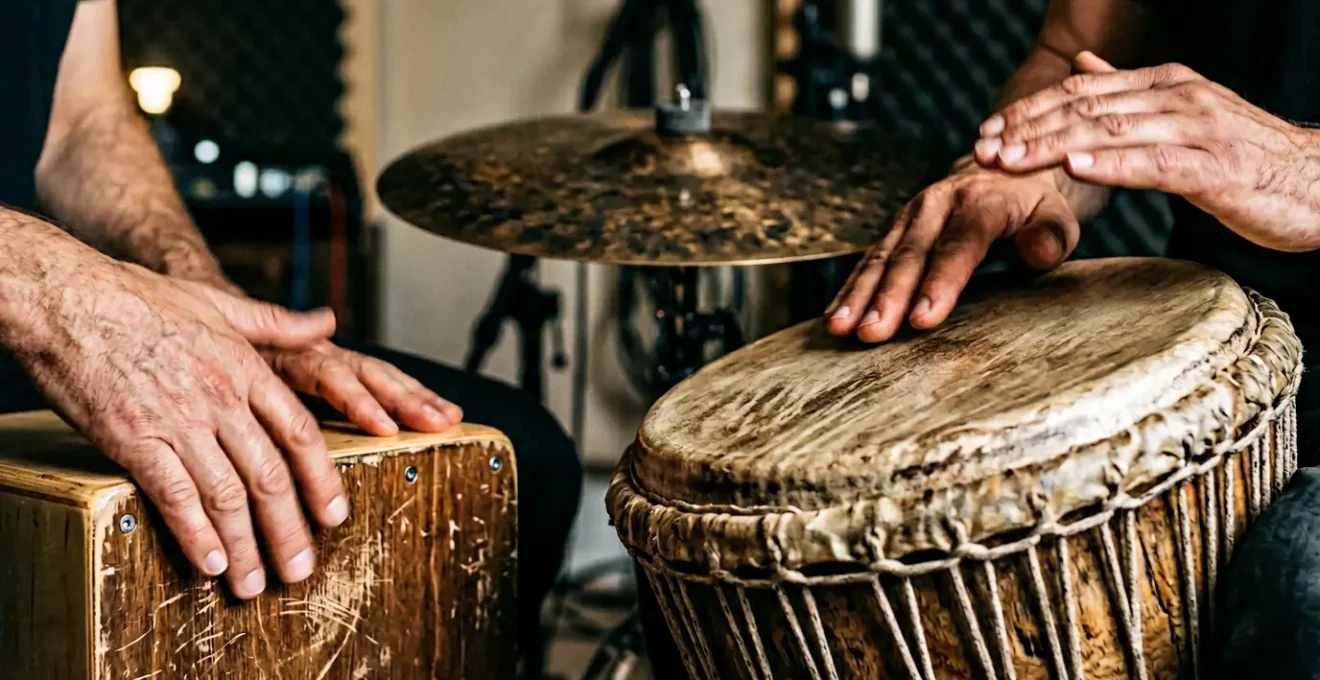
- Djembe vs Cajon: Choosing the Right Texture for Acoustic Gigs
- Ghost Notes and Accents: Making the Groove Breathe
- Paradiddles for Life: Why Hand Independence Fixes Your Feet
- Feeling the Clave: How to Listen to Afro-Cuban Polyrhythms
- The Heartbeat: How the Deep Drum Controls the Parade
- How to improve your internal clock and play « in the pocket »?
It’s Harder Than It Looks: Getting a Consistent 16th Note Feel
The foundation of a great groove isn’t robotic perfection; it’s controlled, human imperfection. When we talk about a « feel, » we’re talking about microtiming—the tiny, almost imperceptible deviations from the rigid grid of a metronome. A perfectly quantized 16th-note pattern sounds sterile and lifeless. A pattern played by a master percussionist, however, is a living thing. Some notes might be a few milliseconds ahead of the beat (pushed), while others are slightly behind (laid back). This subtle push and pull is what creates the swing, the funk, and the very soul of the rhythm.
This isn’t just conjecture; it’s a measurable phenomenon. In an analysis of iconic funk drummers, a comprehensive study of over 1,000 microtiming deviations showed that the magic of their grooves lay in consistent patterns of inconsistency. These aren’t random mistakes; they are intentional, learned nuances that form a player’s rhythmic signature. The goal, then, isn’t to hit every note perfectly on the grid. The goal is to control your placement around the grid to create a specific emotional effect. Pushing the beat creates urgency and excitement, while laying back creates a relaxed, heavy feel.
Developing this skill requires a shift in listening. Instead of just hearing the notes, you must start to feel the space around them. As the experts at Drummerworld note, it’s a visceral experience that goes beyond mere mechanics.
Microtiming isn’t learned by hand alone. It starts in the ear, or more accurately, in the gut.
– Drummerworld Research Team, Drummerworld Articles: Microtiming in Drumming
This « gut » feeling is your internal clock learning to dance with the metronome rather than being enslaved by it. Practicing with a click is still essential, but the objective changes. You practice playing intentionally ahead, behind, and directly on the click. This exercise builds the muscle memory and auditory awareness needed to manipulate time on a microscopic level, transforming your 16th-note patterns from a robotic pulse into a flowing, expressive line. This is the first step in painting with sound: learning to control the finest lines of your brush.
The Note of the Drum: Why Tuning Your Toms to the Key Matters
If microtiming is the line work of our rhythmic painting, then tuning is the selection of our color palette. A common misconception, especially among those who see drums as purely rhythmic, is that the specific pitch of a drum doesn’t matter. This could not be further from the truth. Every drum has a fundamental note and a series of overtones. When these notes clash with the key of the song, it creates a subtle (or not-so-subtle) dissonance that muddies the entire mix. Conversely, when your drums are tuned in harmony with the song, they cease to be just percussive hits and become integral melodic and harmonic components.
This isn’t about tuning your snare to a perfect C# every time. It’s about relationships. Tuning your toms to intervals that complement the song’s key—like thirds, fourths, or fifths—can make your fills sing and your grooves resonate with the other instruments. A tom fill that descends along the notes of a song’s primary chord is infinitely more musical than a random thudding. It creates a rhythmic narrative that supports the song’s harmonic structure. The drum kit becomes a low-resolution piano, capable of adding melodic contour and emotional depth.
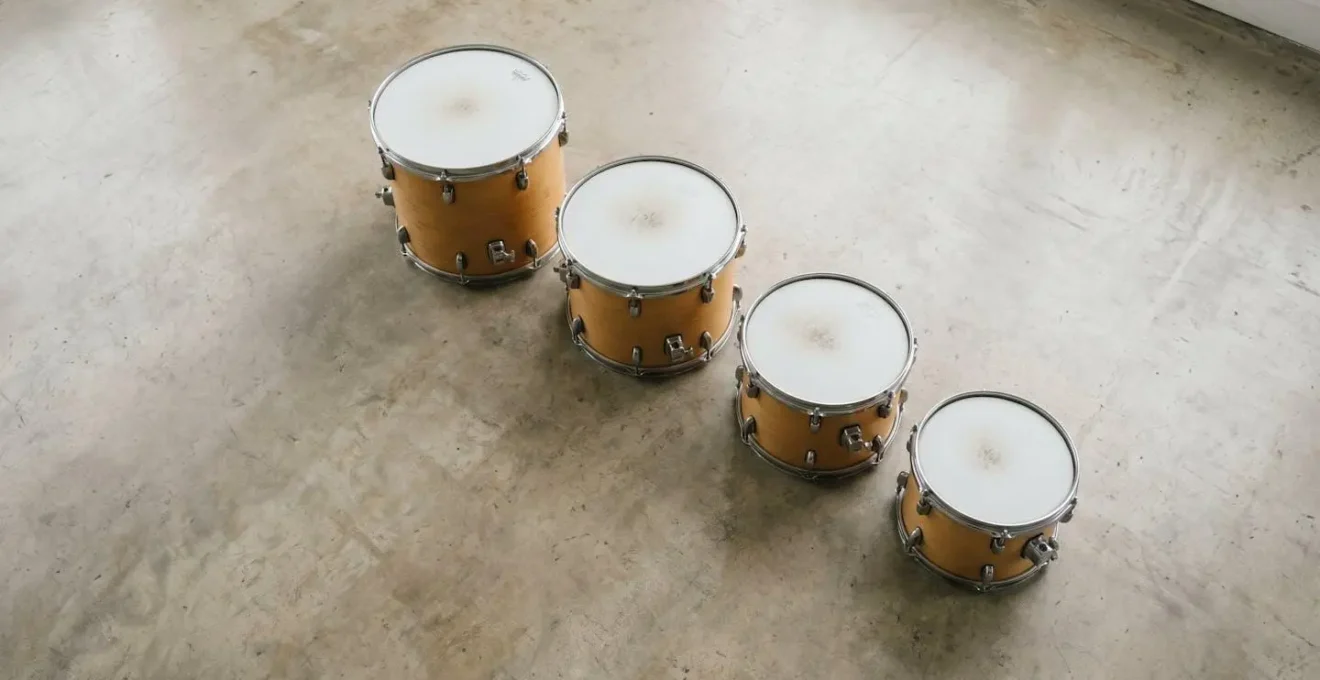
The science behind this is fascinating. The relationship between the top (batter) and bottom (resonant) heads is crucial. As the image above suggests, these drums are not random noise-makers but carefully pitched instruments. In fact, acoustic research demonstrates that when resonant heads are tuned within a specific frequency ratio to the batter head (typically 1.3 to 1.8 times higher), they can produce « phantom » sub-harmonics that give the drum a richer, more defined note. This level of detail is what separates a good sound from a great one. It’s about consciously shaping the timbre of your instruments to build a cohesive and pleasing sonic tapestry. By ignoring tuning, you are essentially painting with a random assortment of clashing colors.
Djembe vs Cajon: Choosing the Right Texture for Acoustic Gigs
Expanding your timbral palette doesn’t stop at the drum kit. For intimate acoustic settings, the choice of hand percussion can define the entire character of the performance. Two of the most common choices, the djembe and the cajon, are often used interchangeably, but this is a mistake. They offer profoundly different textures and fill different sonic spaces. Choosing between them isn’t about which is « better »; it’s a deliberate artistic decision about the kind of sonic environment you want to create.
The djembe, with its West African origins, offers a universe of sound in its goat-skin head. It has a deep, resonant « gun » (bass) tone at its center, a sharp, ringing « go » (open) tone at the edge, and a crisp « pa » (slap). This dynamic range allows for complex, melodic patterns that can carry a song on their own. Its texture is earthy, vocal, and round. It tends to blend into the mix, adding a warm, pulsating undercurrent that feels organic and fluid. It’s the ideal choice when you want the percussion to be a foundational, breathing part of the music’s core.
The cajon, on the other hand, is a different beast. Of Afro-Peruvian origin, it’s essentially a drum kit in a box. The playing surface provides a deep, punchy bass tone reminiscent of a kick drum, while the upper corners, often fitted with snare wires, produce a sharp, cutting crack that mimics a snare drum. This inherent separation makes the cajon feel more like a direct substitute for a drum kit. Its texture is woody, dry, and articulate. It sits on top of the mix rather than blending within it, providing a clear, driving backbeat. The cajon is the right tool when the song demands a sharp, defined rhythmic framework without the volume of a full kit.
Your choice shapes the song’s landscape. Do you want a warm, rolling hill of sound (djembe) or a sharp, rhythmic skyline (cajon)? One creates a fluid, interwoven feel, while the other provides a distinct, structural backbone. This is what it means to think texturally. You are not just playing a beat; you are selecting the right material—the right color and grain—to build the song’s rhythmic architecture.
Ghost Notes and Accents: Making the Groove Breathe
If the main beats of a groove are the skeleton, then ghost notes and accents are the circulatory and nervous systems—they give it life, movement, and feeling. A groove played with uniform velocity is a robot. A groove played with a dynamic tapestry of loud and soft notes is a dancer. This interplay between the notes you emphasize (accents) and the notes you barely play (ghost notes) is arguably the most significant factor in a percussionist’s unique voice. It’s the shading in our sonic painting, creating depth, contour, and perspective.
Ghost notes are low-volume notes played between the main beats, often on the snare drum. They are felt more than heard. Their purpose isn’t to be individually recognized but to create a seamless, bubbling rhythmic bed. They fill the gaps, creating a sense of forward motion and density without cluttering the sonic space. They are the whispers that make the loud notes shout. Without them, a groove can feel stiff and gappy. With them, it becomes a fluid, continuous stream of rhythm that « breathes. »
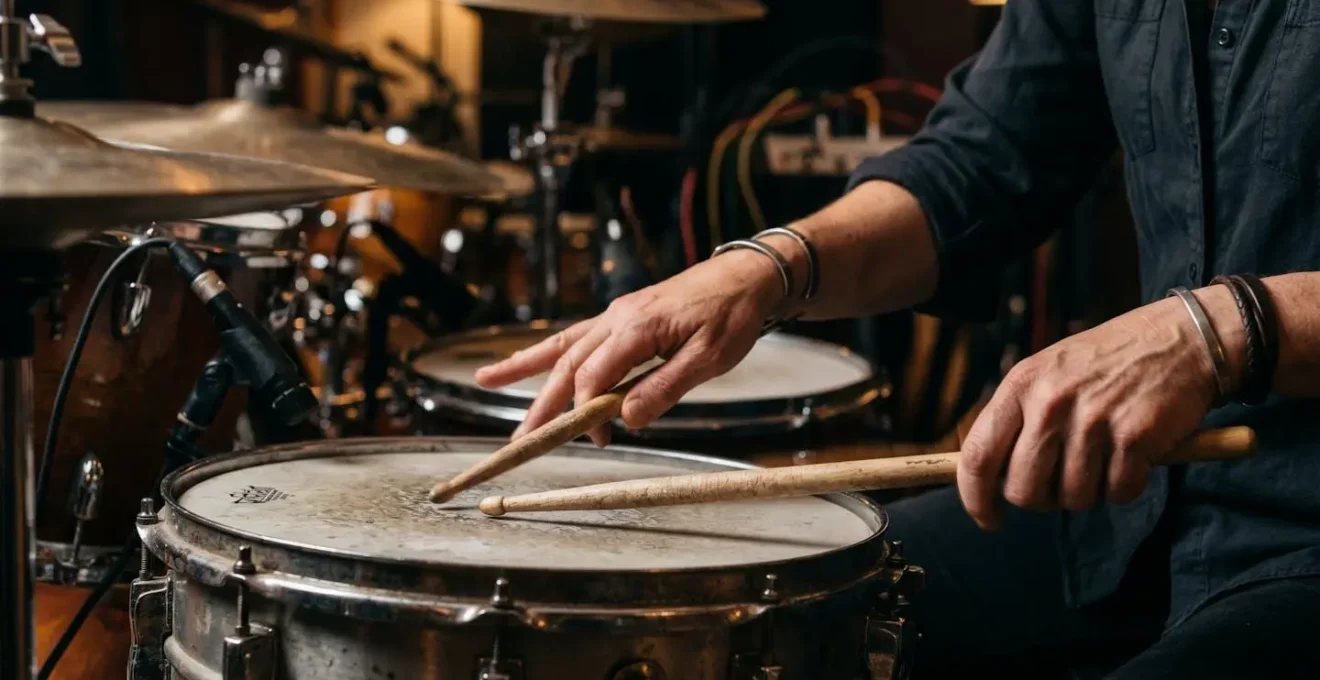
Mastering ghost notes is a journey in subtlety and control, as the focused action in the image suggests. It’s about training your hands to operate at an extremely low volume with consistency, a skill that is often harder than playing loud. Accents are the other side of the coin: intentionally emphasizing certain notes to create a rhythmic pattern that dances over the top of the main pulse. By combining a steady stream of ghost notes with strategically placed accents, you can create the illusion of multiple rhythmic layers playing at once. This is how you make a simple beat sound complex and endlessly fascinating.
Action Plan: Mastering Ghost Note Dynamics
- Apply very little pressure and movement—your stick should barely lift off the drum before striking, like a feather drop rather than a full stroke.
- Practice a tap-accent-tap pattern: Ghost–Accent–Ghost–Accent, focusing on extreme dynamic contrast.
- Incorporate ghost notes into a basic 16th-note groove with your right hand on the hi-hat and your left hand ghosting on the snare.
- Use a metronome at a slow tempo (60–70 BPM) to maintain clean control and precise subdivision placement.
- Practice with and without ghost notes to hear their transformative impact on groove depth and feel.
This dynamic control is the ultimate tool for expression. It allows you to shape the energy of a song, building tension with a flurry of ghost notes and releasing it with a powerful accent. It’s how you tell a story with your rhythm, guiding the listener’s ear and body through a compelling rhythmic narrative.
Paradiddles for Life: Why Hand Independence Fixes Your Feet
Rudiments. For many drummers, the word conjures images of tedious, mechanical practice. We’re told to practice them for « stick control » and « speed, » but their true value is far more profound. Mastering a simple rudiment like the paradiddle (Right-Left-Right-Right, Left-Right-Left-Left) isn’t just about your hands. It’s the key to unlocking your entire body and achieving true four-way independence. The counter-intuitive truth is: deep hand automation fixes your feet.
Think of your brain as a computer processor with a limited amount of bandwidth. When you’re learning a new groove, you’re consciously thinking about every limb: « Okay, right hand on the hi-hat, left hand on the snare for the backbeat, right foot on the kick drum on one and three… » This cognitive load is immense. It leaves very little processing power for nuance, feel, or creativity. Your playing is stiff and robotic because your brain is overwhelmed with basic coordination.
This is where the magic of the paradiddle comes in. When you practice a paradiddle until it becomes as natural as breathing, you are moving that pattern from your conscious brain to your subconscious. It becomes an automated process. Your hands know what to do without you having to think about it. This frees up a huge amount of cognitive bandwidth. Suddenly, your brain isn’t busy managing your hands anymore. That newfound mental space can be redirected to your feet.
With your hands on autopilot, you can start to think creatively about your kick drum patterns. You can experiment with syncopated rhythms, play complex ostinatos with your hi-hat foot, and respond to the other musicians in real-time. The same applies to orchestration. A practiced paradiddle isn’t just a hand pattern; it’s a melodic phrase you can move around the kit. The R-L-R-R pattern can be split between the snare and a tom, creating a fluid, musical fill. By automating the mechanics, you unshackle your creativity. You stop playing patterns and start making music. Rudiments are not the goal; they are the vehicle that transports you from conscious effort to subconscious expression.
Feeling the Clave: How to Listen to Afro-Cuban Polyrhythms
To truly break free from the « background noise » mindset, we must look beyond the Western concept of a steady 4/4 backbeat. Afro-Cuban music offers a profound lesson in rhythmic perspective through its foundational concept: the clave. Clave is not a beat; it’s a rhythmic key, a two-measure pattern that acts as the structural spine for the entire ensemble. All other instruments—the congas, the bass, the piano, the horns—organize their parts in relation to the clave. To play « in clave » means to align your rhythmic phrasing with this guiding pattern. To play « out of clave » is to create a deep, unsettling tension.
The challenge for a Western-trained ear is that the clave is often implicit. It might be played simply on two wooden sticks (the clave itself) or not at all, existing only as a shared understanding among the musicians. The most common patterns are the 3-2 son clave (three hits in the first measure, two in the second) and the 2-3 son clave (the reverse). Learning to hear and feel this pattern is like being given a secret decoder ring for an entire genre of music. You start to hear the intricate web of interlocking parts, or polyrhythms, that dance around this central structure.
This isn’t just a cultural or musical concept; it has a deep neurological basis. Your brain is wired to find patterns. When it encounters complex polyrhythms, it works overtime to decipher the relationships between them. In fact, neuroscience research demonstrates that listening to and processing polyrhythmic structures leads to increased beta and gamma brainwave activity in auditory and motor cortices. This heightened neural engagement is the « feeling » of being locked into a complex groove. You are not just passively listening; your brain is actively participating in solving the rhythmic puzzle.
To learn clave, you must internalize it. Clap the pattern while listening to salsa or rumba. Sing it. Tap it on your steering wheel. The goal is for the pattern to become a part of your rhythmic DNA. Once you feel it, you’ll understand that the « 1 » is no longer the only anchor. The entire two-measure phrase becomes the anchor, creating a much larger, more cyclical sense of time. This is a powerful new color for your timbral palette—the color of rhythmic tension and release on a macro scale.
The Heartbeat: How the Deep Drum Controls the Parade
In our exploration of texture and color, we must not forget the foundation: the bass. Whether it’s a kick drum on a kit, the surdo in a Samba batucada, or the bass tone of a djembe, the deep drum is the gravitational center of the music. Its role is far more profound than simply marking the downbeats. It is the heartbeat. It’s what you feel in your chest. It controls the « weight » and « size » of the groove, and by extension, it controls the physical response of the listener—the desire to dance.
The texture of the bass drum is a critical artistic choice. A tight, muffled kick drum with a sharp attack and quick decay creates a modern, focused, and punchy feel—perfect for pop or funk. It’s a clean, precise color. Conversely, a wide-open, resonant kick drum with a long decay and booming low-end creates a sense of immense space and power—the sound of classic rock or cinematic scores. This is a broad, enveloping wash of color. Each choice communicates a different emotion and dictates how the other instruments will relate to the low end.
This is where the idea of sound sculpting becomes most literal. As a percussionist or producer, you have total control over this texture. You can change the beater (felt for warmth, plastic for attack), the head (single-ply for resonance, double-ply for focus), and the dampening (pillows, blankets, or specialized systems). Each choice is a brushstroke. You are not just playing « kick on 1 and 3 »; you are deciding if the « 1 » should be a sharp point of light or a deep wave of dark color that washes over the entire track.
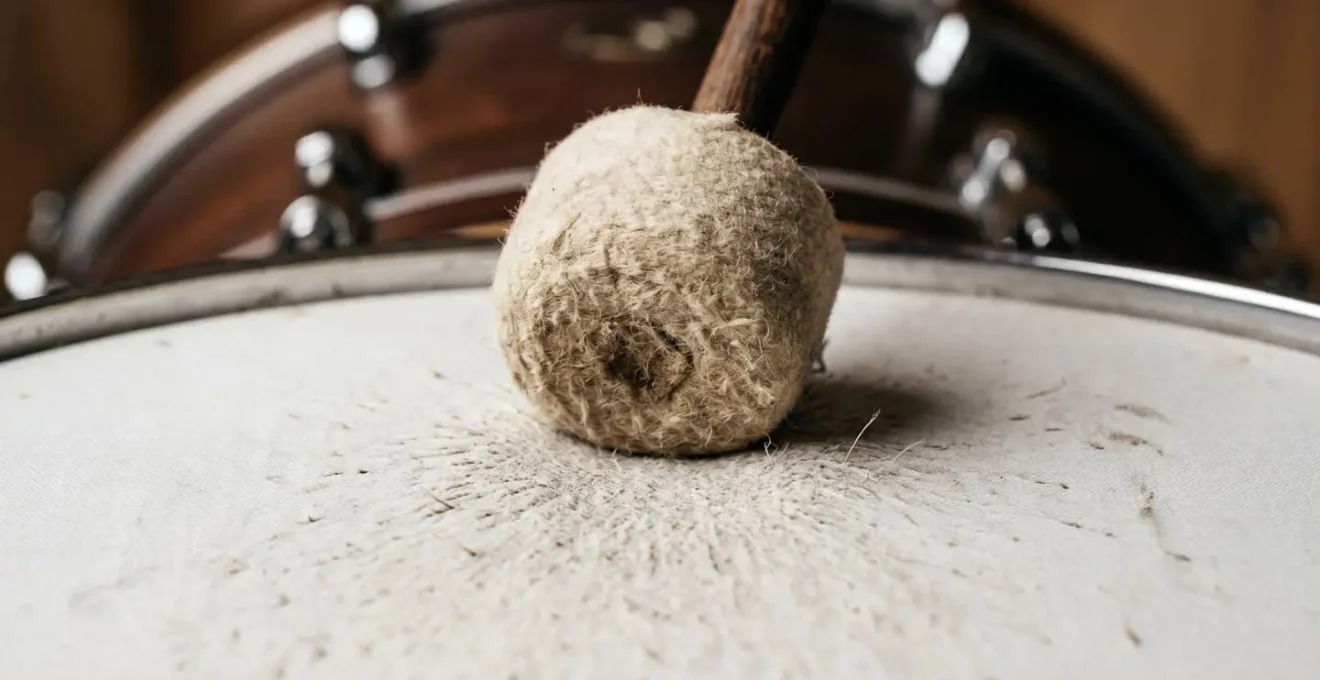
The visceral impact of the bass drum is its power. It connects directly to our most primal rhythmic sense—the pulse of our own heart. By carefully shaping its texture, you control the fundamental energy of the music. You are the one who decides if the groove is a frantic sprint or a slow, heavy march. You are not just in the rhythm section; you are the conductor of the parade, and the deep drum is your baton.
Key Takeaways
- Rhythmic ‘feel’ is not about robotic precision but about the controlled, human inconsistencies of microtiming.
- Drums are tonal instruments; tuning them in harmony with a song adds melodic depth and transforms them from noise-makers into musical contributors.
- Your unique voice as a percussionist is defined by dynamics—the interplay of loud accents and soft ghost notes creates a breathing, three-dimensional groove.
How to improve your internal clock and play « in the pocket »?
We’ve journeyed through micro-timing, tuning, texture, dynamics, and global rhythmic concepts. The final destination is bringing all these elements together into one cohesive, almost mystical state: playing « in the pocket. » The « pocket » isn’t a place on the grid; it’s a state of being. It’s when every limb, every note, and every musician is perfectly locked into a shared sense of time and feel. It’s effortless, it’s groovy, and it’s the ultimate goal for any percussionist. Improving your internal clock to find this pocket is a holistic practice.
First, you must redefine your relationship with the metronome. Stop seeing it as a judge and start seeing it as a sparring partner. Practice « silent bars »: set the click to play for one measure and be silent for the next. Your task is to play through the silence and land perfectly on the « 1 » when the click returns. Gradually increase the silent bars—one measure on, three off. This forces your internal clock to take responsibility for keeping time, building a stable, reliable inner pulse.
Second, record yourself constantly. The gap between what you *think* you sound like and what you *actually* sound like can be vast. Listen back with critical but compassionate ears. Are you rushing the fills? Is your hi-hat pattern consistent? Are your ghost notes truly quiet? This auditory feedback loop is the fastest way to identify and correct the subtle flaws in your timing and feel. It’s the equivalent of a painter stepping back from the canvas to check their work.
Finally, and most importantly, play with other musicians. The pocket is a collective phenomenon. It’s born from deep listening and mutual adjustment. Lock in with the bass player. Listen to the singer’s phrasing and accent your patterns to support it. Your role is to provide the rhythmic framework that allows everyone else to shine. Your internal clock becomes truly great when it learns to sync with the clocks of others, creating a single, unified pulse that is stronger than any individual part. This is the culmination of your journey from time-keeper to sound-sculptor: using your refined timbral palette and rhythmic vocabulary to create a living, breathing musical conversation.
Start applying these principles today, and listen as your rhythmic voice begins to emerge. Move beyond the mechanical and embrace the musical. Transform every beat into a deliberate brushstroke on the vast, colorful canvas of your music.