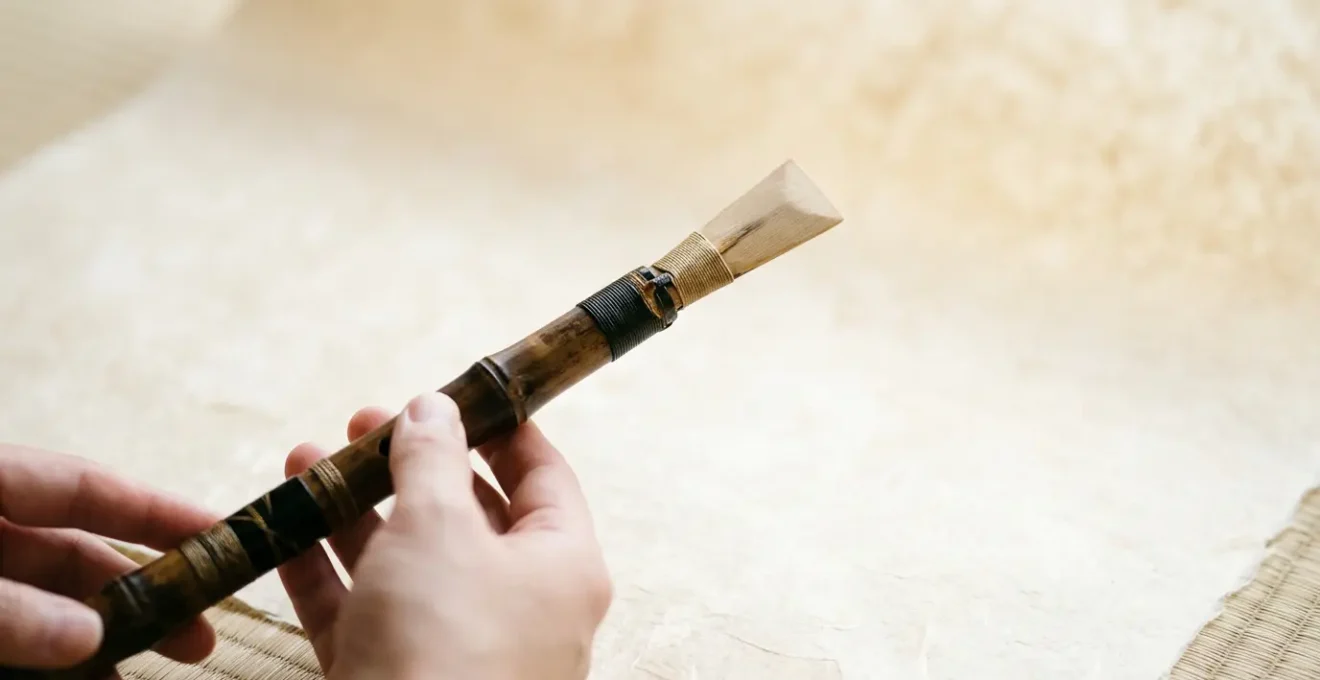
Many assume the hichiriki is just a primitive Japanese oboe. This is a profound misunderstanding. The key to its soul-piercing sound isn’t just its shape, but its philosophy: it is a physical vessel for the human voice. Its unusually wide reed and loose embouchure are not limitations but gateways, designed to transform a player’s raw breath and emotion into a sound that weeps, wails, and cuts through the silence with visceral intensity.
As a wind player, you understand the intimate relationship between breath and sound. You’ve spent countless hours shaping your embouchure, mastering fingerings, and supporting your tone from the diaphragm. But then you encounter the hichiriki. This small, unassuming bamboo pipe, central to Japanese Gagaku court music, seems to defy all Western conventions. Its sound is not the refined, stable pitch of an oboe or clarinet; it is a raw, piercing cry that seems to bend and slide with the emotional weight of a human voice.
The common reaction is to label it as « exotic » or « difficult, » or to simply compare it to its distant European cousin, the oboe. While the comparison is a starting point, it misses the entire point. The hichiriki isn’t built for melodic precision in the Western sense. It is an instrument of pure expression, a conduit for something far more primal. The challenge isn’t merely to play the notes, but to embody the instrument, allowing it to become an extension of your own throat and lungs.
But if the secret to its power isn’t in its complexity, where does it lie? The truth is that the hichiriki’s haunting voice is born from a series of counter-intuitive physical principles. It’s about harnessing a wide, seemingly unwieldy reed, adopting an embouchure that feels impossibly loose, and channeling your breath not just as air, but as the very soul of the music. This guide will dismantle the myths and reveal the physical truths behind its power, from its acoustic properties to the demanding facial control required to make it sing.
This article explores the very anatomy of the hichiriki’s unique voice. We will dissect its components, understand its expressive techniques, and provide a clear path for any wind player to begin appreciating—and perhaps even mastering—this incredible instrument.
Summary: The Hichiriki’s Piercing, Vocal Power Explained
- Oboe vs Hichiriki: Why the Japanese Reed is So Much Wider?
- Sliding Notes: Imitating the Human Voice and Nature
- Small but Mighty: Why It Cuts Through the Whole Orchestra
- The « Gagaku Face »: The Physical Demands of the Loose Embouchure
- Katakana Notation: Reading Tablature for Flute
- The Tired Face: building Muscle Around the Mouth Without Tension
- Between the Notes: The « Ay » That Breaks Your Heart
- Why breath support is the foundation of tone for all wind instruments?
Oboe vs Hichiriki: Why the Japanese Reed is So Much Wider?
The first and most jarring difference for any Western double-reed player is the hichiriki’s reed, or shita. Where an oboe reed is a delicate, precisely sculpted sliver of cane, the hichiriki’s is a monstrously wide and thick piece of mountain bitter bamboo. This is not a primitive design; it is a fundamental choice that defines the instrument’s entire character. The sheer size of the reed demands a completely different approach to playing. It requires a vast amount of air to vibrate, but in return, it produces a sound of incredible volume and timbral richness.
This massive reed is placed in a widened end of the instrument’s pipe. As Britannica’s editors note, this gives the hichiriki an external conical appearance, but this is deceptive. The instrument’s bore is actually cylindrical. This unique combination is acoustically significant. While being a double-reed, the cylindrical bore means that, as described in musical analyses, its sound is technically similar to that of a clarinet, which is known for its strong fundamental tone and rich lower harmonics. This fusion of a powerful double reed with a clarinet-like bore is the first clue to its unique sonic signature.
The width of the reed is also directly linked to the instrument’s expressive capabilities. Unlike a narrow oboe reed designed for stability, the wide shita is built for flexibility. It allows the player to manipulate the pitch dramatically with subtle shifts in embouchure and breath pressure. It is the physical gateway to the instrument’s famous pitch bends and vocal slides, transforming it from a simple pipe into a dynamic, expressive voice. The reed is the heart of the hichiriki, and its unconventional size is the source of its untamed power.
Sliding Notes: Imitating the Human Voice and Nature
If the wide reed is the hichiriki’s heart, then its soul is found in the embai. This is the signature pitch-gliding technique that defines Gagaku music. For a Western-trained musician, whose goal is often perfect pitch stability, this can be deeply unsettling. The hichiriki’s notes are rarely static; they swell, dip, and slide into one another, creating a sound that mirrors the nuances of a human cry or the sigh of the wind. This is not accidental or a sign of poor control—it is the highest form of expression on the instrument.
This ornamentation is controlled almost entirely by the player’s embouchure and breath, not the fingers. As noted by observers of the instrument, it is particularly known for the embai, a kind of pitch-gliding technique that gives the music its fluid, vocal quality. The player achieves this by subtly rolling the instrument in their mouth and altering the pressure of their lips. It’s a physical action that feels more like shaping a word with your mouth than playing a note on an instrument. This is the essence of the hichiriki: it is a vocal channel.
The goal is to blur the lines between distinct pitches, creating a seamless emotional arc. This technique is so integral that it’s considered a core part of the melody itself.
The Enbai Technique in Gagaku Performance
The embai is not just a decorative flourish; it’s a structural element of the music. According to research from Stanford University on Gagaku, this sound is caused by the motion of the instrument in the performer’s mouth with the reed held in a shallow position. This controlled slide can alter a pitch by an interval as large as a perfect fourth. It is frequently used to color a single sustained tone, imbuing it with the signature expressive quality that makes Gagaku music so deeply moving and instantly recognizable.
By mastering embai, the hichiriki player moves beyond being a musician and becomes a storyteller, using pitch and timbre to convey a range of emotions—from profound sorrow to serene contemplation—often within a single, breathtaking phrase.
Small but Mighty: Why It Cuts Through the Whole Orchestra
The hichiriki is a tiny instrument, measuring only about 18 centimeters long. Yet, in a Gagaku ensemble, its sound is the undeniable lead voice. It soars above the gentle harmonies of the shō (mouth organ) and the deep resonance of the drums. This ability to project is not just a matter of being « loud »; it is a phenomenon of acoustic physics. The instrument’s sound possesses a unique timbral quality that allows it to pierce through a complex orchestral texture without needing sheer force.
The secret lies in its incredibly rich harmonic spectrum. The combination of the wide, hard reed and the cylindrical bore produces a sound that is dense with overtones. While the fundamental pitch is strong, it is accompanied by a host of higher frequencies that give the sound its brilliant, cutting edge. These upper partials are what allow the human ear to pick out the hichiriki’s melody amidst a sea of other sounds. It’s the acoustic equivalent of a bright color standing out in a muted landscape.
This is not just subjective perception; it has been measured. Stanford’s Gagaku research reveals that the instrument’s sound is exceptionally complex, showing 55 partials for a single low note (F4) and over 25 partials that extend beyond the upper range of human hearing for a higher note (A5). This density of information across the frequency spectrum is what gives the hichiriki its immense presence and carrying power.
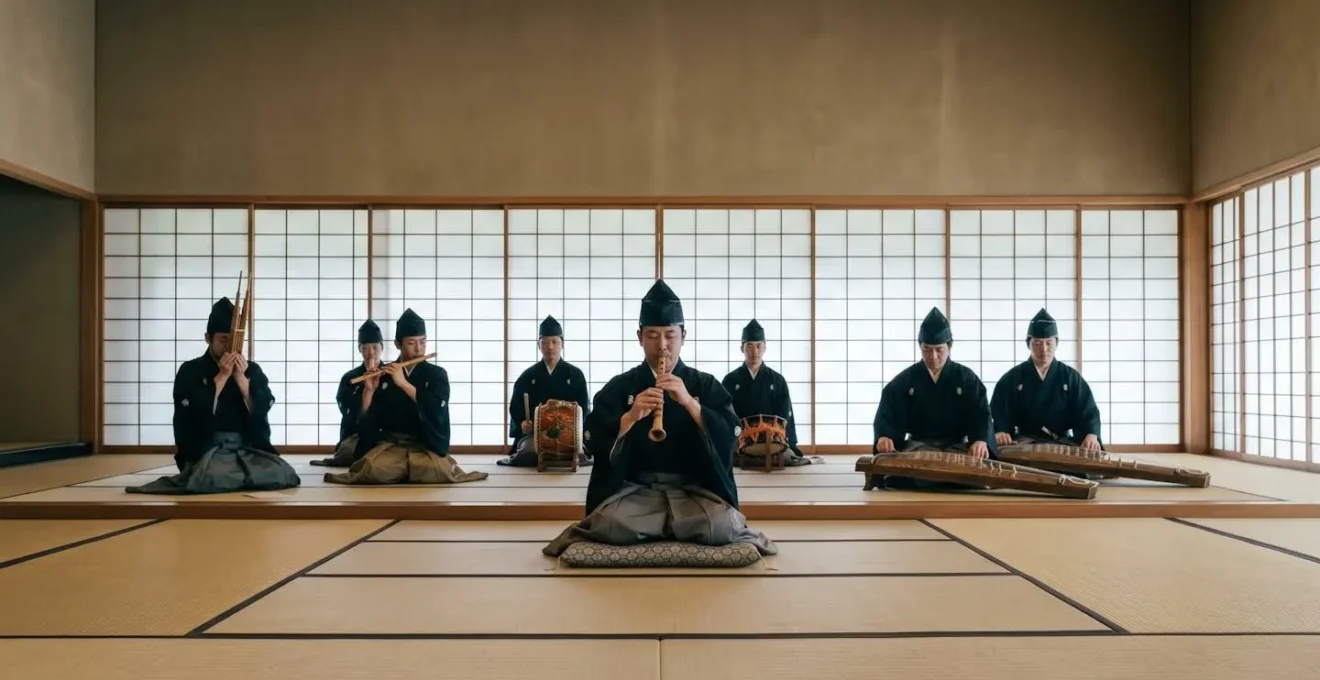
Therefore, when you hear the hichiriki’s wail cutting through the ensemble, you are hearing an instrument that has been perfectly engineered for sonic puncture. It doesn’t need to shout to be heard; its voice is simply so rich and complex that it commands attention, making it the powerful, central soul of the Gagaku orchestra.
The « Gagaku Face »: The Physical Demands of the Loose Embouchure
For a clarinetist or oboist, the embouchure is a foundation of firm, focused control. The corners of the mouth are pulled in, the chin is flat, and the lips create a tight seal to direct a high-pressure stream of air. The hichiriki demands the exact opposite. To play it is to adopt the « Gagaku face »: cheeks puffed out, lips loose and relaxed around the reed. It is a posture that feels, to the uninitiated, completely wrong and inefficient.
This, however, is the key to unlocking the instrument’s voice. As experts from Britannica describe, the musician uses a loose but controlled embouchure and delicate finger movements to create its rich, fluid melodic style. A tight embouchure would choke the massive reed, producing a thin, strident sound and making techniques like embai impossible. The loose lip position allows the reed to vibrate with maximum freedom, creating the broad, open, and resonant tone that is its hallmark. The puffed cheeks are not a sign of weakness but act as a kind of air reservoir, helping to maintain a steady, low-pressure flow of breath.
This technique creates a paradox for the player. The facial posture looks relaxed, almost slack, but it requires incredible underlying muscle control. The player must learn to support the sound entirely from the diaphragm and throat, allowing the face to become a passive, resonating chamber rather than an active, muscular clamp. It is a profound lesson in letting go, in trusting the breath to do the work, and in resisting the instinct to « bite down » on the pitch.
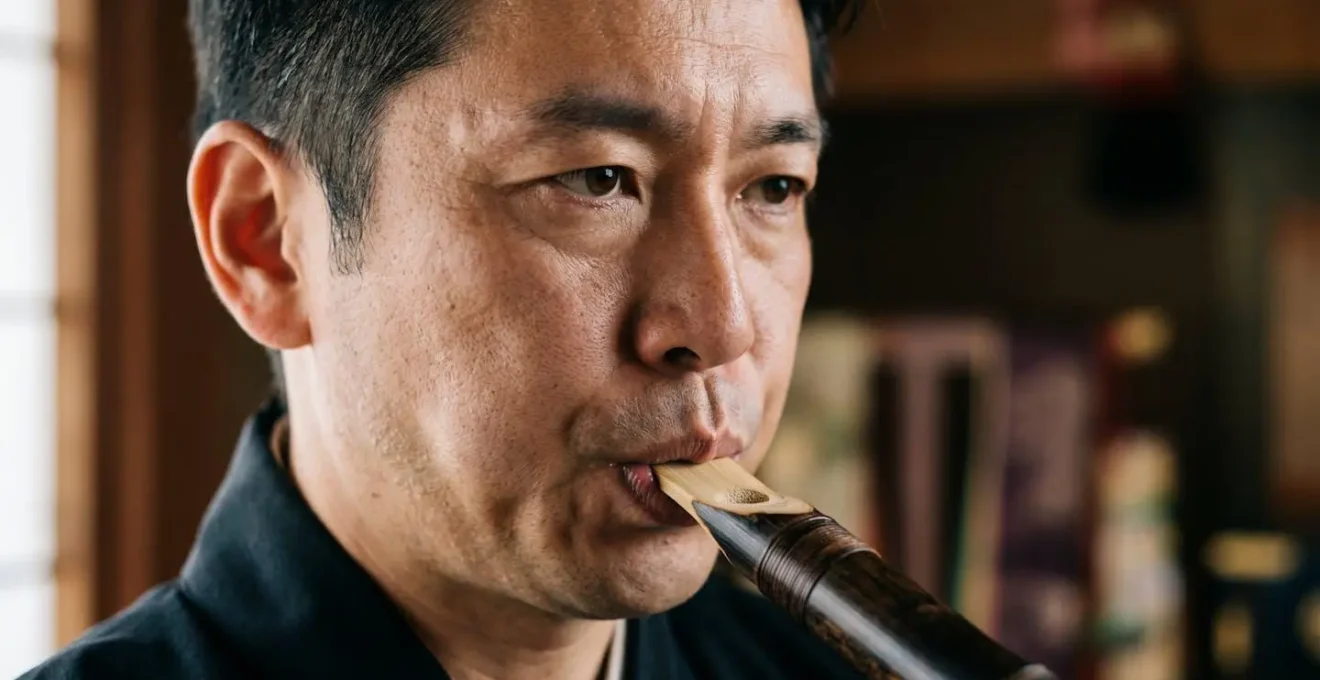
Mastering the « Gagaku face » is a journey in re-learning how to use your body. It is about building strength through relaxation, finding control through looseness, and transforming your entire oral cavity into a physical vessel for the hichiriki’s song.
Katakana Notation: Reading Tablature for Flute
Just as its sound and technique defy Western norms, so too does the hichiriki’s musical notation. A player looking at a Gagaku score for the first time will not find a familiar five-line staff with clefs and note heads. Instead, they will find columns of Japanese characters, specifically from the Katakana syllabary. This system, known as shōga, functions as a form of sung tablature, where each syllable corresponds to a specific pitch and fingering on the instrument.
In this system, the melody is first learned by singing the shōga syllables. For example, the syllable « ro » might correspond to the note A, « tsu » to B, « chi » to C#, and so on. The player memorizes the sung melody, internalizing its rhythm, pitch contours, and phrasing before ever picking up the instrument. This process embeds the music in the body in a deeply intuitive way. The written score serves more as a mnemonic device or a skeletal framework than a complete set of instructions.
Crucially, the most important expressive elements are not written down at all. Nuances like the embai slides, subtle volume changes, and rhythmic inflections are passed down orally from master to student. The shōga notation provides the « what, » but the oral tradition provides the « how. » This highlights the essential role of the master-student relationship in the transmission of Gagaku. It is not a tradition that can be learned from a book; it must be absorbed through listening, imitation, and direct guidance.
This oral/aural approach ensures that the music remains a living, breathing art form. It prioritizes feel and expression over mechanical precision. For a wind player accustomed to detailed Western notation, this can be liberating. It shifts the focus from accurately reproducing a written text to faithfully transmitting a musical spirit, making the player a direct link in an ancient and unbroken chain of sound.
The Tired Face: building Muscle Around the Mouth Without Tension
The paradox of the hichiriki’s loose embouchure is that it requires immense strength. Not the tense, biting strength of a trumpet player, but a deep, foundational stability in the facial muscles that can maintain a relaxed posture for long periods. After a session of playing, it’s common for a beginner’s face to feel « tired » in a way they’ve never experienced. This is the feeling of waking up deep, supportive muscles while unlearning the habit of superficial tension.
Building this muscle is not about pressure; it’s about endurance and control. The goal is to isolate the muscles around the lips and in the cheeks, strengthening them so they can form a gentle, consistent seal without engaging the jaw or creating tension that would choke the reed. Think of it like a marathon runner’s core strength versus a powerlifter’s explosive force. The hichiriki demands the former: sustained, efficient, and relaxed power.
This training involves exercises that seem counter-intuitive. Instead of practicing forceful attacks, you practice long, steady tones. Instead of tightening your lips, you might practice gently puffing your cheeks against slight resistance to build the deep muscles that support the « Gagaku face. » It is a process of deconstruction, of un-tensing the jaw, opening the throat, and allowing the face to become a supple, responsive part of the instrument’s resonating system. This conditioning prevents the player from reverting to the instinctive—but incorrect—habit of biting down to control the pitch.
Your 5-Point Hichiriki Technique Self-Audit
- Breath Connection: Record yourself playing one long, sustained tone. When you listen back, does the sound feel deeply supported from your core, or is it thin and controlled primarily from your throat?
- Reed & Embouchure Inventory: Before playing, examine your shita. Is it properly soaked and pliable? As you play, are your lips forming a loose, cushion-like seal and your cheeks slightly inflated, or are you instinctively biting down?
- Pitch Coherence: Play a simple three-note phrase, first with straight pitches, then by incorporating intentional embai slides between the notes. Compare your attempt to a reference recording. Are your pitch bends controlled and expressive, or do they waver without clear intent?
- Emotional Timbre: Identify one sustained note in a melody. Your task is to make this single note « speak » by subtly altering your breath support and embouchure to create a swelling or decaying effect, giving it a vocal, emotional quality.
- Integration Plan: Based on this audit, identify your single greatest area of tension or weakness. For the next week, dedicate the first five minutes of every practice session exclusively to exercises that address that one specific element.
Ultimately, the « tired face » is a positive sign. It indicates that you are moving beyond superficial tension and beginning to build the true, deep strength required to let the hichiriki sing freely.
Between the Notes: The « Ay » That Breaks Your Heart
Beyond the sliding pitches of embai, the hichiriki’s expressive power is hidden in the space *between* the notes. In Japanese aesthetics, this concept is known as ma (間)—the pregnant pause, the meaningful emptiness. On the hichiriki, this manifests as the « ay, » a subtle, breathy sigh or a gentle lift in pitch that precedes or follows a main note. It is not a note itself, but a moment of preparation or release that imbues the music with a profound sense of humanity.
This « ay » is the sound of breath becoming emotion. It is the audible intake of air before a singer begins a heartbreaking phrase, or the quiet sigh after its conclusion. On the hichiriki, it is a deliberate and controlled gesture. The player might slightly relax their embouchure for a fraction of a second or use a subtle puff of air to create this delicate, vocal inflection. It is what transforms a sequence of pitches into a melody that feels like it is being spoken or sung directly from the soul.
As world reed instrument expert Kristin Naigus poetically states, « The hichiriki’s sound is said to be the people of the earth. » This connection to something elemental and human is perfectly encapsulated in the « ay. » It is a reminder that the music is not coming from a piece of bamboo, but from a living, breathing person. This technique is often what separates a proficient player from a true master—the ability to not just play the notes, but to give them life by artfully controlling the silence and breath around them.

To listen for the « ay » is to listen with your heart. It is the moment of vulnerability in the music, the subtle crack in the voice that conveys more emotion than the loudest note. It is the sound that truly breaks your heart.
Key Takeaways
- Unconventional Design for Vocal Sound: The hichiriki’s extremely wide reed and cylindrical bore are not primitive but a sophisticated design to produce a flexible, voice-like tone, unlike the stable pitch of a Western oboe.
- Expression Over Precision: Techniques like embai (pitch sliding) and ay (breathy inflections) are central to the music, prioritizing emotional, vocal imitation over static, perfect pitch.
- Acoustic Dominance Through Complexity: The instrument’s small size is deceptive; its ability to cut through an orchestra comes from an incredibly rich and dense harmonic spectrum that commands the ear’s attention.
Why breath support is the foundation of tone for all wind instruments?
After exploring the hichiriki’s unique reed, its vocal techniques, and the peculiar demands of its embouchure, we arrive at the universal truth that connects it to every other wind instrument on earth: the absolute supremacy of breath support. All the specialized techniques are meaningless without a steady, controlled, and powerful column of air originating deep in the body. This is the engine that drives the sound, the raw energy that the instrument transforms into music.
For any wind instrument, as the American Lung Association highlights in its discussion on music and breathing, having total breath support and control makes playing easier and helps create a pure, round sound. On the hichiriki, this is amplified. The massive reed requires a huge volume of air, and the loose embouchure means there is little facial muscle resistance to create back-pressure. Therefore, all control must come from the diaphragm and abdominal muscles.
The correct technique is diaphragmatic breathing. This means breathing from the belly, allowing the diaphragm to contract and pull air deep into the lungs, then using the abdominal muscles to expel that air in a controlled, pressurized stream. This method maximizes air intake and gives the player precise control over the air’s speed and volume, which is essential for sustaining long phrases and executing the delicate nuances of embai. Without this core strength, the tone will be weak, the pitch will be unstable, and the player will quickly become exhausted.
The hichiriki, in its beautiful strangeness, is perhaps the ultimate teacher of this principle. It strips away the muscular crutches that other instruments allow. You cannot force the sound with your lips or jaw. You are left with nothing but your breath. To master the hichiriki is to master the art of breathing, transforming a simple physiological act into the very soul of the music.
Now that you understand the principles, the next step is to begin the physical journey. Start by focusing on your breathing, for it is the true source of the hichiriki’s powerful and haunting voice.