Music & kids
Music is often viewed primarily as a specialized talent, a rare gift bestowed upon a lucky few at birth. However, approaching music education for children through this narrow, performance-based lens misses the profound, holistic impact it has on early human development. Introducing melodies, cadences, and rhythms to a child is akin to providing a highly effective, full-body workout for their developing neurological system. The focus in early childhood shifts away from merely producing pristine, stage-ready performances toward fostering fundamental life skills, emotional regulation, and cognitive agility.
Whether a toddler is joyfully tapping on pots and pans in the kitchen or a school-aged child is asking to play the violin, understanding the deep intersection of music and childhood development empowers parents and educators alike. This comprehensive overview explores why active musical participation matters, how to select the right pedagogical tools, and the transformative power of learning within a group setting. By demystifying the educational process, we can help children build a lifelong, joyful relationship with sound.
Cognitive Benefits and Physical Milestones
The relationship between musical training and early brain development is remarkably profound. When children engage with music, they are not just memorizing abstract notes on a page; they are actively building complex neural pathways that enhance various, seemingly unrelated aspects of their daily academic and personal lives.
Boosting Literacy and Speech Through Rhythm
The neurological connection between musical rhythm and language acquisition is undeniable. Exercises that involve clapping out syllables help children organically understand the structural, phonetic breakdown of spoken words. This rhythmic mapping directly translates to improved phonological awareness, making the eventual transition to reading and decoding written text much smoother. By feeling the beat of a word, a child naturally grasps its linguistic anatomy.
Motor Skills and Proprioception
Music is inherently a physical, sensory experience. When toddlers bounce and dance to a steady beat, they are engaging in complex proprioception and balance exercises. These instinctive movements teach them crucial spatial awareness and physical coordination. Furthermore, parents and caregivers often witness the lullaby effect, where specific musical tempos and gentle melodies effectively calm anxiety and de-escalate sudden tantrums by naturally lowering a child’s heart rate and cortisol levels.
Pedagogy: Preserving the Joy of Learning
The quickest way to extinguish a young child’s interest in learning an instrument is to enforce rigid, overly academic teaching methods too early in their journey. Modern music pedagogy heavily emphasizes playful engagement and intuitive understanding over strict, repetitive memorization.
The Sound Before Symbol Philosophy
Children naturally learn to speak their native language long before they ever learn to read the alphabet. Similarly, the sound before symbol approach dictates that kids should experience, sing, and play music aurally before being formally introduced to standard sheet music. This organic sequence prevents early frustration, builds a deep, intuitive musical ear, and ensures that reading notes later becomes a simple translation of what they already know how to hear.
Active Participation vs. Passive Listening
While having classical music playing softly in the background of a playroom is pleasant, active participation yields vastly superior developmental results. Striking a percussion instrument, singing a melody, or participating in a targeted sound walk in nature to actively find pitch and rhythm requires a level of cognitive processing that passive background listening simply does not trigger.
Adapting to Different Personalities
Not every child thrives under the exact same traditional teaching method. Adapting lessons to fit a child’s unique personality and cognitive style is crucial for long-term retention and enjoyment.
- For high-energy learners: Implementing dynamic 5-minute activities keeps the lesson constantly moving, which has proven particularly effective for children with ADHD who struggle with prolonged stationary focus.
- For competitive spirits: Turning basic note reading into a fast-paced race using colorful flashcard games adds a layer of gamification that fuels motivation.
- For creative thinkers: Designing a custom board game, such as a musical monopoly, transforms the learning of dry theoretical symbols into an exciting, creative endeavor.
Selecting the Perfect Starter Instrument
Choosing a child’s very first instrument is a critical foundational decision that balances physical ergonomics, household budget, and the specific core skills the instrument provides. Matching the hardware strictly to the child’s current physical size prevents unnecessary physical strain, pain, and early dropout rates.
Navigating String Instruments for Small Hands
For very young beginners, navigating a wide, steel-stringed fretboard can be physically painful and mentally daunting. This is why starting with four strings, such as a lightweight ukulele or a fractional bass, is often significantly easier than managing the six strings of a standard acoustic guitar. Furthermore, because children grow at rapid, unpredictable rates, renting a scaled-down violin is widely considered a smarter financial and ergonomic choice than purchasing an expensive instrument they will physically outgrow in a matter of months.
Keyboards, Drums, and the Classic Recorder
Different families of popular instruments offer distinct, valuable foundational benefits for a young learner.
- Percussion: Starting with a drum kit builds an exceptionally solid rhythmic foundation and four-limb coordination that translates perfectly to any future instrument they might choose.
- Piano: For aspiring pianists, the debate over using weighted keys is vital; genuine weighted action helps develop crucial finger strength, dexterity, and dynamic emotional control right from day one.
- Wind instruments: The plastic flute, commonly known as the recorder, is a historic staple in elementary classrooms. While occasionally maligned for its shrill tone in beginner hands, it remains highly accessible, requires absolutely zero tuning, and effectively teaches essential breath control and phrasing.
The Social Dynamics of Ensemble Practice
Playing music alone in a quiet bedroom develops technical physical proficiency, but practicing in group ensembles accelerates both social and musical growth exponentially. A band, choir, or orchestra functions as a highly structured microcosm of society, where every individual plays a vital, interconnected role.
Empathy, Patience, and Accountability
Group musical settings naturally teach advanced emotional intelligence. In communal drum circles, children learn the subtle art of taking turns and developing profound patience. They quickly realize that skipping their daily practice directly lets their friends down, fostering a highly organic sense of personal accountability. Additionally, navigating the volume war—the act of learning to play quietly so the primary melody can be heard over the accompaniment—teaches children to actively listen to others and prioritize the group’s collective success over their own individual volume.
Finding Joy in the Harmony
Not everyone can play the lead melody all the time. Ensemble music teaches children the intrinsic, beautiful value of playing the harmony part. They discover firsthand that supporting, foundational roles are exactly what give a piece of music its rich depth and emotional resonance. Furthermore, carefully watching the conductor’s stick trains kids to process and follow complex non-verbal instructions in real-time. Finally, performing together on a stage provides safety in numbers, effectively helping young, anxious musicians overcome stage fright through collective peer support.
The Role of Parents and Digital Tools at Home
The standard weekly music lesson represents only a tiny fraction of a child’s overall musical journey; the vast majority of tangible progress and habit-building happens within the home environment.
The Essential Practice Partner
Parents are highly encouraged to sit in on early lessons. By carefully observing the teacher’s specific communication methods and technical corrections, parents can become an effective practice partner at home. Because young children lack the mature executive functioning required to structure their own practice sessions, a parent’s gentle guidance helps them navigate frustrating hurdles and ensures that proper physical techniques are consistently reinforced between professional lessons.
Integrating Educational Technology
When used purposefully and in moderation, modern digital tools can highly reinforce traditional acoustic learning.
- Interactive visualizers: Innovative platforms like the Chrome Music Lab allow children to freely experiment with sound waves, tempo, and loops, making abstract acoustic concepts visually concrete and understandable.
- Rhythm applications: While tablet learning can never replace the tactile, physical feedback of a real wooden or brass instrument, specific applications can effectively teach rhythm structures and basic notation recognition.
- Movement games: Classic childhood games like musical statues, when played with an educational twist focusing strictly on musical phrasing and cadence, seamlessly blend digital audio with gross motor physical movement.
Ultimately, guiding children through their early musical education is an incredibly rewarding journey of shared discovery. By prioritizing cognitive brain development over immediate perfection, selecting age-appropriate and ergonomically safe instruments, and actively encouraging the communal joy of ensemble playing, parents and educators lay a robust foundation. This foundation extends far beyond the walls of the music room, cultivating empathetic, patient, and cognitively agile individuals who carry a profound, lifelong appreciation for the arts.
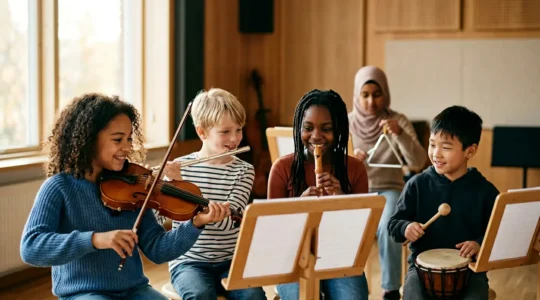
Beyond the Notes: Why Ensembles Accelerate Your Child’s Social and Musical Growth
Playing music with others is one of the most effective ways to develop a child’s social and emotional intelligence. It trains the brain for non-verbal communication, active listening, and empathy in a real-time, collaborative environment. It builds profound accountability and…
Lire la suite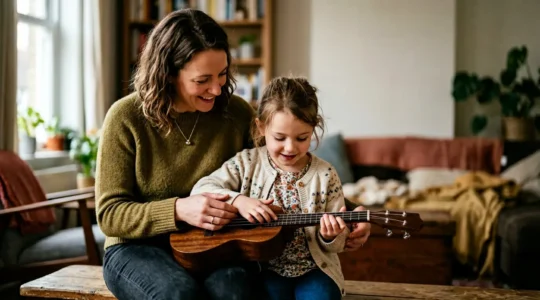
How to Choose the Perfect Starter Instrument for Your Child’s Age and Size
The biggest mistake parents make isn’t choosing the ‘wrong’ instrument, but choosing one that is physically difficult or painful for a child to play. An instrument’s size, string tension, and setup (its « playability ») are far more critical for a beginner’s…
Lire la suite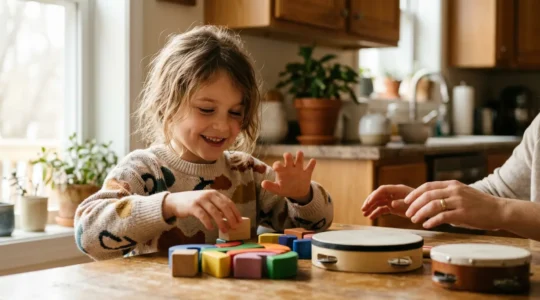
The best educational music games to reinforce learning at home
In summary: The most effective music education comes from active participation, not passive listening. Both digital apps and offline games are powerful tools when they deconstruct and teach a specific musical concept like rhythm, phrasing, or notation. Simple, often free,…
Lire la suite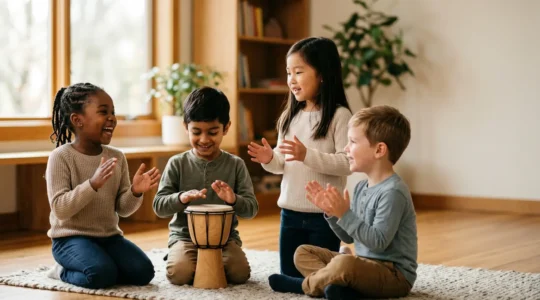
How to Teach Music to Kids: A Guide to Making Learning Fun and Effortless
The secret to fun music lessons isn’t adding rewards or games; it’s designing a learning system where fun is the natural result of a child’s intrinsic drive to play and discover. Match the teaching method to your child’s unique personality…
Lire la suite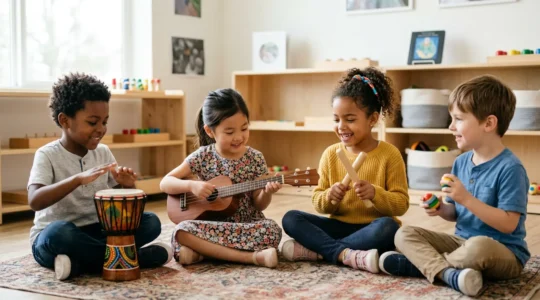
Why Music Education for Children Is About Brain Development, Not Just Talent
Contrary to popular belief, the greatest benefit of early music education isn’t creating a mini-Mozart, but systematically building a better brain. Active musical play directly wires the neural circuits for language, empathy, and physical coordination. Specific musical activities act as…
Lire la suite