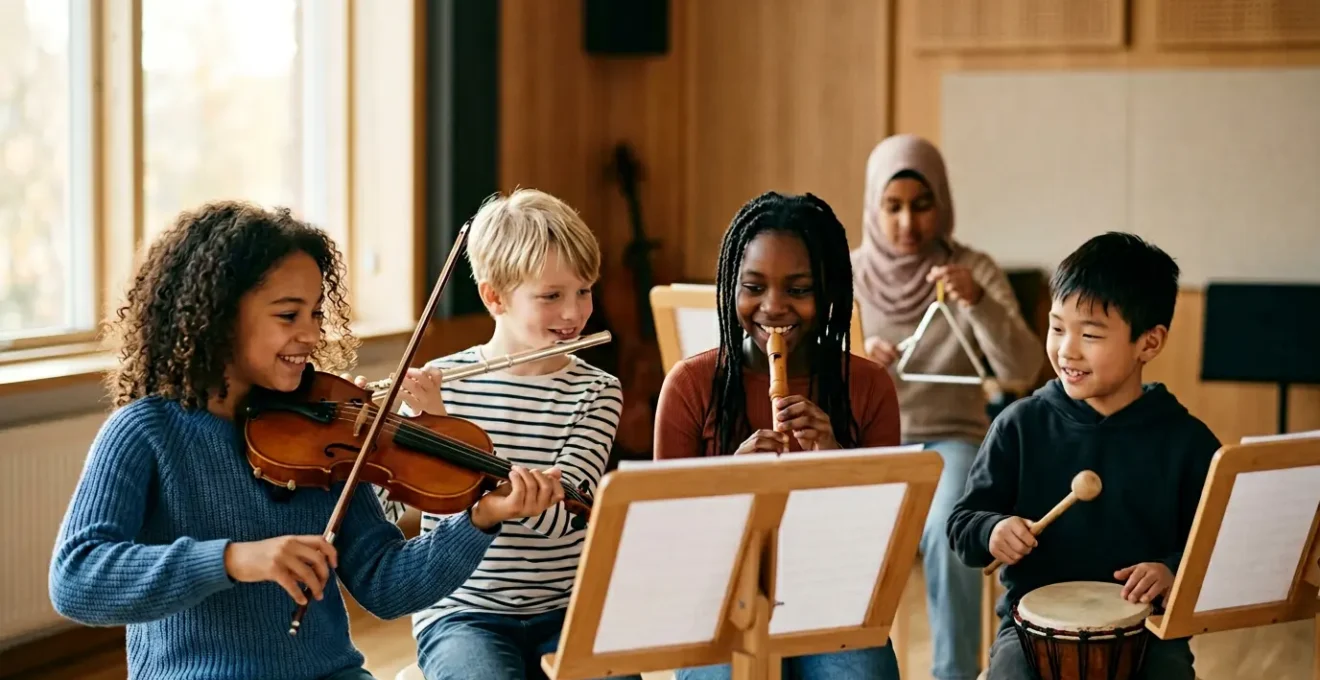
Playing music with others is one of the most effective ways to develop a child’s social and emotional intelligence.
- It trains the brain for non-verbal communication, active listening, and empathy in a real-time, collaborative environment.
- It builds profound accountability and resilience by showing children how their personal effort directly impacts the success of their friends.
Recommendation: Look for ensemble programs that focus not just on technical skill, but on the joy and responsibility of collaborative music-making.
As a conductor, I’ve seen it countless times: a shy child walks into their first rehearsal, instrument case held like a shield, eyes fixed on the floor. They may be a diligent student in solo lessons, focused entirely on their own notes and technique. But the idea of playing with others is terrifying. Parents often hope group music will simply help their child « make friends. » While that’s true, it’s only the surface of a much deeper transformation. The real magic of an ensemble isn’t just social; it’s neuro-social.
Many believe that musical skill is the primary goal of music education. But what if the structure of an orchestra or band is actually a sophisticated training ground for the very social and emotional skills we want for our children? We often focus on solo practice, but that misses the most powerful element of music: connection. The ensemble experience forces a child to move beyond their own world and engage in a dynamic, non-verbal conversation. It’s a place where they learn that listening is as important as playing, that their contribution matters to the whole, and that vulnerability can be a source of collective strength.
This article moves beyond the platitude of « teamwork. » We will explore the specific, often invisible mechanisms within ensemble practice that accelerate a child’s growth. We will look at how adjusting volume becomes an act of empathy, how following a conductor builds non-verbal acuity, and how playing a harmony part teaches a profound lesson in supporting others. This isn’t just about playing music; it’s about learning the language of human collaboration.
This guide will walk you through the key social and developmental milestones that a child achieves in an ensemble, explaining the ‘why’ behind each step. By the end, you will see the orchestra not just as a place to make music, but as a community where your child learns to connect, contribute, and thrive.
Summary: Why practicing in ensembles accelerates social and musical growth for kids?
- The Volume War: Learning to Play Quietly So Others Can Be Heard
- Why Not Practicing Lets Your Friends Down
- Watching the Stick: Learning to Follow Non-Verbal Instructions
- I’m Not the Melody: Finding Joy in Playing the Harmony Part
- Safety in Numbers: Overcoming Stage Fright Together
- The Nod and The Look: How to End a Song Together Without Counting
- Taking Turns: Learning Patience Through Drum Circles
- Why music education for children is about brain development, not just talent?
The Volume War: Learning to Play Quietly So Others Can Be Heard
The first lesson in any ensemble isn’t about notes; it’s about sound. In a child’s world, especially when they are proud of a new skill, the instinct is to play loudly to be heard. But in a group, this creates a « volume war » where no one can hear anyone else. The challenge for a young musician is to learn to play quietly enough for the melody in another section to shine through. This isn’t a technical instruction; it’s a social one. It’s the first step in what I call sonic democracy: the understanding that your voice is just one part of a larger conversation.
This act of consciously reducing your volume to create space for another is a profound exercise in active listening and empathy. The child must listen outside of themselves, identify who has the important part, and then choose to support rather than compete. This dynamic is a powerful driver of prosocial behavior. In fact, research published in 2024 demonstrates that children’s helping and sharing behaviors are significantly enhanced through active music engagement, far more than through passive listening. They are learning, in a very practical way, that collaboration creates something more beautiful than individual effort ever could.
Preschoolers who engaged in joint music and movement activities showed greater group cohesion, cooperation, and prosocial behavior when compared to children who did not engage in the same music activities.
– Kirschner & Tomasello, Evolution and Human Behavior
By learning to control their dynamics for the good of the group, children are internalizing a fundamental social principle. They are moving from « me » to « we, » realizing that their role is to contribute to the whole, not to dominate it. This foundational skill of listening and making space for others is the bedrock upon which all other collaborative abilities are built.
Why Not Practicing Lets Your Friends Down
In solo practice, the only person affected by a lack of preparation is the student. But in an ensemble, the stakes are completely different. When a child comes to rehearsal unprepared, they are not just failing themselves; they are breaking a promise to every other member of the group. This is what I call the social contract of the score. Each player has a unique part that is essential to the whole, and if one part is missing or played incorrectly, the entire musical structure is weakened. The music itself becomes the teacher, showing in real-time how individual accountability impacts the collective.
This creates a powerful and positive form of peer pressure. A child who might be tempted to skip practice is motivated by the desire not to let their friends down. They see the direct consequence when a fellow musician struggles with a part and the whole section has to stop and wait. This experience builds a level of responsibility and sympathy that is difficult to teach in the abstract. A 2015 study in PLOS One found that children in a group music program showed significant increases in sympathy and prosocial behavior, particularly those who started with weaker social skills. The ensemble becomes a safe environment to learn about commitment and its social rewards.
This sense of interdependence is the glue that holds a musical community together. Children learn that their effort matters, that they are counted on, and that they have a responsibility to show up prepared for their peers. It shifts the motivation from an external one (pleasing a teacher or parent) to an internal one: contributing to the success and sound of their group. This is a crucial step in developing a mature sense of personal responsibility.
Watching the Stick: Learning to Follow Non-Verbal Instructions
One of the most fascinating transformations to watch is a child learning to follow a conductor. At first, they are focused solely on the sheet music in front of them. But soon, they learn to split their attention, keeping one eye on the page and one on « the stick. » They are learning to read a complex, silent language—the conductor’s gestures for dynamics, tempo, and emotional expression. This is not passive obedience; it’s an active process of neuro-social synchrony, where the musician’s brain attunes itself to the non-verbal cues of a leader.
This skill of interpreting and responding to non-verbal instructions is a massive boost for a child’s social acuity. They learn to read body language, facial expressions, and subtle gestures, translating them instantly into musical action. This process is deeply rooted in our neurology, particularly the mirror neuron system, which allows us to understand the actions and intentions of others by simulating them in our own brain. This is why watching a skilled conductor can feel so intuitive to the players.
Case Study: Brain-to-Brain Synchronization in Ensembles
The experience of following a conductor is more than just watching; it’s a form of neural coupling. A 2024 systematic review of 32 studies found that musicians performing together exhibit inter-brain EEG synchronization. For string players, the mirror neuron system is crucial for understanding the movements of the conductor and other players, allowing for precise, real-time reactions. This facilitates the subtle, non-verbal communication—eye contact, micro-gestures—that helps the group perform as a single, cohesive unit.
For a shy child, or one who struggles with social cues, this is invaluable training. The feedback is immediate and impersonal: if you miss the conductor’s cue to slow down, you will be out of sync with everyone else. The ensemble provides a low-stakes environment to practice and master the art of reading a room, a skill that translates directly to navigating social situations at school and beyond. They are learning to look up and out, connecting their actions to the guidance of a leader and the flow of the group.
I’m Not the Melody: Finding Joy in Playing the Harmony Part
In music, as in life, not everyone can have the spotlight all the time. For many young musicians, the goal is to play the melody—the recognizable, celebrated tune. Being assigned a harmony part can initially feel like a disappointment. Yet, learning to love your role as a harmony player is one of the most profound lessons in social and emotional intelligence. It requires a shift from a self-centered perspective to one of harmonic empathy: the ability to find joy and purpose in supporting another part.
Playing harmony well is an act of deep listening. You cannot simply play your own notes in isolation; you must constantly listen to the melody and adjust your pitch, rhythm, and volume to complement it. You are actively providing the foundation, the color, and the emotional depth that makes the melody beautiful. The child learns that their « less important » part is, in fact, essential. Without the harmony, the melody sounds thin and incomplete. This discovery is a powerful metaphor for understanding one’s role within any group or community.
This process builds cognitive empathy, which is the ability to understand another person’s perspective. The harmony player must ask, « What does the melody need from me right now? Does it need support? Does it need space? » They learn that their contribution, while different, is equally valuable. For a shy child, playing a harmony part can be incredibly empowering. It allows them to contribute meaningfully without the pressure of being the sole focus of attention. They learn that they can be a crucial part of the team, valued for their supportive role. This builds a quiet confidence based not on being the star, but on being an indispensable part of the fabric.
Safety in Numbers: Overcoming Stage Fright Together
The fear of performing in front of an audience—stage fright—is one of the most common anxieties, for adults and children alike. For a shy child, the prospect of a solo recital can be paralyzing. The ensemble offers a powerful antidote. It’s not that the fear disappears, but its nature changes. Instead of being an isolating experience, it becomes a form of shared vulnerability. When a child looks to their left and right and sees their friends feeling the same nervous excitement, the fear becomes manageable.
The focus shifts from « all eyes are on me » to « we are all in this together. » This collective experience builds a unique form of resilience. If one person makes a mistake, the rest of the group carries on, providing a safety net of sound that covers the error and allows the individual to rejoin without a catastrophic failure. The child learns that mistakes are not the end of the world and that their peers are there to support them, not to judge them. This shared risk-taking fosters immense trust and camaraderie within the group.
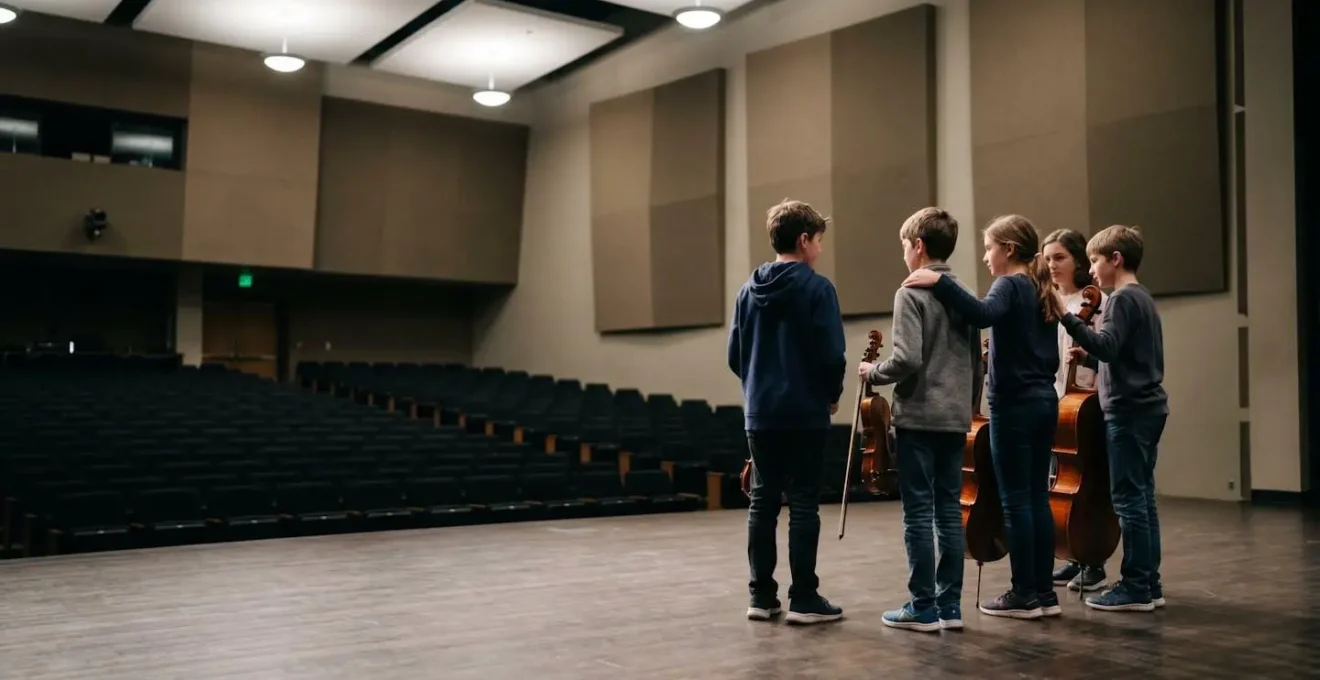
This environment is the perfect incubator for confidence. A child who would never dare to stand on a stage alone can find the courage to do so as part of a group. Each successful performance, no matter how small, becomes a shared victory. They celebrate together, they bow together, and they feel the applause as a collective. This experience of overcoming a shared challenge builds a deep and lasting self-confidence that is rooted in community and mutual support, a far more resilient form of confidence than one built on solo achievement alone.
The Nod and The Look: How to End a Song Together Without Counting
One of the most magical moments in an ensemble performance is the final chord. How do dozens of musicians, without a word, end a piece at the exact same millisecond? While the conductor provides the main cue, a complex web of non-verbal communication is happening between the players themselves. It’s « the nod » from the principal violinist to the cellist, « the look » shared between two wind players taking a breath together. This is the pinnacle of group attunement, a form of non-verbal group synchronization that goes beyond simply following a leader.
The musicians are not just playing with each other; their brains are literally syncing up. They anticipate each other’s movements and intentions through constant, subtle observation. This isn’t magic; it’s neurology. A 2024 study published in NeuroImage revealed that inter-brain synchronization occurs in areas of the brain responsible for both recognizing musical structure and for interpersonal understanding. During coordinated musical activity, the performers’ neurons are firing in harmony, creating a shared neural state.
For children, learning to participate in this silent dialogue is a masterclass in social awareness. They learn to look up from their music stand and connect with their peers, reading their body language for cues about timing and intention. It teaches them to be present and responsive in a way that few other activities can. This constant, high-speed loop of observation, prediction, and action is training for the complex, non-verbal dance of all human social interaction. It helps a child who might be more internally focused to develop an outward-looking sensitivity, learning to trust the cues from their peers to achieve a common goal.
Taking Turns: Learning Patience Through Drum Circles
While orchestras and bands have defined structures, other forms of group music-making offer different lessons. A drum circle, for example, is a fantastic environment for teaching patience and the art of turn-taking. In an improvised circle, there isn’t a conductor dictating who plays when. The group must collectively create a space for individuals to solo, and the individual must learn to wait for their moment and, just as importantly, to stop when their turn is over to give someone else a chance.
This requires active listening and impulse control. A child must resist the urge to play constantly and instead listen to the groove, feeling the right moment to add their voice without disrupting the flow. The social context of drumming together makes this synchronization easier for children to learn. A study on joint drumming highlighted that preschool children synchronize their playing far more effectively in a social group than when drumming alone. The mirror neuron system is again at play, helping children learn to perform in synchrony with others by observing and internalizing their actions.

A drum circle provides immediate, auditory feedback. If you play at the wrong time or for too long, you can hear how it disrupts the group’s rhythm. This teaches a natural lesson in social self-regulation. The child learns to be patient, to listen for openings in the conversation, and to make their contribution count. They also learn to cede the floor, an essential skill for respectful dialogue in any setting. It’s a playful and powerful way to practice the give-and-take of successful social interaction.
Key Takeaways
- Ensemble playing forces children to listen actively and adjust their own playing, teaching a form of social empathy I call « sonic democracy. »
- The shared goal of a performance creates a powerful sense of mutual accountability and responsibility that solo practice cannot replicate.
- The synchronization required in music physically wires the brain for better executive function, non-verbal communication, and interpersonal understanding.
Why music education for children is about brain development, not just talent?
Ultimately, the reason ensembles are so effective at fostering social growth is because music-making is a full-brain workout that directly targets the networks responsible for social and emotional regulation. When a child plays in a group, they are not just learning notes. They are managing attention, inhibiting impulses, processing non-verbal cues, and coordinating their actions with others in real-time. This is a complex task that strengthens crucial cognitive abilities. In particular, neuroscience research confirms that learning to listen to others in a group setting enhances executive functioning skills.
These executive functions—including working memory, cognitive flexibility, and self-control—are the building blocks of social competence. A child with strong executive functions is better able to manage their emotions, pay attention in a group, and think before they act. The ensemble provides a structured, repetitive, and enjoyable way to build these skills. The act of sharing musical experiences physically synchronizes brain activity among participants, fostering a lasting sense of togetherness and empathy.
Children who undergo musical training have better verbal memory, second language pronunciation accuracy, reading ability and executive functions. Learning to play an instrument as a child may even predict academic performance and IQ in young adulthood.
– Researchers, How musical training affects cognitive development: rhythm, reward and other modulating variables
This is why music education isn’t just for the « talented. » It is a foundational developmental activity. For the shy child, it’s a safe space to build confidence. For the solo-focused student, it’s a lesson in collaboration. For every child, it’s an opportunity to develop the cognitive and emotional tools they need to navigate their world with greater empathy, awareness, and connection.
Action Plan: Assessing a Music Program’s Social-Emotional Impact
- Observe the Conductor’s Focus: Do they only give technical feedback (« play louder, » « wrong note ») or do they also use collaborative language (« listen to the flutes, » « let’s support the melody »)?
- Analyze the Repertoire: Does the music chosen offer opportunities for different sections to shine? Are there pieces that require intricate interplay and listening, not just everyone playing at once?
- Watch the Student Interactions: Do children seem to be listening to each other? Do they make eye contact? Is there a sense of shared focus and purpose, or are they all in their own worlds?
- Assess the Performance Culture: Is the focus on flawless, high-pressure perfection, or on the joy of making music together? How are mistakes handled—as learning opportunities or as failures?
- Ask About the « Why »: Talk to the program director. Do they speak about building community, teaching listening skills, and fostering confidence, or do they only talk about competition results and technical proficiency?
Give your child the gift of a musical community. Explore a local youth orchestra, band, or choir, and watch them find their voice—not just on their instrument, but within a group of their peers. It is one of the most beautiful and lasting investments you can make in their social and emotional well-being.