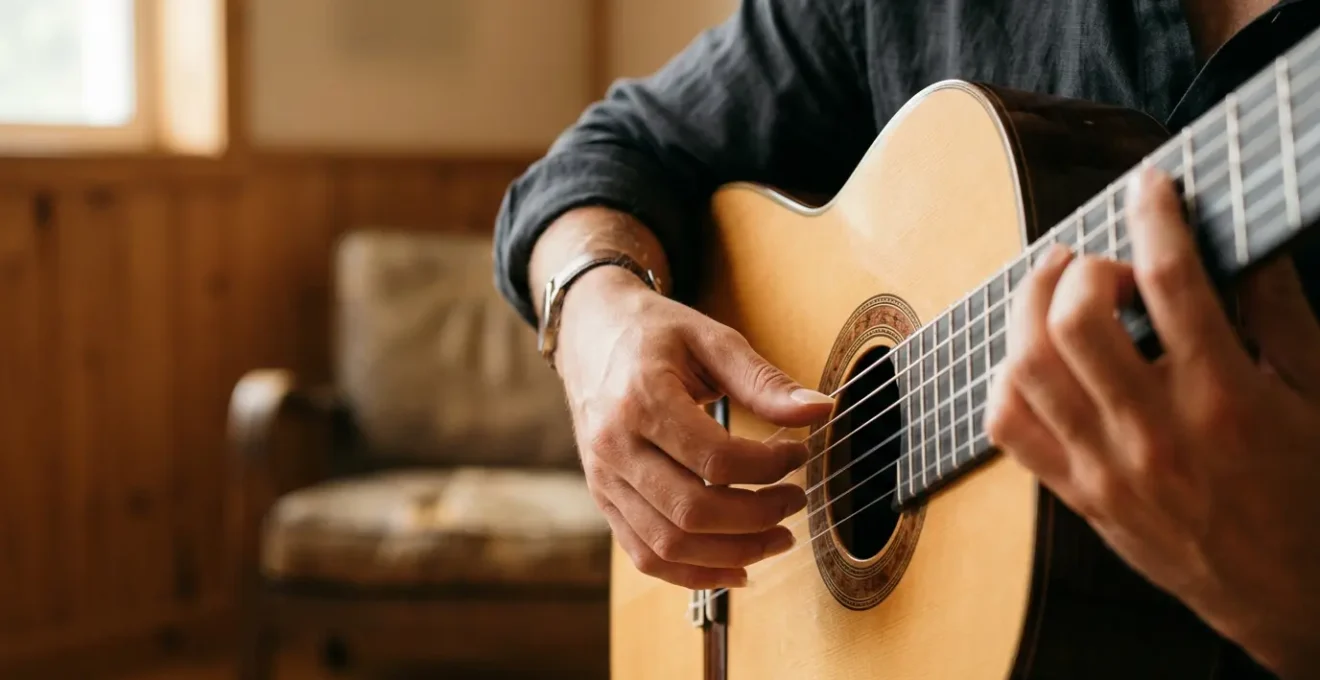
True mastery of the classical guitar lies not in simply learning techniques, but in embracing a series of disciplined rituals. From the microscopic shaping of your fingernails to the ergonomic choices that protect your spine, every detail is a conscious act that sculpts your tone. This approach transforms playing from a mechanical act into a refined art form, revealing that the instrument’s authentic voice is found in this profound attention to detail.
For the guitarist transitioning from the world of steel strings and plectrums, the nylon-stringed classical guitar presents a challenge that is as much philosophical as it is technical. You may already know scales and chords, but you quickly discover that raw facility is not enough. The common advice—to sit correctly, grow your nails, and practice scales—feels inadequate. It touches upon the ‘what’ but completely misses the profound ‘why’ that defines this venerable tradition.
The journey to an authentic classical tone is littered with these superficial instructions. You’re told to use a footstool, but not how this choice can lead to spinal issues over decades. You’re given tablature for a Bach fugue, only to find the music itself remains elusive. But what if the secret to mastery wasn’t in accumulating more techniques, but in cultivating a deeper, more disciplined mindset? What if the key was to treat every aspect of your playing, from nail care to notation, as a deliberate ritual?
This guide reframes the path to mastery. We will explore how the most minute details become the engine of your tone and how disciplined practice is not about repetition, but about conscious refinement. We will deconstruct the essential rituals that separate the novice from the maestro, providing you with a complete framework for developing a truly refined and authentic classical guitar voice.
To navigate this deep exploration of classical guitar discipline, the following guide breaks down the essential rituals and technical philosophies that form the foundation of true mastery. Each section builds upon the last, creating a holistic understanding of this profound art form.
Summary: The Disciplined Path to Classical Guitar Mastery
- Shape and Polish: The Obsessive Ritual of the Right Hand
- Footstool vs Support: Saving Your Spine During Practice
- Apoyando vs Tirando: When to Use Which for Projection
- Why Tablature Isn’t Enough for Bach
- Recuerdos de la Alhambra: The Illusion of Continuous Sound
- High vs Low Action: Finding the Sweet Spot for Playability and Tone
- Tab + Standard: The Best of Both Worlds for Learning
- Guitar Tablature: The pros, cons, and how to use it effectively
Shape and Polish: The Obsessive Ritual of the Right Hand
The plectrum is a tool of convenience; for the classical guitarist, the right-hand fingernails are the very soul of tone production. This is not mere grooming, but a daily, obsessive ritual of shaping and polishing. The shape of the nail—specifically, the creation of a subtle ‘ramp’ on the striking edge—is the tonal engine that determines warmth, clarity, and projection. A flat nail will produce a thin, brittle sound, while a perfectly sculpted and polished ramp allows the string to glide smoothly, releasing a round, full-bodied note. The shape you choose is a fundamental question of musical identity: are you aiming for a bright, percussive sound or a dark, lyrical one? The answer begins here.
For a classical guitarist, the right hand (or left hand if you are left handed) nails are arguably the most important ‘tool’ to hone and maintain in order to play well.
– Rosie Bennet, Tonebase Guitar – Nail Shaping & Care for Classical Guitar
This obsessive focus is not an affectation. It is the first and most critical discipline. The image below reveals the microscopic precision required. Notice the smooth, ramped contour where the nail is filed to a specific profile. This surface is then polished with micro-mesh paper to a glass-like finish, eliminating any friction that could cause string noise.
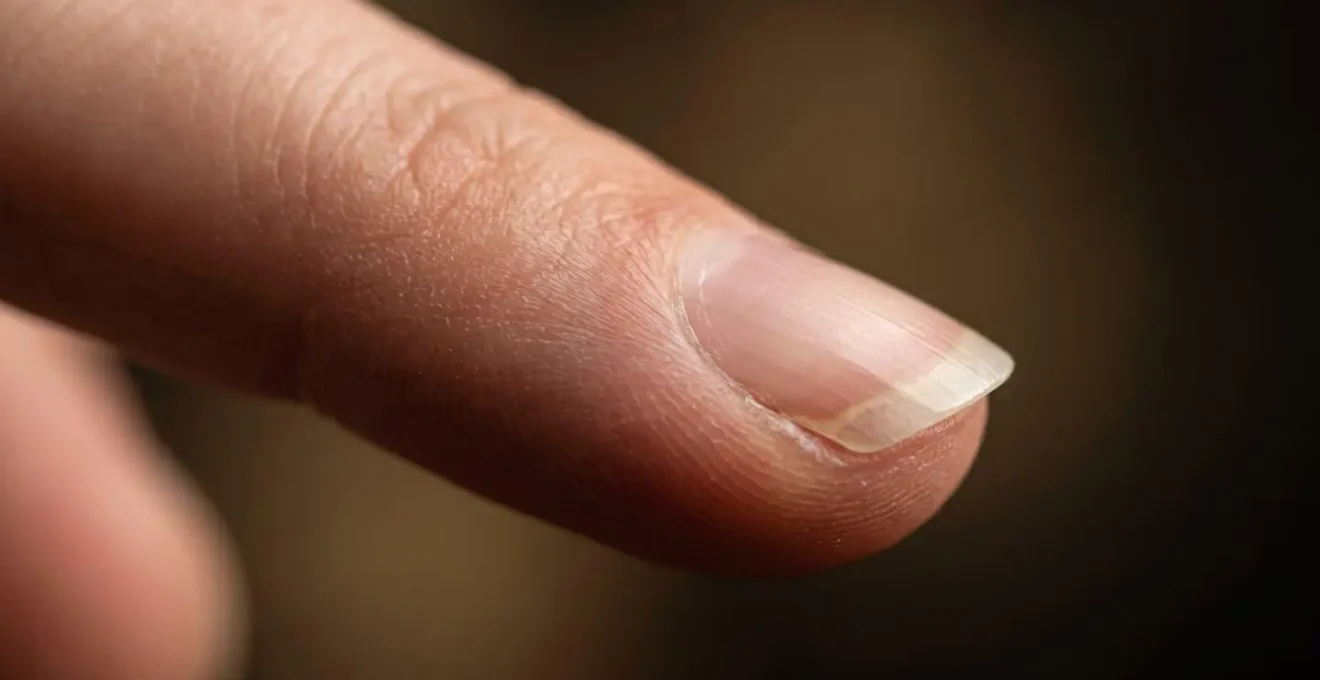
As the illustration demonstrates, the contact point is a carefully engineered surface. This level of detail ensures that every note is born from a place of intention. Mastering this ritual is the first step away from being someone who simply plays the guitar and toward becoming a musician who sculpts sound with their own hands. It transforms a biological feature into a bespoke, high-performance tool.
Footstool vs Support: Saving Your Spine During Practice
The traditional image of the classical guitarist—one foot elevated on a small stool—is iconic, but it is also ergonomically flawed. This posture, adopted for hours daily over many years, introduces a subtle twist in the spine and an imbalance in the hips. While it achieves the correct angle for the guitar, it does so at a significant physical cost. Indeed, a study on musicians’ health confirms that poor seated posture is one of the leading causes of chronic pain among guitarists. A career in music is a marathon, not a sprint, and preserving one’s physical well-being is a core discipline.
This has led to the rise of modern guitar supports. These devices, which attach to the instrument via suction cups or magnets, lift the guitar to the correct height and angle while allowing the player to keep both feet flat on the floor. This maintains a neutral, stable, and balanced spine, turning posture from a compromise into a foundation of strength. The choice between a traditional footstool and a modern support is therefore not merely about comfort, but about a commitment to ergonomic discipline and a sustainable practice.
These days most guitar teachers agree that a guitar support that allows both feet to be flat on the ground will be best. This provides an ergonomic approach that will allow you to play for long periods of time without pain.
– Classical Guitar Corner, Footstool vs Guitar Support article
Embracing a guitar support is an acknowledgment that your body is as much a part of your instrument as the wood and strings. Neglecting it leads to pain, shortened practice sessions, and potentially the end of a playing career. Protecting it is a non-negotiable aspect of the classical discipline, ensuring you can pursue your art without sacrificing your health.
Apoyando vs Tirando: When to Use Which for Projection
The right hand of a classical guitarist has two primary modes of attack: apoyando (rest stroke) and tirando (free stroke). To the uninitiated, the difference is subtle; to the maestro, it is the difference between a whisper and a declaration. Understanding when and why to employ each stroke is fundamental to musical expression and dynamic control. Apoyando, where the finger pushes through the string and comes to rest on the adjacent one, produces a full, round, and powerful tone. It is the voice of melody, used to make a single line sing out above the harmony and project to the back of a concert hall. In contrast, tirando, where the finger plucks the string and moves freely toward the palm, produces a lighter, quicker sound. It is the voice of accompaniment, essential for playing chords and rapid arpeggios where multiple strings must ring out simultaneously.
The choice is never arbitrary; it is a strategic decision dictated by the musical texture. A powerful melodic line demands the weight of an apoyando, while a delicate, shimmering arpeggio requires the lightness of a tirando. As this detailed technical comparison highlights, mastering both is essential for articulating the complex layers of classical guitar music.
| Characteristic | Apoyando (Rest Stroke) | Tirando (Free Stroke) |
|---|---|---|
| Finger Motion | Finger rests on adjacent string after stroke | Finger moves freely into palm without touching adjacent string |
| Tone Quality | Fuller, rounder, more powerful tone | Lighter, brighter, more ethereal tone |
| Primary Use | Single-line melodies, emphasized notes, projection | Arpeggios, polyphonic passages, shimmering textures |
| String Dampening | Slightly dampens unwanted harmonics | Allows string and harmonics to ring freely |
| Hand Position | Knuckles positioned above lower strings | More space underneath hand for finger movement |
| Versatility | Limited to passages where adjacent strings aren’t needed | Can be used for both arpeggios and melodic passages |
Ultimately, the interplay between these two strokes is what gives classical guitar its unique ability to sound like multiple instruments at once. The thumb might play a bass line with a weighty apoyando, while the fingers simultaneously spin a delicate harmonic web with a light tirando. This technical duality is the key to unlocking the orchestra within the instrument.
Why Tablature Isn’t Enough for Bach
Tablature, with its direct, physical map of the fretboard, is an incredibly intuitive system for guitarists. For folk songs or rock riffs, it is perfectly sufficient. However, when approaching the complex contrapuntal music of composers like J.S. Bach, tablature reveals its critical limitation: it shows you where to put your fingers, but it tells you almost nothing about the music. Bach’s work is defined by polyphony—the interweaving of multiple independent melodic lines. Tablature collapses this rich tapestry into a single set of fret numbers, rendering the crucial element of voicing and separation invisible.
A standard notation score, by contrast, visually separates these voices through stem direction and note duration. It allows the musician to see the architecture of the piece: to identify the bass line, the soprano melody, and the inner voices, and to make conscious decisions about how to articulate each one. Playing Bach from tablature is like trying to appreciate a grand cathedral by looking only at a list of its stone blocks; you miss the structure, the harmony, and the genius of its design entirely.
Case Study: Bach’s Lute Works and the Failure of Tablature
Bach’s Lute Suites (BWV 995-1000) demonstrate the critical limitations of tablature for complex polyphonic music. While tablature shows finger placement on the fretboard, it fails to communicate the essential contrapuntal structure—the independent melodic voices that define Bach’s compositional genius. A scholarly edition in standard notation, however, reveals voice-leading, note duration, and harmonic relationships that are invisible in tablature. As emphasized by guitarist Stanley Yates in his work on Bach, proper interpretation requires understanding these musical layers. The result is a profound distinction: tablature may help you find the notes, but standard notation is what teaches you the music.
Therefore, the discipline of learning to read standard notation is non-negotiable for any serious student of classical guitar. It is not an elitist preference but a practical necessity for engaging with the core repertoire on its own terms. It is the only tool that provides the complete architectural blueprint required to construct a faithful and musically intelligent interpretation.
Recuerdos de la Alhambra: The Illusion of Continuous Sound
Francisco Tárrega’s masterpiece, *Recuerdos de la Alhambra*, is built upon one of the most iconic and challenging techniques in the classical guitar repertoire: the tremolo. This technique, typically executed with a p-a-m-i (thumb, ring, middle, index) right-hand pattern, creates a sonic illusion. A long, sustained melodic line, played by the fingers on a single string, appears to float above a separate, harmonically rich bass line played by the thumb. The goal is not just speed, but a perfectly even, shimmering texture that sounds like a continuous, unbroken note, akin to a bowed violin or a singer’s voice.
Achieving this illusion requires immense control and discipline. The common mistake is to focus on speed, resulting in a frantic, uneven « stutter » rather than a smooth, lyrical line. The true discipline lies in achieving perfect evenness of rhythm and volume between the a, m, and i fingers. Each finger must be an exact clone of the others in its attack and tone. Furthermore, these three fingers must operate as a single, quiet unit, creating a pianissimo backdrop for the expressive, dynamic melody played by the thumb. The thumb is the singer; the fingers are the shimmering air around them.
Mastering this technique is a long-term project that demands patient, methodical practice. It is the pinnacle of right-hand independence and control, transforming a percussive instrument into one capable of breathtaking lyricism. The following routine breaks down this complex skill into manageable steps.
Action Plan: Mastering the Tremolo for a Flawless Sound
- Isolate the tremolo pattern (P-A-M-I) on a single string, playing slowly at 40-60 BPM to establish the basic motion.
- Practice with shifting accents—emphasize each finger in turn (P-A-M-I, then P-A-M-I, then P-A-M-I) to diagnose and strengthen the weakest finger.
- Use dotted rhythms to build control and balance, playing the pattern with varied durations on different fingers to develop independence.
- Separate the thumb melody from the tremolo accompaniment; practice the P (thumb) notes alone with dynamic shaping while imagining the a-m-i backdrop.
- Combine both elements gradually, maintaining the thumb’s expressive dynamics while keeping the a-m-i fingers at a constant pianissimo for the shimmering effect, as detailed in guides from professional players.
High vs Low Action: Finding the Sweet Spot for Playability and Tone
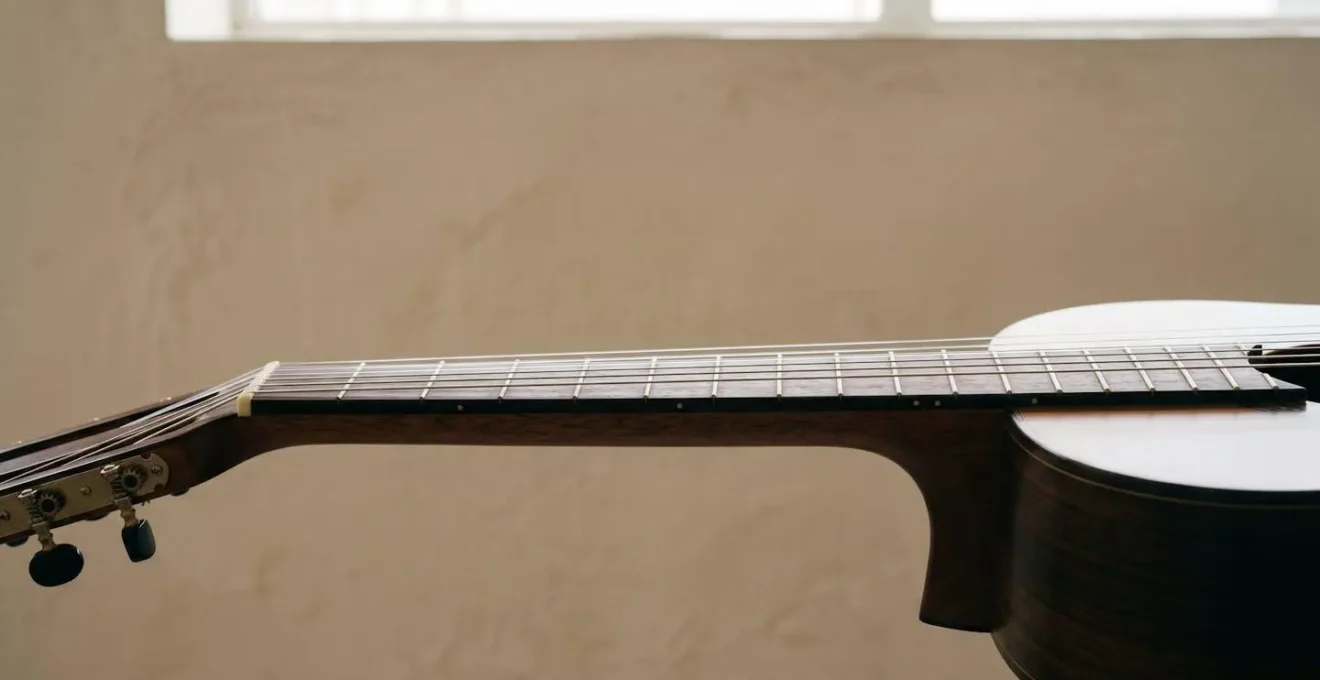
The ‘action’ of a guitar refers to the height of the strings above the fretboard. In the world of electric guitar, the quest is often for the lowest possible action to facilitate speed. For the classical guitarist, the calculation is far more complex. The ideal action is not a fixed measurement but a dynamic sweet spot, a delicate compromise between playability, tone, and the player’s individual technique. A low action makes fretting notes easier and can feel faster, but it comes with risks: the reduced string clearance can lead to buzzing, especially during loud passages, and it can choke the string’s vibration, resulting in a thinner tone with less sustain and dynamic range.
Conversely, a high action provides ample clearance for the string to vibrate freely, producing a powerful, open tone with maximum volume and sustain. This is often preferred by players who use a strong attack. The trade-off, however, is that it demands greater fretting-hand strength and can make fast, intricate passages more challenging to execute cleanly. This creates a fascinating symbiosis between the instrument’s setup and the musician’s technique.
A powerful ‘apoyando’ player needs more string clearance (higher action) to avoid fret buzz. A delicate ‘tirando’ player can get away with a much lower action for speed.
– Classical Guitar Technique Analysis, Action height and technique correlation
The relationship between the strings and the fretboard, as shown below, is a critical geometric factor. It is not just about a single measurement at the 12th fret but about the entire relief curve of the neck. Finding your personal sweet spot is a process of experimentation.
Ultimately, the action must serve the music and the musician. A luthier can set the guitar’s action, but only the player, through an intimate understanding of their own touch and tonal goals, can determine what that ideal setting should be. This is not a one-time setup but an ongoing dialogue between the player and their instrument.
Tab + Standard: The Best of Both Worlds for Learning
While standard notation is the undisputed language for serious musical interpretation, to dismiss tablature entirely is to ignore a powerful learning tool, especially for guitarists transitioning from other styles. The most pragmatic and efficient approach is to use both systems in tandem, leveraging the strengths of each. Think of it as a bilingual approach to learning music: standard notation is the language of musical grammar, while tablature is the language of physical geography.
When learning a new piece, begin with the standard notation. Analyze its structure, identify the melodic lines, understand the harmony, and make phrasing and dynamic decisions. This is where the musicality is born. Only after this analysis should you consult the tablature. Its role is not to teach you the piece, but to offer efficient fingering suggestions. The guitar offers many ways to play the same note; tablature can quickly show you a logically positioned fingering that a master arranger has chosen for its ergonomic or tonal properties.
This hybrid method accelerates learning without sacrificing musical depth. You use the standard score to understand *what* music to make, and you use the tab as a helpful reference to figure out the most effective physical path to making it. For example, a complex chord voicing might be ambiguous on the staff, but a quick glance at the tab clarifies the exact fretboard position instantly, saving valuable practice time. This is not a crutch; it is an intelligent use of all available information.
By treating tablature as a supplemental guide rather than a primary source, you gain its benefits of speed and clarity without succumbing to its limitation of musical ignorance. This balanced discipline allows for a faster and more efficient path toward a deep and informed musical performance.
Key Takeaways
- Mastery is a set of disciplined rituals, not just techniques. Your right-hand nail is the engine of your tone.
- Prioritize long-term health with ergonomic posture choices, such as using a guitar support over a traditional footstool.
- Standard notation is essential for understanding the polyphonic structure of classical music, a dimension tablature cannot convey.
Guitar Tablature: The pros, cons, and how to use it effectively
Throughout this exploration, we have established that the path to classical guitar mastery is one of disciplined, conscious choices. From the microscopic world of nail shaping to the architectural understanding of a Bach fugue, every element matters. Where, then, does a seemingly simple tool like guitar tablature fit into this refined philosophy? Its greatest pro is its immediacy; it translates musical notation into a direct physical command. Its greatest con is that it encourages this physical action without demanding any musical understanding.
To use tablature effectively is to understand its proper place in the hierarchy of learning. It is a map, not a destination. It can show you a path across the fretboard, but it cannot explain the beauty of the landscape. An effective musician uses it as a final check on fingering, a quick-reference guide after the real musical work—analysis of the standard score—has already been done. Its effectiveness is directly tied to the discipline of the user. In the hands of a beginner, it can create a dependency that stunts musical growth. In the hands of a disciplined student, it becomes a time-saving tool for confirming ergonomic fingerings.
The ultimate goal is to move beyond a reliance on any single tool and instead cultivate a holistic understanding of the music. This involves training your hands through rituals, protecting your body through ergonomic discipline, and educating your mind through the proper study of musical language. Tablature can be a part of this journey, but it must remain a servant to the music, never its master.
The next logical step is to apply this philosophy of disciplined ritual to your own practice. Begin by evaluating a single aspect—your nail care, your posture, or how you approach a new piece—and commit to refining it with conscious intention.