
The ethereal sound of the Shō is not magic; it is a masterpiece of sonic architecture. This article reveals how its ancient design, from the seasoned bamboo to the pre-heating ritual, constitutes a deliberate system for generating harmony. We will explore the material science, breathing techniques, and cultural significance that make this instrument sound both ancient and profoundly futuristic.
To hear the Shō is to experience a sound that seems to defy physics. It doesn’t begin or end; it simply *is*—a column of light and harmony hanging suspended in the air. For centuries, poets have described it as the voice of the phoenix or the light of heaven. As an instrument builder and player, I can tell you the reality is even more fascinating. The Shō is not an artifact to be revered from a distance; it is a living, breathing system, a piece of sophisticated sonic architecture where material, ritual, and breath converge.
Many know the Shō visually, as the iconic instrument of Japanese Gagaku court music, its clustered pipes evoking the image of a mythical bird at rest. But to truly understand it, one must look past the poetic descriptions and delve into its mechanics. The true artistry lies not just in the playing, but in the very construction and maintenance of the instrument. Its voice is a direct result of its physical form, a lesson in how material consciousness shapes sound.
This is the core of our journey. We will dismantle the mystique to reveal the science, without losing the magic. We are not just discussing a musical instrument; we are exploring a complete philosophy of sound. Why is the bamboo seasoned for a century? How does a single breath, in and out, create a seamless, endless drone? And why must you roast it over a flame before it will sing for you? The answers reveal a level of intentionality that is staggering.
This exploration will take us from the forests of Japan to the avant-garde studios of Björk and John Cage. We will see how this thousand-year-old technology produces harmonies that sound strikingly modern and discover how its principles are reflected in everything from synthesizers to other ancient wind instruments. Prepare to see—and hear—the Shō not as a relic, but as a timeless piece of engineering.
Summary: The Shō: The sound of heavenly light in Japanese music
- Seasoning the Bamboo: The Craftsmanship Behind the Pipes
- Inhale and Exhale: Continuous Sound Like an Accordion
- Modern Harmony 1000 Years Ago: The Dense Chords of the Shō
- Why You Must Roast the Shō Before Playing
- Björk and Cage: The Shō in Modern Avant-Garde Music
- Carriers and Modulators: Why FM Sounds Metallic and Glassy
- The Didgeridoo Trick: Keeping the Sound Going While Sniffing Air
- Gagaku: Preserving the world’s oldest orchestral tradition
Seasoning the Bamboo: The Craftsmanship Behind the Pipes
The soul of a Shō begins in smoke and time. The seventeen slender bamboo pipes that form its body are not just any bamboo. The most prized material is susudake, or « smoked bamboo, » harvested from the ceilings of traditional Japanese farmhouses (minka) that are at least a century old. For generations, this bamboo has been slowly seasoned by the smoke from the indoor hearth, giving it a deep, reddish-brown patina and, more importantly, an unparalleled acoustic stability and resilience. The scarcity of this material is a growing concern, as smoked bamboo from 100+ year-old ceilings is increasingly difficult to find, making each true Shō a vessel of architectural history.
Inside the base of each pipe, hidden from view, lies the heart of the instrument’s voice: a tiny, hair-thin metal free reed. This is where the true sonic architecture becomes apparent. Each reed is meticulously crafted from a copper alloy and mounted within its lacquered bamboo housing. The tuning process is an act of microscopic precision. As Wikipedia contributors note, « The pipes are tuned carefully with a drop of a dense resinous wax preparation containing fine lead shot. » This mixture of beeswax and lead is painstakingly applied or scraped away to adjust the pitch. It is a delicate balance; too much weight and the note is flat, too little and it is sharp. This is not factory production; it is a conversation between the craftsman and the material.
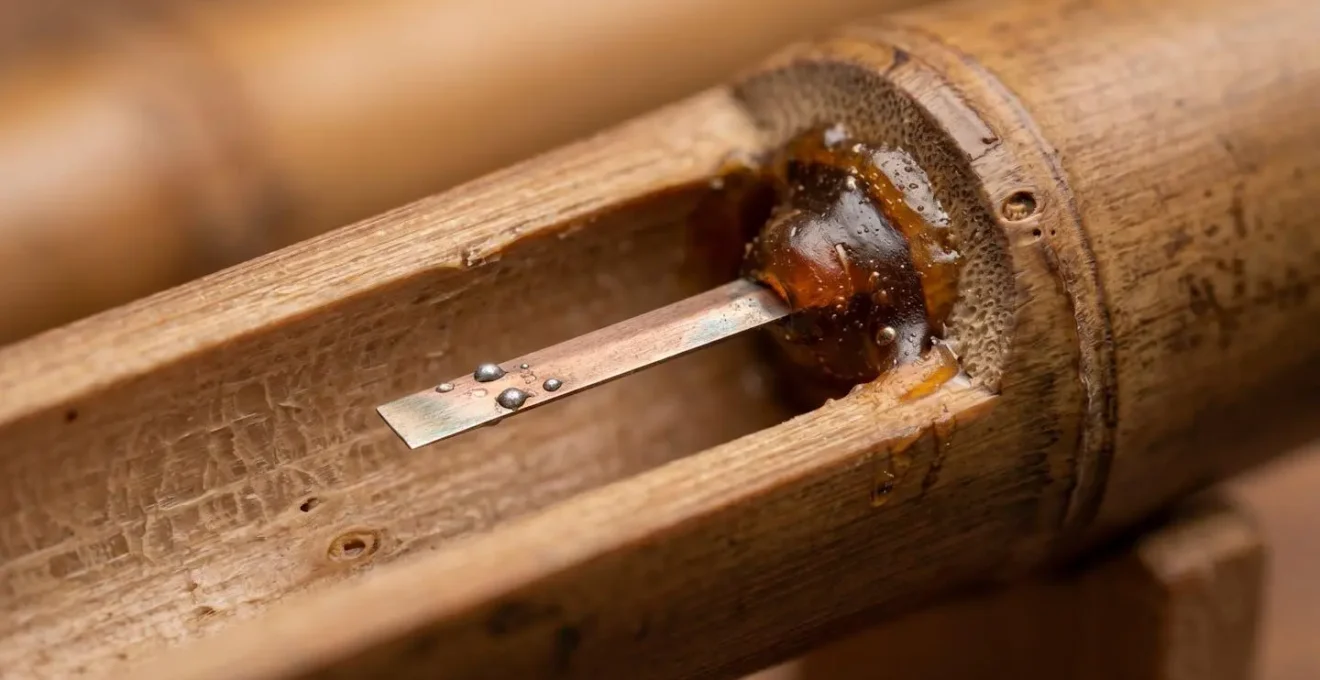
This image reveals the secret world inside the Shō. You can see the delicate reed, the sculptural quality of the wax, and the very fibers of the ancient bamboo. Every element is functional. The length and thickness of the reed, the specific gravity of the lead-wax mixture, and the resonant volume of the pipe itself all work in concert. This is not mere decoration; it is a precisely engineered system designed to vibrate with otherworldly purity. When I build or repair a Shō, I am always humbled by this level of inherited knowledge, a thousand years of acoustical science passed down through hands, not textbooks.
Inhale and Exhale: Continuous Sound Like an Accordion
Here we arrive at the central miracle of the Shō’s design: its ability to create a truly continuous sound. Unlike most wind instruments that produce sound only on the exhale, the Shō is a bidirectional engine. Its delicate metal reeds are designed to vibrate and produce a tone whether air is pushed past them or pulled through them. As the Organology Encyclopedia concisely states, « The shō produces sound on both exhalation and inhalation, allowing for continuous sound. » This simple fact has profound implications for both the player and the music.
For the player, this means the breath is not a series of interruptions but a cyclical, unbroken flow. There is no need for the frantic, hidden gasps for air required by a flutist or a singer holding a long note. Instead, the musician’s breathing becomes a calm, meditative loop, mirroring the very life process. The exhale flows into the inhale, and the sound never ceases. This removes the physical strain of breath support and reframes the act of playing as an extension of natural being. The instrument breathes with you, or perhaps, you breathe with it.
For the music, this creates the possibility of a truly unbroken sonic landscape. The Shō provides a « harmonic firmament »—a stable, shimmering cloud of harmony that can be sustained indefinitely. It is the canvas upon which the other, more transient, instruments of the Gagaku orchestra (like the hichiriki and ryūteki flutes) paint their melodic lines. This continuous drone is not static; it is alive, subtly shifting in timbre as the player’s breath changes direction. The sound on the inhale is often slightly brighter and more delicate than the sound on the exhale, creating a gentle, internal pulse within the ever-present chord. It is a sound without beginning or end, existing in a perpetual present.
Modern Harmony 1000 Years Ago: The Dense Chords of the Shō
While the continuous breath gives the Shō its eternal quality, its harmony gives it its celestial voice. The instrument is not typically played as a melodic voice but as a chordal one. The player’s fingers move in slow, deliberate patterns to form a series of traditional tone clusters known as aitake. These are not simple triads; they are dense, complex voicings that were established over a millennium ago yet sound astonishingly modern to the Western ear. There are 11 primary aitake chords, often consisting of five or six notes, each with a specific name and role within the Gagaku repertoire.
These chords are the building blocks of the Shō’s « heavenly light. » They are constructed to create a shimmering, ambiguous harmonic field. The intervals are stacked in a way that blurs the lines between consonance and dissonance, resulting in a sound that is rich, full, and filled with complex overtones. When you hear an aitake chord, you are not hearing a simple harmony that resolves neatly. You are hearing a pillar of sound, a static yet internally vibrant texture that fills the space. This is the « sonic architecture » at its most brilliant, using a specific combination of pitches to evoke a feeling of expansive, sacred space.
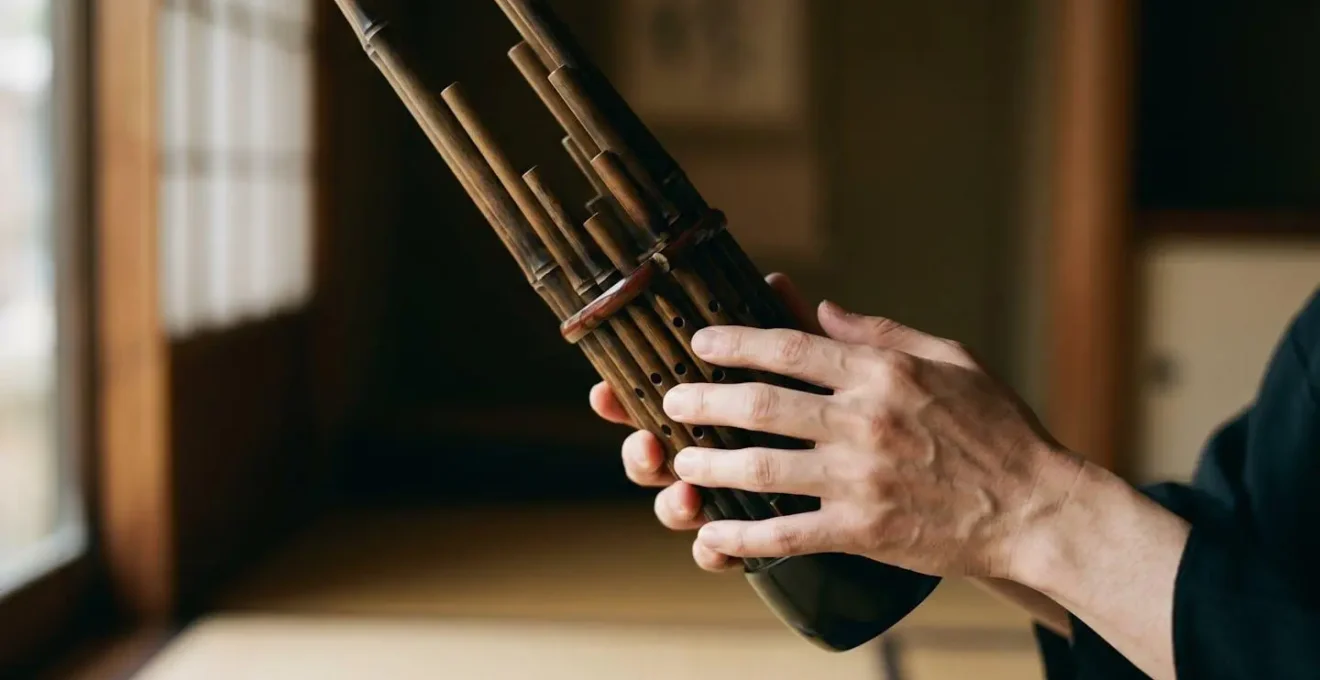
The technique to produce these chords, as seen here, is a kind of slow, graceful dance of the fingers over the pipes. The player’s hands gently cup the instrument, with fingers moving from one hole to another to transition between chords. The movement is not rapid or virtuosic in the Western sense. The goal is to connect the chords seamlessly, creating a gradual shift in the harmonic color, like clouds slowly moving across the sky. The physical act of forming an aitake chord—covering five or six holes simultaneously—requires a deep intimacy with the instrument’s unique circular layout. It is a technique that prioritizes stillness and precision over speed.
Why You Must Roast the Shō Before Playing
One of the most distinctive rituals associated with the Shō is the need to warm it before and during a performance. Players are often seen holding their instruments over a small charcoal brazier (hibachi) or a modern electric heater, slowly rotating it. This is not for show, nor is it a purely spiritual act; it is a critical matter of thermal dynamics and instrument maintenance. The delicate metal reeds are highly sensitive to moisture. The player’s warm breath, especially in a cooler room, will inevitably cause condensation to form on the cold metal, and a wet reed will not vibrate properly, leading to a weak, gurgly sound, or no sound at all.
As explained by Drifter Art & Music, « To prevent condensation on the reed, it must be constantly warmed by turning the instrument with an electric heater or brazier before playing or while not playing. » By keeping the pipes and the reeds inside them warmer than the dew point of the exhaled air, the player ensures that moisture cannot condense. This is a constant, active process. The Shō is warmed before the performance begins, and during any significant rests, the player will return to the heater to maintain the instrument’s internal temperature. It is a gesture of care that underscores the Shō’s status as a living, sensitive entity that requires nurturing.
This meticulous moisture control is the single most important aspect of preserving the instrument’s playability and longevity. After each use, the instrument must be gently dried to prevent any residual moisture from causing corrosion on the reeds or warping the delicate wax and bamboo components. This process transforms the player from a mere musician into a caretaker. You learn to read the instrument’s needs, to feel the slight resistance of a « cold » reed, and to understand the precise amount of warmth needed to bring it to life. This constant, gentle roasting is a reminder that the sound is not a given; it is a potential that must be coaxed into being through knowledge and care.
Action Plan: The Pre-Performance Warming Ritual
- Safety First: Confirm your heat source (traditional hibachi or a modern electric warmer) is stable and placed in a well-ventilated area. Never leave it unattended.
- Initial Assessment: Gently play a few notes by inhaling and exhaling. Listen for any « sticky » or unresponsive reeds that indicate condensation. This establishes your baseline.
- The Slow Rotation: Hold the Shō’s base approximately 10-15 cm (4-6 inches) above the heat source. Rotate it slowly and continuously, ensuring an even distribution of warmth across all pipes.
- Listen for Clarity: After 30-60 seconds of warming, test the reeds again. The sound should become noticeably clearer, brighter, and more responsive as the moisture evaporates from the metal.
- Maintain the Warmth: This is a continuous process. During any extended pauses in performance, return the instrument to the warmer to prevent it from cooling and accumulating new condensation.
Björk and Cage: The Shō in Modern Avant-Garde Music
For an instrument so deeply rooted in a thousand-year-old tradition, the Shō possesses a sound that is uncannily contemporary. Its shimmering, static clusters of harmony resonate with modern aesthetics, from ambient music to electronic drones. It’s no surprise, then, that visionary artists from the Western avant-garde have been drawn to its unique voice. Perhaps the most famous example is the Icelandic artist Björk, who placed the instrument at the heart of her 2005 soundtrack for the film « Drawing Restraint 9. » As noted in the album’s history, « Björk traveled to Japan to study ancient Japanese music and used the shō as the primary instrument in three songs for Drawing Restraint 9. » In tracks like « Holographic Entrypoint, » the Shō is not an exotic flavor; it is the fundamental harmonic and textural element, creating an atmosphere that is both ancient and otherworldly.
Decades before Björk, another pioneer of the avant-garde, John Cage, also fell under the Shō’s spell. His encounter with the instrument and its foremost modern performer, Mayumi Miyata, led to one of his final creative acts. This collaboration was a landmark moment, as it brought the Shō into the world of contemporary Western compositional practice. Cage created several of his famous « Number Pieces » specifically for Miyata, demonstrating that the instrument’s capacity for long, sustained tones and complex harmonic textures was perfectly suited to his explorations of time, space, and sound. He treated the Shō not as a historical artifact, but as a living sound source with limitless potential.
These collaborations are more than just interesting footnotes; they highlight the universal appeal of the Shō’s sonic principles. Both Björk and Cage recognized that the instrument’s sound transcends cultural boundaries. Its ability to create dense, slowly shifting harmonic fields and its focus on texture over melodic virtuosity align perfectly with the goals of much 20th and 21st-century experimental music. The Shō provides a bridge between the ancient imperial court of Japan and the modern concert hall, proving that its « heavenly light » can illuminate any musical space it enters.
Carriers and Modulators: Why FM Sounds Metallic and Glassy
To truly grasp the unique texture of the Shō’s harmony, it can be helpful to draw a parallel to a much more modern invention: Frequency Modulation (FM) synthesis. This is the technology behind the iconic, often metallic and glassy, sounds of 1980s synthesizers like the Yamaha DX7. In FM synthesis, a simple sound wave (the « carrier ») has its frequency rapidly altered by another, unheard wave (the « modulator »). This process creates a host of new, complex, and often non-harmonic sideband frequencies. The result is a sound that is bright, shimmering, and rich in overtones that don’t follow the simple integer ratios of traditional acoustic instruments.
Now, consider the Shō. When an aitake chord is played, five or six pipes sound simultaneously. Each pipe produces a fundamental tone, but also its own unique series of overtones. When these are combined, the interactions between the closely-spaced pitches create a sonic effect remarkably similar to FM synthesis. The pitches « beat » against each other, creating a cascade of psychoacoustic phenomena—sum and difference tones, and a shimmering, vibrant texture. It’s no wonder that a description on Bjorknet states, « The shō’s rich, dense harmonics are a reflection of its unique structure. » This structure, with its multiple reeds sounding at once, functions like a complex acoustic modulator.
This is why the Shō’s chords don’t sound « blurry » or « muddy, » despite their density. Instead, they sound glassy, crystalline, and bright. The sound has a metallic sheen, a quality often sought by electronic musicians but achieved here through purely acoustic means over a thousand years ago. The Shō is, in effect, a biological FM synthesizer. It demonstrates that the principles of complex sound design are universal, discoverable through both digital algorithms and the patient, empirical refinement of bamboo, metal, and wax. The « heavenly light » is the sound of acoustic sidebands flooding the auditory spectrum.
The Didgeridoo Trick: Keeping the Sound Going While Sniffing Air
The Shō’s ability to produce a continuous, unbroken sound is one of its defining characteristics. But it is not the only instrument in the world capable of such a feat. The Australian didgeridoo is famous for its powerful, rhythmic drones that can be sustained indefinitely. However, the *method* used to achieve this continuity reveals a profound philosophical difference in instrument design and playing technique. The key lies in understanding a technique called circular breathing.
A didgeridoo player achieves a continuous drone by mastering circular breathing. This is an advanced technique where the player stores a small amount of air in their cheeks, pushes it out to keep the drone going, and simultaneously takes a quick sniff of air in through their nose to replenish their lungs. It is an act of incredible skill and physical control, often taking years to master. The effort is audible; the sound has a rhythmic, pulsating quality as the player manages this complex breathing cycle. It is a testament to human endurance and ingenuity.
The Shō achieves the same goal of continuous sound through a completely different philosophy: not through advanced player technique, but through elegant instrument design. The work is done by the bidirectional reeds. The player simply breathes in and out, a natural, effortless cycle. There is no need to learn a difficult « trick » like circular breathing. The instrument itself is designed for effortless continuity. This comparison highlights a core principle in the Shō’s design, perhaps reflecting a Taoist concept of *wu wei* or effortless action. The goal is achieved not by striving, but by aligning with the natural flow.
| Aspect | Shō (Japan) | Didgeridoo (Australia) |
|---|---|---|
| Mechanism | Bidirectional free reeds (sound on inhale and exhale) | Circular breathing technique (exhale while inhaling through nose) |
| Design vs. Technique | Built into instrument design—no special breathing required | Requires advanced player technique to master |
| Sound Character | Seamless, ethereal, perfectly smooth sustain | Rhythmic, pulsating drone with earthy quality |
| Sonic Philosophy | Effortless action (wu wei), balanced cycle of breath | Human effort and endurance emphasized |
| Learning Curve | Continuous sound immediate, chord technique advanced | Circular breathing takes months/years to master |
Key Takeaways
- The Shō’s sound is a product of « sonic architecture, » where every material, from 100-year-old smoked bamboo to lead-wax tuning, is deliberately chosen.
- It produces a seamless, continuous sound because its reeds work on both inhalation and exhalation, a design-based solution unlike the technique-based circular breathing of a didgeridoo.
- Its dense « aitake » chords, established 1,000 years ago, create complex, shimmering harmonies that sound strikingly modern and have inspired avant-garde artists like Björk and John Cage.
Gagaku: Preserving the world’s oldest orchestral tradition
To understand the Shō, one must understand Gagaku. The instrument does not exist in a vacuum; it is the heart of a vibrant, living musical ecosystem. Gagaku (雅楽, literally « elegant music ») is the ancient imperial court music of Japan, a tradition that has been performed continuously for over 1,200 years, making it one of the oldest surviving orchestral traditions in the world. Its importance is so profound that Gagaku was inscribed on UNESCO’s Representative List of the Intangible Cultural Heritage of Humanity in 2009, a recognition that it has flourished for more than a millennium.
Within this ancient orchestra, the Shō serves a unique and vital role. It is the harmonic foundation, the provider of the « harmonic firmament. » As Kagurazaka Gayu eloquently puts it, « The Shō produces ethereal chords said to resemble light from the heavens, providing the harmonic firmament upon which other Gagaku instruments paint. » It creates the sacred space, the luminous, unchanging backdrop against which time and melody can unfold. Its sound is the constant, the eternal present of the musical universe.
Preserving this 1,300-year-old oral tradition in the modern world is a monumental task fraught with challenges. According to the Imperial Household Agency, these include sourcing rare materials like the aforementioned susudake bamboo, the dwindling number of master craftsmen capable of building and tuning these complex instruments, and the delicate balance of passing down knowledge through traditional methods while embracing modern documentation. Despite these hurdles, court musicians, collectively designated as « living national treasures » in Japan, work tirelessly to preserve the art form, ensuring that the sound of heavenly light that graced the imperial court in the 8th century can still be heard today. The Shō is more than an instrument; it is a key to a living, breathing time capsule of sound.
By understanding the material, the breath, the harmony, and the history, we can begin to hear the Shō not just as beautiful music, but as a complete philosophical system. The next time you have the chance to listen to a Gagaku performance, either live or recorded, close your eyes and focus on that shimmering, continuous sound. It is the sound of a tradition that has conquered time, a testament to the enduring power of sonic architecture.