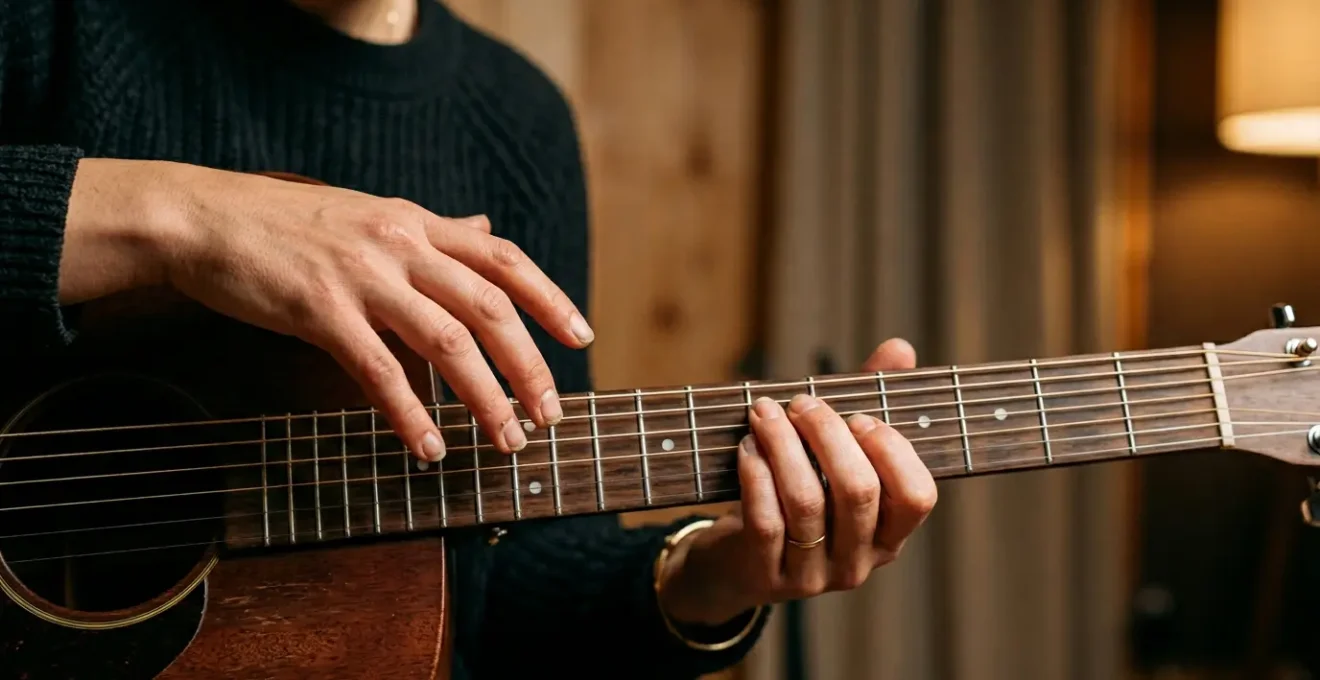
Contrary to popular belief, hand tension isn’t a hand problem—it’s a full-body system failure.
- Chronic tension often originates from poor posture, shallow breathing, and even jaw clenching, not just finger pressure.
- The « no pain, no gain » mindset is destructive; true speed comes from neuromuscular efficiency, not muscular effort.
Recommendation: Stop treating the symptom. Start re-educating your body’s entire system for effortless performance, from the ground up.
For many intermediate musicians, hitting a wall is a familiar and frustrating experience. The notes are there, the desire is strong, but your hands just can’t keep up. They feel tight, achy, or simply exhausted long before your practice session should be over. The common advice is predictable: stretch more, practice with a metronome, take a break. While not incorrect, this advice barely scratches the surface. It treats the symptom—hand tension—without ever diagnosing the root cause. This approach is like fixing a flickering light by repeatedly changing the bulb, without ever checking the faulty wiring in the walls.
The truth is, hand tension is rarely an isolated issue. It is the final, audible alarm of a body-wide system operating inefficiently. The problem might start in your spine, be exacerbated by your breathing, and get amplified by tension you hold in your jaw. Lasting relief and genuine speed don’t come from forcing your fingers to move faster; they come from a fundamental neuromuscular re-education. This means teaching your entire body to work in harmony, prioritizing efficiency over brute force. It’s a shift from a mindset of effort to one of elegance.
This article will guide you through that systemic shift. We won’t just give you more stretches. We will dissect the interconnected chain of tension, from your posture to your mental state. By understanding the ‘why’ behind the ‘what,’ you will gain the tools to dismantle the architecture of your playing-related pain and unlock a new level of speed, endurance, and musical freedom.
This guide explores the interconnected physiological systems that contribute to hand tension. Each section addresses a critical link in the chain, providing actionable, evidence-based strategies to rebuild your technique from a foundation of relaxation and efficiency.
Summary: A Systemic Approach for Musicians
- Sitting or Standing: Which Posture Minimizes Back Pain for Guitarists?
- The 5-Minute Warm-Up That Prevents Tendonitis in Winter
- Why Feeling the Burn is Actually destroying Your Technique
- Pomodoro for Musicians: How Resting Every 25 Minutes Boosts Motor Learning
- Clenching While Playing: The Hidden Cause of Sloppy Rhythm
- Why Relaxing Your Grip Makes You Play Faster
- The Belly Breath: Why Shoulders Should Never Move When You Inhale
- Improving finger coordination for speed and accuracy on your instrument
Sitting or Standing: Which Posture Minimizes Back Pain for Guitarists?
All physical tension begins with a structural frame. For a musician, that frame is your posture. A misaligned spine acts like a kink in a hose, forcing every muscle downstream—including those in your shoulders, arms, and hands—to work harder to compensate. Whether you sit or stand, the goal is not a rigid, military-style straightness, but a dynamic, balanced alignment. Your head should feel like it’s floating lightly atop your spine, your shoulders should be relaxed and down (not pulled back), and your lower back should maintain its natural curve. This creates a clear and efficient pathway for neural signals and physical force to travel from your core to your fingertips.
The common mistake is to focus only on the instrument. We hunch over a guitar or contort our bodies to reach a keyboard, creating a cascade of systemic tension. The principle of postural integrity is universal across all instruments, as it’s about optimizing the human body first. Techniques designed for postural re-education can have profound and lasting effects on playing ability by addressing the foundational source of strain.
Case Study: The Lasting Impact of Postural Re-education
A 2024 study on pianists who undertook 10 lessons in the Alexander Technique—a method focused on improving postural habits—provides clear evidence of this principle. Researchers measured significant improvements in the angles of the head, neck, and trunk, indicating a more extended and efficient spinal alignment. Crucially, these positive postural changes persisted even a month after the lessons concluded, demonstrating that correcting the body’s foundational alignment creates a lasting framework for tension-free playing.
Before you even touch your instrument, take 30 seconds to establish this balanced posture. Feel the connection from your feet on the floor, up through a lengthened spine, to a freely balanced head. This is the first and most critical step in dismantling the chain of tension.
The 5-Minute Warm-Up That Prevents Tendonitis in Winter
A musician’s warm-up is often misunderstood as simply « getting the blood flowing. » While important, especially in colder temperatures, its primary physiological purpose is far more specific: to prepare the tendons for movement. Your tendons are housed in sheaths, and they need to slide smoothly and without friction. A proper warm-up lubricates this system and gently activates the muscles, a process known as tendon gliding. This is not about aggressive stretching, which can be counterproductive on cold muscles, but about gentle, repetitive motion.
Think of your hand and forearm as an intricate system of pulleys and levers. A good warm-up ensures all these parts are moving freely before you demand high-speed, repetitive work from them. Simple exercises that take your fingers and wrist through their full, natural range of motion are far more effective than static, forceful stretches. The goal is to wake up the neuromuscular pathways and ensure the mechanical parts are ready to perform efficiently.

This close-up view visualizes the very structures you are targeting. The goal of a warm-up is to facilitate this smooth, gliding motion, reducing friction and preparing the hand for the complex demands of playing. A simple five-minute routine focusing on gentle finger bends, wrist circles, and tendon gliding exercises can dramatically reduce the risk of strain and inflammatory injuries like tendonitis.
Why Feeling the Burn is Actually destroying Your Technique
In athletics, the mantra « no pain, no gain » is often celebrated. For a musician, applying this philosophy is a direct path to injury and technical ruin. The « burn » you feel when practicing a difficult passage is not a sign of progress; it’s your body’s distress signal. It indicates a buildup of lactic acid due to oxygen-starved muscles, a direct result of excessive, static tension. Ignoring this signal and « pushing through the pain » only reinforces poor neuromuscular habits and can lead to chronic injury. The prevalence of this issue is staggering; research indicates that between 50 and 76 percent of professional musicians report sustaining musculoskeletal injuries during their careers.
Pain is your body’s most valuable feedback mechanism. When you feel it, the correct response is not to endure it, but to stop and diagnose its cause. Is your wrist bent at an extreme angle? Are your shoulders creeping up to your ears? Are you using a death grip on the instrument? True progress is achieved by identifying and eliminating these inefficiencies, not by building a tolerance for discomfort. Speed and endurance are byproducts of efficiency, not brute force.
No Pain, No Gain is a disastrous policy for a musician. If it hurts, back off.
– University of Nebraska-Lincoln RSI Resource Center, Musicians and Injuries Prevention Guidelines
The moment you feel that familiar ache or burn, stop. Take a deep breath, consciously release the tension in your hands, shoulders, and jaw, and re-approach the passage with a focus on relaxation. This deliberate practice of listening to your body’s feedback is what separates sustainable technique from a path to injury.
Pomodoro for Musicians: How Resting Every 25 Minutes Boosts Motor Learning
The brain learns new motor skills not during the act of practice itself, but during the periods of rest that follow. This process, known as memory consolidation, is when neural pathways are strengthened and refined. Practicing for hours without a break is therefore highly inefficient; it leads to physical fatigue and mental saturation, diminishing the returns of your efforts. A structured approach to rest is essential for maximizing motor learning.
The Pomodoro Technique, typically used for productivity, is a perfect framework for musicians. It involves focused practice intervals (e.g., 25 minutes) followed by short, mandatory breaks (e.g., 5 minutes). This structure prevents the onset of deep fatigue and provides the brain with the regular downtime it needs to consolidate what you’ve just practiced. The benefits are not just theoretical; a 2023 study found that students using systematic breaks reported lower fatigue and higher concentration, achieving similar results in less time compared to those who took breaks whenever they felt like it. This demonstrates the power of pre-determined rest for efficient learning.
The key, however, is what you do during those breaks. Mindlessly scrolling on your phone can erase the benefits. The most effective breaks involve a change of state that still supports the learning process. Stepping away from the instrument and engaging in light physical movement or, even better, structured mental rehearsal, can supercharge the consolidation process.
Action Plan: 5-Minute Mental Rehearsal for Motor Consolidation
- Find a Quiet Space: Step away from your instrument. Stand up, stretch gently, and physically disengage from the playing position.
- Auditory Rehearsal: Close your eyes and ‘hear’ the passage played perfectly in your mind. Focus on the correct notes, precise rhythm, and desired tonal quality.
- Visualize Technique: ‘See’ your hands moving on the instrument with absolute economy and relaxation. Envision no wasted motion and no excess tension.
- Kinesthetic Sensation: Imagine the physical feeling of effortless playing—the light touch of fingers on keys or strings, using only the ‘minimum effective pressure’ needed for a clean sound.
- Confirm the Blueprint: Take one deep, diaphragmatic breath, holding this mental image of perfect, tension-free execution before returning to your instrument.
Clenching While Playing: The Hidden Cause of Sloppy Rhythm
One of the most overlooked sources of hand tension has nothing to do with the hands at all: it’s the jaw. Many musicians, when concentrating on a difficult passage, unconsciously clench their teeth or tighten their jaw. Due to the way our brains are wired, this tension doesn’t stay localized. It triggers a phenomenon known as sympathetic tension, where tension in one muscle group radiates to others, most commonly the neck, shoulders, and, critically, the hands.
This sympathetic tension is incredibly detrimental. It restricts the fine motor control necessary for clean articulation and precise rhythm, making your playing sound stiff and sloppy. It also causes your hand muscles to fatigue much faster. You might be practicing with a perfectly relaxed hand position, only to find it tightening up against your will. The culprit is often a tense jaw you’re not even aware of. Becoming conscious of this connection is the first step toward breaking the cycle.

This image illustrates the neurological link between facial and manual control. A relaxed jaw promotes a relaxed hand. To cultivate this, periodically check in with your face as you play. Is your brow furrowed? Are your lips pursed? Is your jaw tight? A simple cue is to let your jaw hang slightly open, with your tongue resting gently on the bottom of your mouth. By consciously releasing tension in your face, you send a powerful signal to the rest of your body—especially your hands—to relax as well.
Why Relaxing Your Grip Makes You Play Faster
The intuitive but incorrect assumption for many players is that a stronger grip equals more control and power. The physical reality is the exact opposite. Excessive pressure, whether on a fretboard, a keyboard, or a bow, creates muscular co-contraction. This means your agonist muscles (the ones doing the work) are fighting against your antagonist muscles (the ones that oppose the motion). This internal battle wastes a tremendous amount of energy, slows you down, and is a primary cause of overuse injuries. As one analysis of overuse injuries in string musicians notes, pressing down just 20-30% harder than necessary can have a cumulative, damaging effect.
The secret to speed and endurance is to use the Minimum Effective Dose (MED) of pressure. This is the absolute least amount of force required to produce a clean, clear, and buzz-free note. Anything more is wasted effort that actively hinders your technique. Finding and internalizing this feeling of minimum pressure is a cornerstone of proprioceptive awareness—your body’s internal sense of effort and position. It requires shifting your goal from « playing the note » to « playing the note with the least possible work. »
This can feel strange at first, as you may be accustomed to the perceived security of a firm grip. A dedicated exercise is needed to recalibrate your senses. Here is a simple protocol to find your personal MED:
- Place your fingers lightly on the keys or strings without applying any downward force.
- Gradually and slowly increase pressure until you achieve the minimum force needed for a clean, sustained note. Pay close attention to this tipping point.
- Mentally mark this pressure level as your 100%—your ‘minimum effective dose’.
- Practice playing simple scales or passages using only this level of pressure, consciously resisting the urge to press harder.
- Pretend your hands are incredibly lazy and want to do as little work as possible.
- Allow your fingers to rest comfortably on the playing surface, avoiding the tendency to lift them high in the air between notes.
Mastering this light touch transforms your playing. It conserves energy, frees up your muscles for rapid movement, and dramatically reduces the risk of strain.
The Belly Breath: Why Shoulders Should Never Move When You Inhale
Your breathing pattern is a direct regulator of your nervous system and a major contributor to physical tension. Many people, especially when concentrating or anxious, adopt a pattern of shallow, « vertical » breathing. This involves using the muscles of the neck and shoulders to lift the chest and collarbones to inhale. This type of breathing is inefficient, provides less oxygen, and, most importantly, creates significant tension directly in the shoulder girdle—tension that travels straight down your arms and into your hands.
The correct, most efficient way to breathe is diaphragmatic breathing, or « belly breathing. » This involves using the large, dome-shaped diaphragm muscle at the base of your lungs. As you inhale, the diaphragm contracts and moves downward, pulling air into the lower lungs and causing your abdomen to expand. Your shoulders and chest should remain almost completely still. This pattern is how we breathe as infants, but stress and poor habits often overwrite it. Reclaiming this natural pattern is vital for a musician seeking to eliminate tension.
Case Study: The Alexander Technique’s Impact on Breathing and Tension
The Alexander Technique places a strong emphasis on breathing coordination as a means to reduce unnecessary muscular effort. By teaching musicians proper alignment, it allows the diaphragm to function without restriction. When the neck is free and the ribcage can expand naturally, diaphragmatic breathing improves, leading to greater breath capacity and control. This method has proven especially effective for wind players and singers, but its core principle applies to all musicians: proper breath support through the diaphragm, rather than the shoulders, dramatically reduces performance anxiety and systemic physical tension.
To practice this, place one hand on your chest and the other on your belly. Inhale slowly through your nose. The hand on your belly should move outward, while the hand on your chest remains still. Exhale slowly. Making this your default breathing pattern while you play will keep your shoulders relaxed and your hands free from the unnecessary tension caused by vertical breathing.
Key Takeaways
- Tension is Systemic: Hand pain is often a symptom of a full-body issue, originating from poor posture, breathing, or even jaw clenching.
- Efficiency Over Effort: Speed and endurance come from neuromuscular efficiency and using the minimum force necessary, not from « pushing through the pain. »
- Rest is Active Learning: Structured breaks and mental rehearsal are critical for motor skill consolidation and preventing fatigue.
Improving finger coordination for speed and accuracy on your instrument
After addressing the systemic sources of tension—posture, breath, and mindset—we can finally focus on the fingers themselves. True finger independence is not about strength, but about eliminating sympathetic tension. This is the tendency for non-playing fingers to tense up or move in « sympathy » with the finger that is actively playing a note. This unconscious co-contraction is a major source of sloppiness, limits speed, and is a significant factor in the high rate of playing-related injuries. Indeed, studies demonstrate that up to 89% of musicians experience occupational injuries during their careers, with wrist and hand pain being the most common complaints.
The goal is to teach each finger to act as an independent agent while the rest of the hand remains completely relaxed and passive. This requires slow, conscious, and highly focused practice. It’s a mental exercise as much as a physical one, demanding that you bring your full awareness to the state of your hand and actively suppress any unwanted tension. This level of proprioceptive awareness is the hallmark of a refined technique, allowing for the fluid and seemingly effortless playing you see in virtuosos.
A specific drill can help you isolate and eliminate this sympathetic tension. Practice this slowly and deliberately for just a few minutes each day, and you will build a new foundation of control and relaxation in your hands.
- Hold down one finger on a single note with moderate, but not excessive, pressure.
- Consciously focus on keeping all other non-playing fingers completely loose, soft, and relaxed. They can rest lightly on the playing surface.
- Slowly, and with minimal effort, move another finger to play a different note while maintaining the first finger’s position and the overall relaxation of the hand.
- Notice any tendency for the non-playing fingers to tense up, lift, or curl in ‘sympathy’ with the active finger. When you feel this, stop and consciously release that tension.
- Practice this independence drill daily, rotating through different finger combinations until the relaxation of non-active fingers becomes automatic.
By shifting your focus from effort to efficiency and from isolated symptoms to the interconnected system, you can fundamentally transform your relationship with your instrument. Start today by applying these principles not as quick fixes, but as the new foundation for every practice session. This is the path to playing faster, longer, and with the freedom that only comes from a body and mind working in complete harmony.