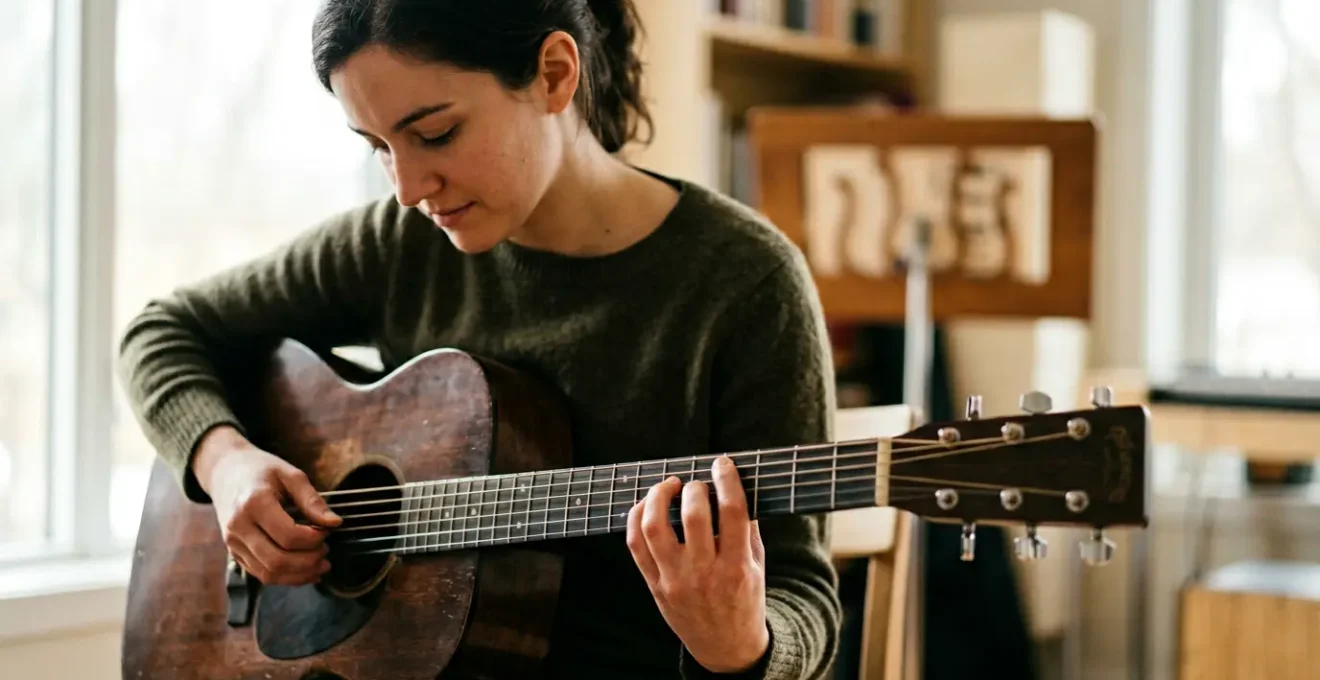
Your 45 minutes of daily practice are only effective if you treat them like a surgical intervention, not a jam session.
- True progress comes from isolating weaknesses and attacking them with slow, deliberate repetition.
- Systematic rest and self-recording are non-negotiable tools for accelerating motor learning.
Recommendation: Stop « playing » and start training. Structure every minute of your session with the framework in this guide.
The 45-minute countdown starts. You sit down with your instrument, filled with determination. But what happens next is what separates marginal improvement from exponential progress. For the busy adult or student, every second of practice time is a precious commodity that cannot be squandered.
The common advice— »be consistent, » « use a metronome, » « break it down »—is not a strategy; it is the bare minimum. Too many aspiring musicians fall into the trap of simply playing through songs they mostly know, a passive act that feels like work but yields little fruit. This is a monumental waste of your time and potential. The objective is not to « feel good » about practicing; it is to get quantifiably better.
The key isn’t playing more; it’s practicing with surgical precision. We must discard the romantic notion of unstructured creativity during practice time and adopt a new guiding principle: stop ‘playing’ and start *programming*. Your brain is a supercomputer, and your hands are the hardware. Practice is the act of writing clean, efficient code. It is a series of targeted, neuroscientifically-backed interventions designed to build skill with ruthless efficiency.
This guide will dissect your 45-minute session into a disciplined, results-oriented system. We will cover the optimal allocation of time, the counter-intuitive power of slow practice, the unflinching feedback of self-recording, and the psychological framework that makes skills stick. Prepare to transform your approach and unlock the progress you are capable of.
To navigate this disciplined approach, we have structured the essential components of a hyper-efficient practice session. The following sections break down each core principle into an actionable strategy, ensuring every minute of your time is dedicated to tangible improvement.
Summary: A Disciplined Framework for Rapid Musical Progress
- Technique, Repertoire, Improvisation: Balancing Your Session
- Why Playing at 50% Speed Is 200% More Effective?
- The Brutal Mirror: Why Listening Back Fixes Errors Faster
- Isolating the Problem: Don’t Play the Whole Song for One Mistake
- Positive Reinforcement: Why the Last Thing You Play Sticks
- Pomodoro for Musicians: How Resting Every 25 Minutes Boosts Motor Learning
- Consistency vs Duration: Why Short Sessions Build Reading Reflexes
- Why disciplined drills are the unsexy secret to musical freedom?
Technique, Repertoire, Improvisation: Balancing Your Session
A 45-minute session cannot be a monolithic block. It must be a dynamic allocation of resources targeting different facets of musicianship. A common failure is over-focusing on one area—typically repertoire—while technique and creativity atrophy. A balanced session is not a compromise; it’s a strategic force multiplier. We will divide our 45 minutes into three distinct zones: Technical Drills (15 min), Repertoire Work (20 min), and Creative Application/Improvisation (10 min).
This structure is based on the principle of interleaved practice. Instead of practicing one skill block for an extended period (« blocked practice »), you switch between different but related tasks. This method feels harder in the moment and may even lead to more errors during the session, but it is unequivocally superior for long-term retention and flexible application of skills. The cognitive effort required to switch between a scale pattern, a difficult passage of a Bach sonata, and a blues improvisation forces your brain to build more robust and accessible neural pathways.
The science is clear on this: research from Western University demonstrates that interleaved practice, despite feeling less fluid during training, significantly boosts long-term learning. Your 15 minutes of technique aren’t just for warm-ups; they prime the motor skills for the repertoire. The repertoire work then provides the context for those skills. Finally, the improvisation block forces you to take those structured patterns and make them your own, testing the true internalization of the material. This is not three separate practices; it’s one integrated system for growth.
Embrace the mental gear-shifting. The initial discomfort is a sign that your brain is actively forging new connections, moving beyond rote memorization to genuine musical understanding.
Why Playing at 50% Speed Is 200% More Effective?
The single greatest accelerator of skill acquisition is also the most resisted: radically slow practice. The urge to play at tempo is driven by ego, not by the principles of motor learning. When you make a mistake at full speed, you are not practicing the passage; you are practicing the mistake. Your brain and muscles are encoding the error, making it more likely to happen again. To achieve flawless execution, you must first give your brain a flawless model to encode.
Playing at 50% speed, or even slower, is a surgical intervention. It dramatically reduces the cognitive load on your brain, freeing up mental bandwidth to move from « surviving » the passage to « analyzing » it. At this speed, you can meticulously observe every detail: the precise angle of your fingers, the evenness of your tone, the relaxation in your shoulders, the exact rhythmic placement of each note. You are transforming a frantic physical act into a mindful, deliberate process of neurological programming.
This paragraph introduces a concept complex. To truly grasp the level of detail required, it is useful to visualize the instrument not as a whole, but as a landscape of micro-mechanisms. The illustration below captures this philosophy of precision.
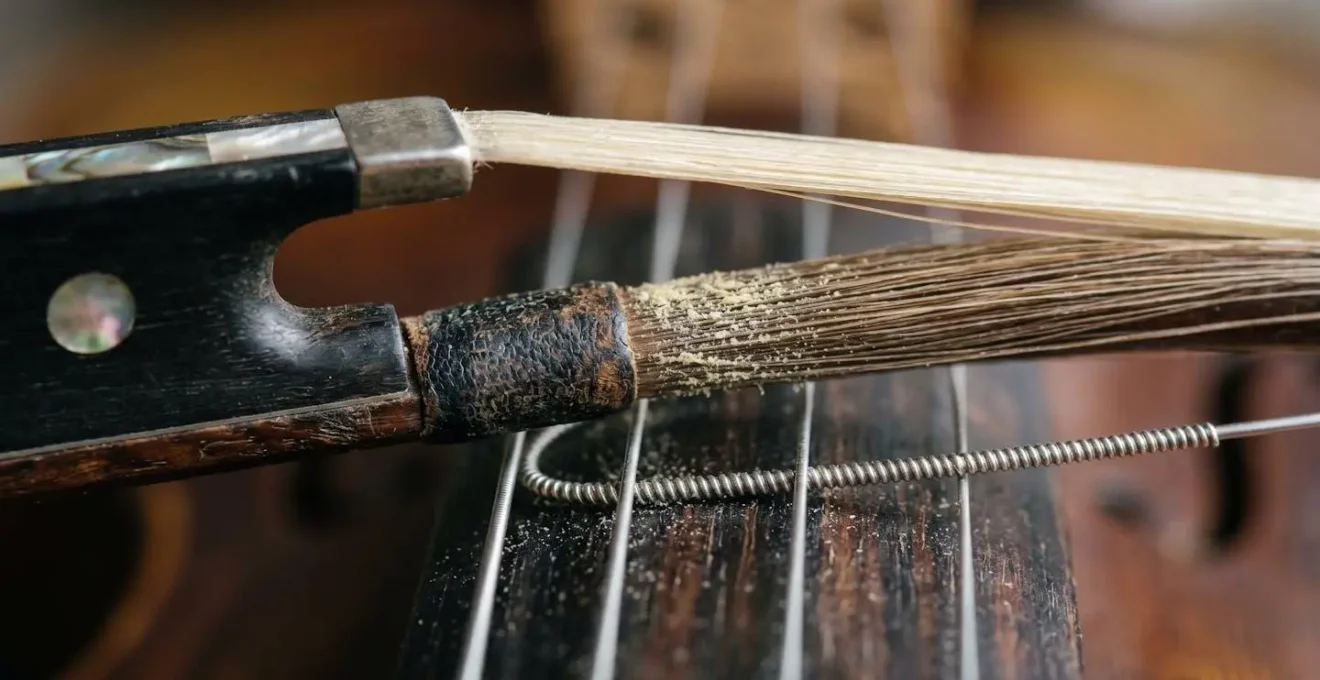
As this image suggests, mastery lies in the details. A 2022 study in Psychology of Music found that a slower tempo allows for a reduction of cognitive load and detailed attention to feedback, which directly improves motor control. It is at this snail’s pace that you build the unshakable foundation for speed. You are not practicing slowly; you are practicing *correctly*, at the only speed where correctness can be guaranteed. Speed is not the goal; it is the byproduct of a perfectly encoded motor program.
Only when a passage is absolutely perfect—in rhythm, dynamics, and articulation—five times in a row at 50% speed should you even consider increasing the metronome by a few BPM. This is the discipline that forges virtuosity.
The Brutal Mirror: Why Listening Back Fixes Errors Faster
While playing, you are operating under a divided-attention cognitive load. You are reading music, managing physical technique, listening for pitch, and maintaining rhythm simultaneously. Under these conditions, your brain is an unreliable narrator. It filters out a shocking number of small errors in intonation, timing, and articulation. You don’t hear what you *actually* played; you hear what you *intended* to play. This is where the brutal, objective honesty of a recording becomes your most powerful diagnostic tool.
Listening back to a recording of your own playing removes the task of execution, allowing 100% of your cognitive resources to be dedicated to critical listening. It is the musical equivalent of a replay review in sports. You will be confronted with every rushed note, every slightly out-of-tune bend, and every moment of rhythmic hesitation. This can be a humbling experience, but it is the fastest path to identifying and eliminating recurring errors that have become ingrained in your muscle memory.
The goal is not to produce a studio-quality album, but to gather data. A simple smartphone recording is all you need. Record a small, problematic section, then listen back with a critical ear. What you thought was a minor « blip » may reveal itself as a fundamental misunderstanding of the rhythm. What felt « expressive » may sound sloppy and uncontrolled. This objective feedback loop is non-negotiable for anyone serious about progress. To structure this analysis, use a consistent protocol.
Your 5-Step Recording Audit Protocol: Using the Brutal Mirror
- Record a ‘One-Take’ Performance: Choose a short, challenging passage (8-16 bars). Play it from start to finish without stopping, as if in a real performance. This captures your current, unfiltered skill level.
- Listen Without Your Instrument: Put your instrument down. Listen to the recording with your full attention. Your only job is to identify the single biggest discrepancy between your intention and the result.
- Isolate the Primary Error: Don’t try to fix everything. Pinpoint the most significant issue. Is it a rhythmic inaccuracy? A wrong note? A tonal inconsistency? Name the specific bar or beat where it occurs.
- Diagnose the Root Cause: Why did the error happen? Was it an inefficient fingering? A lack of breath support? A misunderstanding of the key signature? Be a detective and find the ‘why’ behind the ‘what’.
- Prescribe a Micro-Drill: Create a tiny, targeted exercise that addresses only the root cause. Loop the two notes surrounding the error. Practice the specific hand shift. Play the rhythm on a single note until it’s perfect.
The recording does not lie. Embrace its brutal feedback, and you will fix problems in one session that might have otherwise persisted for months.
Isolating the Problem: Don’t Play the Whole Song for One Mistake
The most common and inefficient practice habit is « run-through repetition. » A musician plays a piece from the beginning, makes a mistake in bar 32, gets frustrated, and starts over from bar 1. In a five-minute piece, this means they spend 95% of their time practicing the parts they can already play, while giving the problematic bar only a fleeting, frustrated attempt. This is not practice; it is a recipe for reinforcing bad habits and building frustration.
The principle of deliberate practice, a concept extensively studied by researchers like K. Anders Ericsson, demands a different approach. The core idea is to move away from mindless repetition and engage in highly structured activities designed specifically to improve performance. It involves identifying a very specific weakness, devising a strategy to overcome it, and applying focused, repetitive effort to that area alone. Playing the entire song to fix one mistake is the polar opposite of this principle.
Your job as an efficient practitioner is to become a master diagnostician. When an error occurs, you must stop immediately. Your focus should then narrow like a laser beam onto the site of the error. Is the problem a single note? A two-note transition? A four-beat phrase? Define the smallest possible unit that contains the mistake. This is your new practice loop. You might spend ten minutes of your session on just two bars of music, and this is an infinitely better use of time than ten run-throughs of the entire piece.
Stop rewarding yourself with the easy parts. True progress lies in the disciplined, targeted assault on your weaknesses. The satisfaction comes not from playing the song, but from conquering the passage that stood in your way.
Positive Reinforcement: Why the Last Thing You Play Sticks
The end of a practice session is a psychologically critical moment. Our brains have a cognitive bias known as the recency effect, where we tend to remember the last items in a series better than the ones in the middle. In a musical context, this means that the final notes you play and the emotional state you’re in when you put your instrument down have a disproportionate impact on your memory of the session and your motivation for the next one.
Many musicians end their practice on a note of frustration. They attempt a difficult passage one last time at a speed they can’t handle, fail, and pack up in a huff. This is a catastrophic error. It reinforces the mistake in your muscle memory and creates a negative psychological association with your instrument, making it harder to feel motivated to practice the next day. You are effectively programming your brain to link your instrument with failure.
The disciplined musician must seize control of this final moment. The last 3-5 minutes of your 45-minute session should be strictly reserved for positive reinforcement. The goal is to end on an undeniable success. This does not mean playing something easy; it means taking a section you have been working on and playing it at a speed where you are 100% confident you can play it perfectly. It might be that difficult passage from bar 32, but played at 50% speed. It might be a simple scale played with beautiful tone and perfect rhythm.
You walk away from the instrument with the feeling of success and the correct motor program as the most recent memory. This small piece of psychological discipline pays massive dividends in long-term motivation and skill retention.
Pomodoro for Musicians: How Resting Every 25 Minutes Boosts Motor Learning
The myth of the marathon practice session is one of the most damaging in music education. The belief that « more is more » leads to diminishing, and often negative, returns. Your brain’s ability to maintain the high level of focus required for deliberate practice is a finite resource. Practicing in a state of mental fatigue is not just ineffective; it’s counterproductive. You begin to make sloppy mistakes, which then get encoded into your muscle memory.
A more effective model is to treat your practice like interval training. The Pomodoro Technique, a time management method developed by Francesco Cirillo, is perfectly suited for this. The structure is simple: 25 minutes of intense, uninterrupted focus on a single task, followed by a 5-minute break completely away from the task. For our 45-minute session, this could be one 25-minute block and one 15-minute block, separated by a 5-minute rest.
During the 25-minute work interval, your focus must be absolute. No phone notifications, no distractions. You are fully engaged in deliberate practice. Then, the 5-minute break is non-negotiable. It is during this rest period that the magic happens. Your brain consolidates the information and motor patterns it has just learned—a process known as synaptic consolidation. Stepping away from the instrument allows this crucial background process to occur without interference.
This paragraph highlights the importance of the practice environment itself—it should be a space that encourages both focus and rest. The following image captures this ideal of a serene, prepared space.
Even Ericsson’s research on elite musicians revealed that they rarely engaged in deliberate practice for more than an hour at a time and limited their total daily practice to 4-5 hours. These are the top performers in the world, yet they instinctively understand the need for strategic rest. The 5-minute break isn’t laziness; it is an active and essential part of the learning process. Get up, stretch, get a glass of water, and look out a window. Do not check your phone. Let your mind rest so it can be ready for the next focused sprint.
This structured approach respects your brain’s biological limits, leading to faster, more durable learning than any brute-force, non-stop session ever could.
Consistency vs Duration: Why Short Sessions Build Reading Reflexes
For the busy adult, finding a multi-hour block to practice is a logistical nightmare. This often leads to an « all or nothing » mentality: « If I don’t have at least an hour, I won’t bother. » This is a profoundly flawed and self-defeating mindset. When it comes to building the fast, automatic reflexes required for skills like sight-reading, the frequency of practice is far more important than the duration of any single session.
Think of building a skill like creating a path in a forest. One four-hour hike once a month will leave little trace. But walking the same path for 15 minutes every single day will soon create a well-worn, permanent trail. Your neural pathways work in exactly the same way. The goal of daily practice is not just to learn new material, but to reinforce the connections made the day before, preventing the natural process of forgetting. A short, daily session tells your brain, « This information is important. Do not discard it. »
This is especially true for sight-reading. Sight-reading is not about slowly deciphering notes; it is a reflex. It depends on the instant recognition of patterns—intervals, chord shapes, rhythmic figures. These reflexes are built through high-frequency, low-duration exposure. A 15-minute daily session dedicated solely to reading new, simple music will do more for your reading ability in a month than a two-hour session every Saturday.
Abandon the idea that you need a huge chunk of time to make progress. A focused, consistent 20-minute daily session is infinitely more valuable than a sporadic two-hour cram session. It’s the daily reinforcement that builds the unbreakable reflexes of an expert musician.
Key Takeaways
- Slow practice (50% speed) isn’t for beginners; it’s a tool for experts to ensure flawless motor encoding.
- Recording yourself is a « brutal mirror » that provides the objective feedback your brain needs to correct errors.
- A 25-minute focus burst followed by a 5-minute rest (Pomodoro) is more effective for motor learning than a 60-minute slog.
Why disciplined drills are the unsexy secret to musical freedom?
The ultimate goal of any musician is freedom: the ability to express the music that is in their head, unhindered by technical limitations. A common misconception is that this freedom is achieved through unstructured, « creative » exploration. In reality, the opposite is true. True, uninhibited musical freedom is built upon a foundation of brutally disciplined, often « unsexy, » technical work. The drills, the scales, the arpeggios—these are not musical prisons; they are the keys that unlock the cage.
Every technical drill is designed to solve a specific physical problem. A scale is not just a series of notes; it is a training module for smooth fingering transitions, even tone production, and rhythmic precision across the entire range of your instrument. An arpeggio drill isn’t about playing a chord; it’s about training your hand to find and execute chord shapes instantly and accurately, anywhere. When you automate these fundamental mechanics through disciplined repetition, you free up your conscious mind.
When your technique is so deeply ingrained that it becomes an unconscious reflex, your brain is no longer bogged down with the « how » of playing. It is liberated to focus entirely on the « what » and the « why »—musicality, expression, phrasing, and interacting with other musicians. The pianist doesn’t have to think about how to shape their hand to play a G-major chord; they just think « G-major, » and the hand responds instantly. This is the freedom that discipline buys you.
Case Study: The Pianist and the Power of Mock Performance
This principle is not just theory; it is borne out in observation of expert performers. A compelling 2021 study of piano majors at an Australian conservatory provides a stark example. When learning new pieces, the top-ranked pianist was the only one who consistently practiced by attempting full, ‘mock’ performances without stopping. This drill simulated the real-world pressure of a performance, forging a level of resilience the others lacked. The same pianist also noted that their teacher frequently discussed practice *methods*, giving them a strategic plan. The other students were largely left to their own devices and performed worse. The lesson is clear: disciplined, strategic drills, including performance simulation, are what separates the top performers from the rest.
Do not resent the drills. See them for what they are: the most direct path to the effortless, expressive freedom you seek. The discipline of today is the liberty of tomorrow. The framework is laid out. The only variable left is your discipline. Apply this structure starting with your very next session and measure the results.