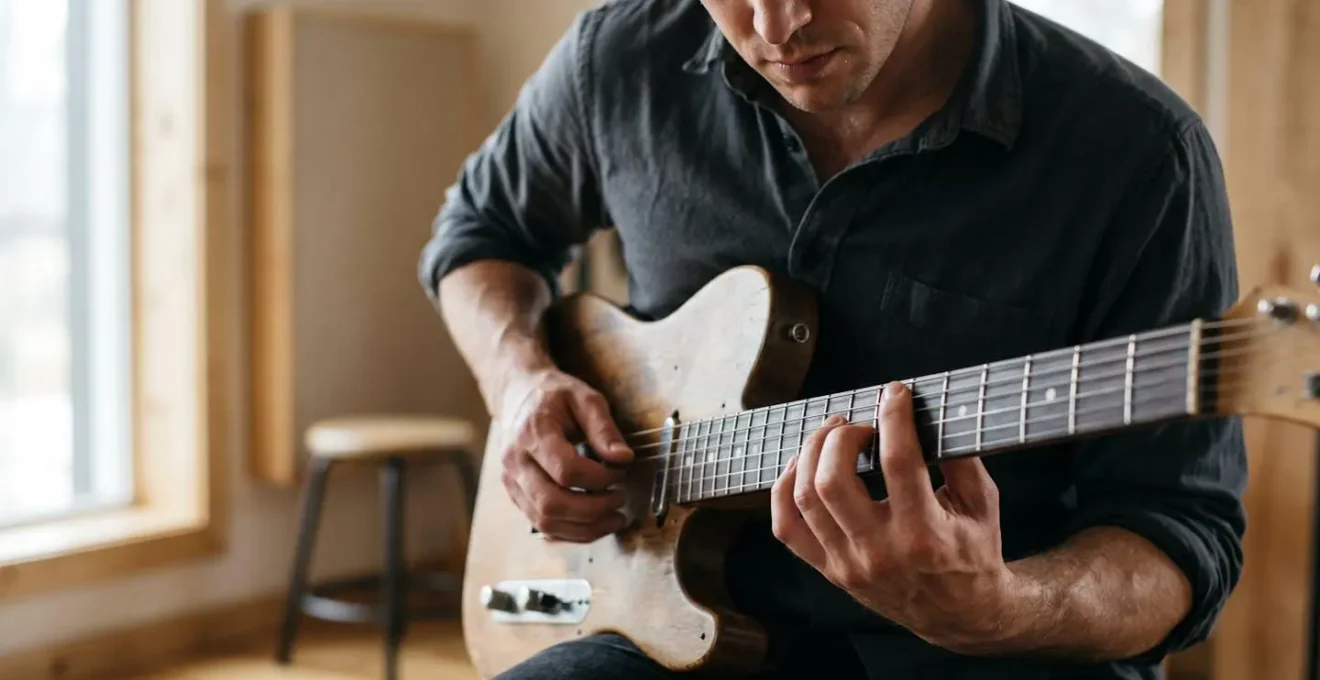
The path to musical freedom isn’t found in aimless jamming; it’s built through the rigorous, unsexy discipline of deliberate practice. This is the non-negotiable truth.
- Mechanical drills build neurological pathways that aimless playing cannot.
- The metronome is a truth-teller, not a prison; it exposes every flaw in your timing.
- True knowledge lies in understanding musical formulas, not just memorizing fretboard shapes.
Recommendation: Stop ‘playing’ and start training. Weaponize your practice with the methods in this guide to build an unbreakable internal clock.
You pick up your instrument, ready to create. You want to channel the fire of rock or the sophistication of jazz. But what comes out is the same tired lick you’ve played a thousand times, a faint echo of the music in your head. The frustration is real. You’ve been told to ‘feel it,’ to ‘just jam over backing tracks,’ to ‘learn more scales.’ You’ve done it all, yet you still feel trapped in a cage of your own making, unable to truly improvise.
Here’s the hard truth from your new drill sergeant: That advice is a lie. Creative freedom is not the absence of structure; it is the ultimate reward for it. The improvisational masters you admire didn’t get there by accident. They got there through thousands of hours of disciplined, repetitive, and frankly, unsexy drills. They didn’t run from the boring stuff; they weaponized it. They understood that every scale run, every arpeggio, every click of the metronome was another brick in the foundation of their freedom.
This is not a list of fun ‘hacks.’ This is your new training manual. We will break down why your current practice is failing. We will dismantle the myth of ‘natural talent’ and replace it with the ironclad reality of deliberate work. We will transform scales from a chore into a weapon, arpeggios from an exercise into a map, and the metronome from an annoyance into an unbreakable ally. It’s time to stop wishing for freedom and start earning it.
This guide provides a clear, no-excuses framework for transforming your practice from aimless noodling into a targeted mission. The following sections break down the essential drills and mindset shifts required to build true musical command.
Summary: Forging Freedom Through Unsexy Discipline
- Rhythms and Accents: Making Scales Less Boring to Play
- Connecting the Dots: How Arpeggios Unlock the Fretboard
- The Truth Teller: Why You Must Practice with a Click
- Deliberate Practice vs Just Playing: Quality Over Quantity
- Playing it in F#: The Ultimate Test of Knowledge
- The Mistake of Learning Scales by Shape Instead of Formula
- Silencing the Metronome: Testing If You Keep Time When It Stops
- How to Improve Your Internal Clock and Play « in the Pocket »?
Rhythms and Accents: Making Scales Less Boring to Play
Your first command is to stop ‘playing’ scales and start attacking them. The mind-numbing repetition of running up and down a scale is the fastest way to kill your motivation. The problem isn’t the scale; it’s that you’re treating it like a ladder instead of a rhythmic playground. To make a scale musical, you must inject it with rhythm. This is non-negotiable.
Start with a simple C major scale. Now, instead of playing straight quarter notes, play it in eighth notes. Then triplets. Then sixteenths. Feel the difference in your fingers and your brain. Now, add accents. Play the scale in eighth notes, but accent every third note. Then every fourth. You are no longer just climbing notes; you are creating patterns. You are forcing your brain and hands to coordinate in new ways, building rhythmic dexterity that translates directly to improvisation. This is how you weaponize a simple scale into a powerful tool for developing your groove.
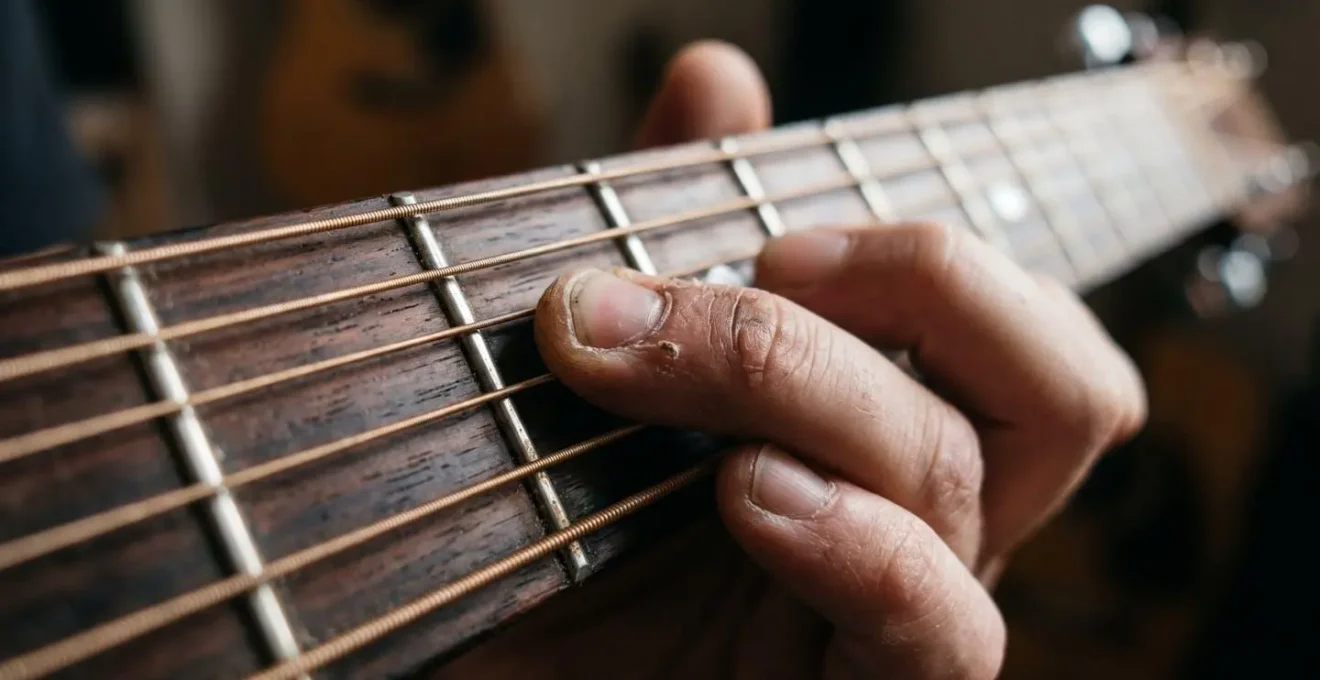
As the image above suggests, the focus is on the physical act of creating varied patterns. Each accented note is a deliberate punch, a conscious choice. You are training your hands to be a percussive engine, not just a note selector. This isn’t about speed; it’s about control. By practicing with different subdivisions and accent patterns, you are building a vocabulary of rhythmic ideas that will spontaneously appear when you improvise. You are turning a boring drill into a source of creative fuel.
Connecting the Dots: How Arpeggios Unlock the Fretboard
If scales are the roads on your musical map, arpeggios are the landmarks. Simply knowing the scales over a chord progression is not enough. Great improvisers don’t just play ‘in key’; they outline the harmony. They hit the critical notes of each chord—the root, 3rd, 5th, and 7th—at the precise moment the chord changes. This is the function of arpeggio practice. It is the bridge between playing scales and actually making music.
An arpeggio is simply the notes of a chord played one at a time. Practicing them teaches your fingers and your ears to connect melodic lines to the underlying chords. You stop seeing the fretboard as a series of disconnected scale shapes and start seeing it as a web of harmonic possibilities. Your solos begin to sound intentional, as if they belong to the song, rather than being layered on top of it. This is how you gain fretboard command.
The goal is to move beyond seeing arpeggios as vertical shapes and start using them to create horizontal melodic lines that flow through a chord progression. A powerful method for this is the ‘target note’ approach.
Case Study: The Target Note Improvisation Method
A concrete teaching method involves taking a two-chord vamp (like Am7 to D7) and practicing the ‘target note’ approach. You begin by playing the Am7 arpeggio slowly in one position. When the chord changes to D7, your mission is to identify a note from the Am7 arpeggio that is also in the D7 chord. In this case, the note ‘A’ is the root of Am7 and the 5th of D7, making it a perfect common tone. By consciously targeting this note during the change, you train your ear and fingers to outline the harmony in real-time. This exercise transforms arpeggios from static shapes into dynamic pathways, embodying the principle: ‘stop practicing shapes, start practicing movement’ for true fretboard freedom.
The Truth Teller: Why You Must Practice with a Click
There is no room for negotiation on this point: you will practice with a metronome. It is not an optional accessory. It is not a suggestion. The metronome is the ultimate, objective Truth Teller. It has no ego, it does not care about your feelings, and it will mercilessly expose every single flaw in your timing. Your sense of time is likely not as good as you think it is. The click is the mirror that shows you the unfiltered truth, and using it consistently is the only way to develop a professional, ‘in the pocket’ feel.
You might think the constant ticking is restrictive, but the opposite is true. According to professional music educators, the metronome should be used for as much as 90% of practice time because it provides a solid foundation. This rhythmic stability allows your mind to focus on other critical aspects of your playing, such as dynamics, tone, and phrasing.
As the experts at Musical U point out, the metronome does more than just keep you in line. It actively forges your internal clock.
While that steady tick-tock of the metronome keeps you in time and passively develops your internal metronome, your mind is actually freed up to focus on other aspects of music.
– Musical U, What’s the point of using a metronome?
Stop making excuses. Stop telling yourself you have ‘natural feel.’ Turn on the click and face the truth. The discipline of locking in with an unforgiving pulse is what separates amateurs from pros. It is the boot camp for your rhythm, and there are no shortcuts.
Deliberate Practice vs Just Playing: Quality Over Quantity
There is ‘playing,’ and there is ‘practice.’ They are not the same thing. ‘Playing’ is jamming, having fun, and repeating what you already know. ‘Deliberate Practice’ is a systematic, highly structured activity focused on improving a specific skill. It is often not fun. It is mentally and physically demanding. It is the only thing that leads to real improvement.
Deliberate practice means identifying a weakness, devising a targeted exercise to fix it, focusing with 100% concentration, and getting immediate feedback. It means recording yourself and listening back with a critical ear. It means slowing a difficult passage down to a crawl until it’s perfect, then gradually increasing the tempo. This focused effort is profoundly more effective than hours of mindless noodling. In fact, research shows that deliberate practice accounts for 21% of the variance in music performance—a significant factor that is entirely within your control.
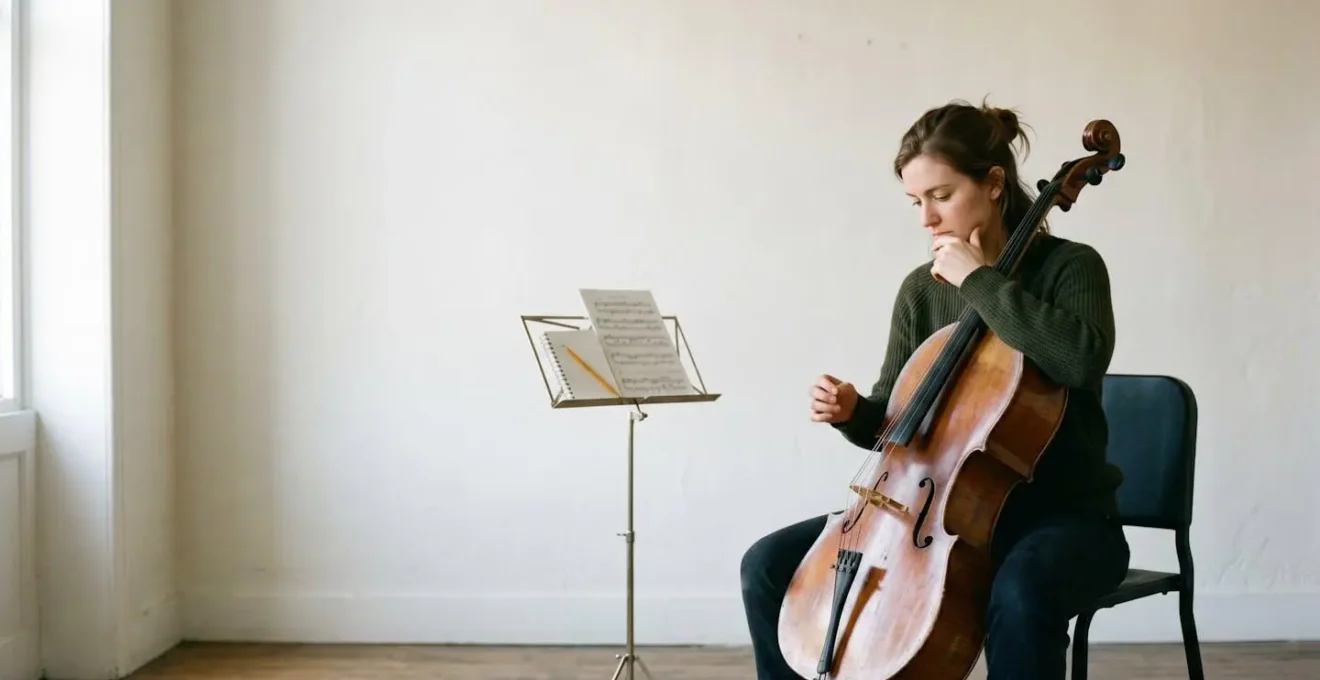
The image above captures the essence of deliberate practice: the quiet, solitary moment of critical self-assessment. This is where the real work happens. It’s not on stage; it’s in the practice room, confronting your mistakes and systematically eliminating them. The quantity of hours is less important than the quality of those hours. A landmark study on violinists proves this point unequivocally.
Case Study: Ericsson’s Elite Violinists Study
A famous study by K. Anders Ericsson at the Berlin Academy of Music demonstrated the power of accumulated, deliberate practice. He found that by age 20, the top-tier, world-class violinists had averaged 10,000 hours of solitary practice. In contrast, the merely ‘good’ violinists had averaged 8,000 hours, and those destined to become music teachers had only clocked about 4,000 hours. The most telling detail, as a report on the study highlights, was the escalating intensity: elite players practiced over 30 hours per week by their late teens. This shows that mastery is not a matter of linear time, but of exponential commitment to high-quality, deliberate work.
Playing it in F#: The Ultimate Test of Knowledge
You think you know a scale? You think you have mastered an arpeggio? Play it in F-sharp. Now play it in E-flat. If you hesitate, if your fingers get tangled, if you have to stop and think about the ‘shape,’ you do not truly know it. You have only memorized a pattern in a comfortable key. Relying on ‘easy’ keys like C, G, A, or E is a crutch. True fretboard command means being able to execute any musical idea, in any of the 12 keys, with equal fluency.
Practicing in so-called ‘unfriendly’ keys—those with many sharps or flats—is the ultimate acid test of your knowledge. It forces you to abandon muscle memory based on open strings and familiar patterns. It compels you to rely on your understanding of interval formulas and the true structure of the fretboard. This is not about showing off. It is about building a robust, flexible, and complete musical foundation. If you can play it in F-sharp, you can play it anywhere.
The method is simple and brutal: transposition. Take a lick, a scale pattern, or an arpeggio that you know well in an easy key. Now, move it up one fret (one semitone) and master it there. Then move it again. And again. You will do this until you have played it flawlessly in all 12 keys. This systematic drill erases the distinction between ‘easy’ and ‘hard’ keys, transforming them all into neutral territory.
Your Action Plan: The 12-Key Transposition Drill
- Master the Source: First, master a musical phrase or scale pattern in an easy, comfortable key like A minor. Play it until it is second nature.
- Systematic Transposition: Move the exact same pattern up one semitone (e.g., to B-flat minor). Do not change the fingering; focus on the new starting point and interval relationships.
- Drill the New Key: Practice the pattern in the new key until it feels just as comfortable and automatic as the original key.
- Cycle Through All 12 Keys: Continue this process chromatically, moving through all 12 keys without skipping any. You must conquer them all.
- Integrate and Internalize: Regularly repeat the full 12-key cycle. This drill is not a one-time task; it is a permanent part of your training regimen to maintain total fretboard knowledge.
The Mistake of Learning Scales by Shape Instead of Formula
Let’s address a fundamental flaw in how most guitarists and bassists learn: you learned shapes, not music. You memorized dot patterns on the fretboard. This is why you feel trapped. A shape only works from one starting note. Move it, and the context is lost. This is the musical equivalent of learning to spell only one word. To be truly fluent, you must learn the alphabet—the musical formula.
Every scale and mode is a formula of intervals, a series of whole steps (two frets) and half steps (one fret). The major scale formula is Whole-Whole-Half-Whole-Whole-Whole-Half. This formula is true starting on ANY note. If you know this, you are not trapped by a shape. You can construct the scale anywhere on the neck, on any string, in any key. You have knowledge, not just muscle memory.
This is a profound shift in thinking. Stop seeing the fretboard as a collection of boxes to memorize. Start seeing it as a grid of intervals. This is what unlocks true improvisation. You can create melodic lines that move across the entire neck because you understand the relationships between the notes, not just their position in a memorized pattern. As the experts at GuitarScale.org explain, this is the ultimate shortcut.
A tip is to take a shortcut by learning the intervals. Here are the intervals for the Dorian scale: 2 – 1 – 2 – 2 – 2 – 1 – 2. This means that whenever you start on a root note, you can go two steps up or down the fretboard on the same string.
– GuitarScale.org, Guitar scales guide with pictures, information and exercises
Learn the formulas for the major scale, the three minor scales, and the modes. Drill them. Sing them. Write them down. This is the deep work. It is harder than memorizing a shape, but the payoff is infinite. It is the difference between being a parrot and being a poet.
Silencing the Metronome: Testing If You Keep Time When It Stops
You have served your time with the Truth Teller. You have drilled your scales and arpeggios to its unforgiving click. Now it is time for the final exam. Can you keep time when it stops? The ultimate goal of using a metronome is to not need a metronome. You must internalize the pulse until it is a part of your own physiology. This is how you build a rock-solid internal clock.
The exercise is called ‘metronome ghosting’ or ‘silencing the click.’ The concept is simple, but the execution is revealing. You will set your metronome to play for a certain number of bars and then be silent for the same number. Your mission is to continue playing in perfect time during the silence and land exactly on the downbeat when the click returns. If you are early or late, you fail. Do it again.
This drill is the bridge between external timekeeping and internal feel. It forces you to be the metronome. You must feel the subdivisions in your body—a quiet toe tap, your breathing, a slight head nod. You must establish your own internal pendulum that keeps swinging even when the external guide is gone. This is the essence of playing ‘in the pocket.’ It’s a physical, deeply ingrained sense of time that cannot be faked.
Here is your progressive training program. Master each step before moving to the next.
- Downbeat Clicks: Start by setting the metronome to click only on beat 1 of each measure. You are responsible for feeling beats 2, 3, and 4.
- Two-Bar Ghosting: Program your metronome to play for two bars and be silent for two bars. Your goal is to land perfectly on beat 1 when it returns.
- Extended Silent Periods: Once you can nail two bars, increase the challenge. Try two bars of click followed by six bars of silence. Then four bars followed by twelve.
- Physicalize the Pulse: While the click is silent, maintain a subtle, consistent physical motion. This is your new internal metronome.
- Off-Beat Clicks: For an advanced challenge, set the click to only sound on the ‘and’ of beat 2 and 4. This will test your internal pulse at the highest level.
Key Takeaways
- Freedom Is Earned, Not Found: True improvisational ability is the direct result of structured, disciplined practice, not aimless jamming.
- The Metronome Is Your Mirror: Use the click track as an honest, objective tool to expose timing flaws and forge a rock-solid internal clock.
- Practice with Purpose: Ditch mindless repetition. Embrace deliberate practice by isolating weaknesses and using targeted drills to achieve measurable improvement.
How to Improve Your Internal Clock and Play « in the Pocket »?
We have covered the drills. We have established the mindset. Now, let’s put it all together. Improving your internal clock and playing ‘in the pocket’ is not the result of a single secret technique. It is the cumulative effect of everything we have discussed. It is the synthesis of rhythmic discipline, harmonic knowledge, and unwavering commitment to deliberate practice.
Your internal clock is built when you attack scales with rhythmic accents, forcing your body to feel subdivisions. It is strengthened when you drill arpeggios against a click, locking your harmonic choices to the pulse. It is calibrated when you face the Truth Teller—the metronome—day after day, eliminating the microscopic inconsistencies in your timing. It is tested when you force yourself to play in F-sharp, proving your knowledge is independent of comfortable patterns. And it is finally confirmed when you silence the click and discover the pulse continues to beat within you.
Playing ‘in the pocket’ is not a mystical state. It is a physical skill. It’s the feeling of being perfectly synchronized with the groove, so relaxed and confident in your timing that you can play with nuance and expression. You don’t have to think about time anymore, because you *are* the time. This is the freedom you have been seeking. It was never going to be found in a new piece of gear or a ‘magic’ scale. It was waiting for you at the end of a long, hard road of unsexy, disciplined work.
The drills are laid out. The method is clear. The only variable left is you. Stop looking for shortcuts. Pick up your instrument, turn on the click, and get to work. Your freedom is waiting on the other side of the discipline.