
In summary:
- Developing your ear is less about drilling isolated sounds and more about learning to hear the function and emotional role of each note.
- Your most powerful tools are your own voice and the bassline; they provide the context needed to decipher harmony.
- Ear training apps are a starting point, but true transcription skill comes from bridging app exercises with real musical context.
- Systems like solfège (Do-Re-Mi) are not just for singers; they are a universal language for hearing harmonic relationships on any instrument.
If you’re a musician, you know the feeling. You’re in a jam session or trying to learn a favorite song, and while everyone else seems to magically know the chords, you feel completely deaf. You hunt and peck on your instrument, trying to find the notes by trial and error, a frustrating process that feels more like a guessing game than making music. Many of my students come to me with this exact problem, convinced they simply weren’t born with « the gift. »
The common advice is often to download an ear training app and drill intervals for hours, or to memorize « reference songs » for each melodic leap. While these methods have some value, they often fail in the real world. Why? Because music is not a series of isolated, sterile sounds. It’s a dynamic, emotional language built on relationships and context. Hearing a major third in an app is one thing; recognizing it in a fast, complex song played on a distorted guitar is another entirely.
But what if the key wasn’t just memorizing sounds, but learning to hear their purpose and emotional weight within the music? What if you could develop an internal framework that allowed you to predict and understand the music as it unfolds? This is the secret of musicians with « big ears. » They don’t just hear notes; they hear function, tension, and resolution. They feel the « color » of each sound.
This guide will walk you through that very process. We will move beyond simple interval drills to explore the deeper perceptual skills that connect your ears, your mind, and your instrument. We’ll discover why the bass is your best friend, how your own voice can unlock your ear, and how ancient systems like solfège are the key to true musical fluency.
This article provides a structured path to developing a truly functional musical ear. Explore the sections below to understand the building blocks of audiation and how to apply them in your daily practice.
Summary: How to Develop « Big Ears » and Identify Chords and Melodies
- Hearing the « Color » of Degrees: Why the 3rd Feels Different from the 5th
- Why Listening to the Bass reveals the Chord Progression
- The Feedback Loop: Connecting Your Throat to Your Instrument
- Major vs Minor vs Diminished: The Emotional Signature of Chords
- Why Perfect Score on the App Doesn’t Mean You Can Transcribe
- Why Recognizing Intervals by Ear Saves You Hours of Trial and Error
- Which System Helps You Hear Key Relationships Better?
- Why mastering solfège (Do-Re-Mi) improves your instrument playing?
Hearing the « Color » of Degrees: Why the 3rd Feels Different from the 5th
The first major shift in developing your ear is to stop hearing notes as just « high » or « low » and start hearing them in terms of their function within a key. Each note of a scale has a unique personality, a specific job it does. This « color » or « flavor » is what tells your brain where you are in the musical landscape. For example, the first note of a scale, the tonic (or ‘Do’), feels like home—it’s a point of rest and stability. You can end a song on it, and it will sound complete.
In contrast, other notes create tension. The fifth degree of the scale (the ‘Sol’) is also very stable, but in a strong, foundational way, like a pillar supporting a structure. It doesn’t have the same « finality » as the tonic, but it provides a solid anchor. The third degree (the ‘Mi’) is perhaps the most emotionally significant, as its quality determines whether the key is major (bright, happy) or minor (somber, reflective). It’s the primary source of a chord’s emotional character.
The most active and tense note is often the seventh degree, also known as the leading tone. This note feels incredibly unstable and desperately wants to resolve upwards to the tonic. According to music theory research on scale degree functions, this strong pull is one of the most powerful forces in Western harmony. Learning to identify this intense feeling of « needing to go home » is a massive shortcut to orienting yourself within a key.
This concept of « color » is not just theoretical. A practical study demonstrated how musicians’ brains automatically « fill in » the expected harmony for single melodic notes. For instance, the fourth degree (‘Fa’) sounds stable and plain in a major scale, but if it’s raised by a semitone (becoming ‘#Fa’ or ‘Fi’), it instantly acquires the dreamy, bright character of the Lydian mode. Your brain hears that single note and infers an entire harmonic world around it. Your goal is to train your ear to recognize these distinct emotional functions, not just the pitches.
Why Listening to the Bass reveals the Chord Progression
When musicians struggle to hear a chord progression, they almost always make the same mistake: they only listen to the most prominent part, usually the vocal melody or a guitar riff. But the secret to decoding harmony quickly lies at the bottom of the mix. The bassline is the blueprint of the chord progression. It provides the foundation upon which everything else is built, and training your ear to follow it is the single most effective way to start hearing changes.
The bass player’s primary job is to outline the harmony, typically by playing the root note of each chord on the strongest beat. If you can identify the sequence of root notes the bass is playing—C, then G, then A minor—you have effectively identified the core of the progression: C, G, Am. The rest of the instruments are simply adding color and texture on top of that foundation. Focusing your attention on the low end filters out the melodic complexity and reveals the simple, powerful harmonic structure underneath.
This doesn’t mean the bass *only* plays root notes. Sometimes, it plays a different note from the chord to create what’s called an inversion. For example, in a C major chord (C-E-G), the bass might play an E. Learning to recognize the sound of these inversions—which often feel a bit less stable or « in transit » compared to the solid feeling of a root position chord—is a more advanced skill, but the principle remains the same. Start by just identifying the bass note at the moment the chord changes.
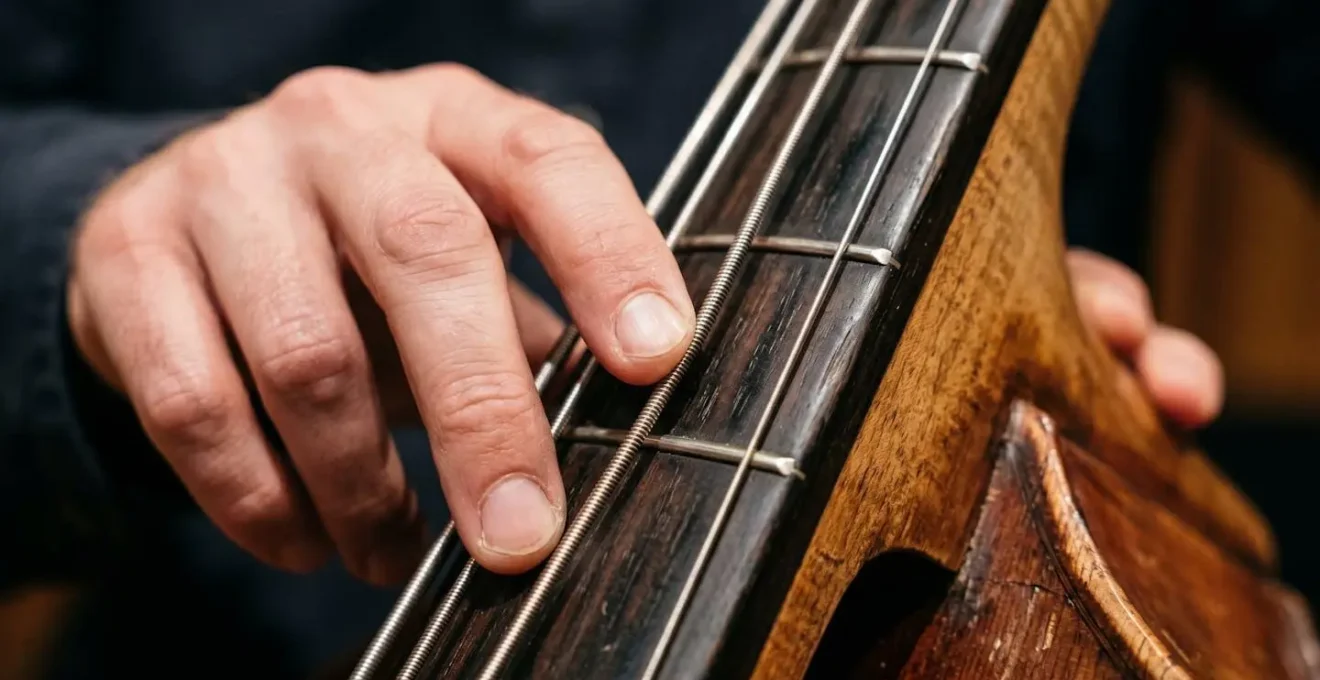
As you can see, the physical act of playing the bass is about securing the harmonic foundation. To train your ear for this, actively ignore everything else in a song and just hum along with the bass. Can you hear when it moves? Does it move by a big leap or a small step? This simple practice will build your sensitivity to harmonic movement faster than almost any other exercise.
Action Plan: Decode Chord Progressions by Ear
- Tap the rhythm of bass changes to identify harmonic rhythm patterns before attempting note identification
- Hum the melodic contour of the bassline to internalize its shape and direction
- Identify the bass note at key moments in the progression
- Listen for whether the bass note feels stable (root position) or ‘in transit’ (inversion)
- Cross-reference the bass note with the main melody note to deduce chord quality quickly
The Feedback Loop: Connecting Your Throat to Your Instrument
One of the most overlooked yet powerful tools in ear training is your own voice. The ability to sing a note you hear in your head before you play it on your instrument creates a powerful bio-feedback loop. This process, often called « audiation, » is the core of musical intuition. It’s the ability to think in sound, to hear a melody or harmony internally with the same clarity as thinking a sentence.
Audiation is to music what thought is to language.
– Edwin Gordon, Music Learning Theory research publications
When you hear a note and try to find it on your instrument, you’re just guessing. But when you hear a note, sing it back, and then match that pitch on your instrument, you are doing something profound. You are confirming the sound with your body, solidifying the connection between your inner ear and your physical actions. This loop—Hear, Sing, Play—is the fastest way to internalize pitches and intervals. If you can sing it, you own it. If you can’t sing it, you don’t truly hear it yet.
You don’t need to be a professional singer. The goal isn’t performance; it’s pitch accuracy. Start simply. Play a random note on a piano or guitar. Turn away, try to « hold » that pitch in your mind, and then sing it out loud. Now turn back and check yourself. At first, it will be difficult, but with practice, you’ll be amazed at how accurate your internal pitch memory becomes. This skill directly translates to transcribing music, as you’ll be able to « hold » a melodic phrase in your head long enough to sing it and then figure it out.
This isn’t just a folk method; it’s backed by science. Extensive neuroscience research published in Nature Reviews Neuroscience demonstrates that music training, especially methods involving vocalization, leads to physical changes throughout the auditory system. It primes your brain to be more efficient and accurate at processing all sounds, not just musical ones. You are literally re-wiring your brain to be a better listener.
Major vs Minor vs Diminished: The Emotional Signature of Chords
Just as individual notes have a functional « color, » chords have a distinct emotional signature. This is the most direct and intuitive information you can extract from music. Before you can even name a chord, you can feel it. Is it bright and happy? Is it dark and melancholic? Or is it tense and unsettling? These feelings are your primary guideposts in the world of harmony.
The most basic distinction is between major and minor chords. This difference comes down to a single note: the third. A major chord contains a major third interval above the root, which our brains perceive as open, bright, and stable. A minor chord contains a minor third, which feels more introspective, somber, or serious. Learning to instantly distinguish this fundamental emotional quality is a crucial first step. When a new chord plays, ask yourself the simple question: « How does this make me feel? » before you even try to identify a single note.
Beyond major and minor, other chord qualities have even more potent emotional signatures. A diminished chord, for example, is built from two minor thirds stacked on top of each other. The result is a sound that is notoriously unstable, dissonant, and tense. In film scores, it’s often used to create a sense of suspense, danger, or confusion. When you hear a chord that feels like a question mark or makes you feel on edge, you are very likely hearing a diminished chord. It’s a sound that begs to be resolved.

Conversely, chords like a major seventh feel sophisticated, jazzy, and relaxed, while dominant seventh chords have a strong, bluesy tension that pulls you toward the next chord in the progression. Your task as a developing musician is to build a personal library of these sound-to-emotion connections. Play a C major chord, then a C minor, then a C diminished. Don’t just analyze the notes; close your eyes and pay attention to the shift in feeling. This emotional awareness is the foundation of hearing harmony by instinct.
Why Perfect Score on the App Doesn’t Mean You Can Transcribe
Many aspiring musicians spend countless hours on ear training apps, acing quizzes on interval and chord identification, only to find they are still lost when faced with a real piece of music. This is an incredibly common frustration, and it stems from a fundamental misunderstanding: the skills that lead to a high score in an app are not the same skills required for real-world transcription. This is what I call the « context gap. »
Ear training apps are brilliant for one thing: learning to identify musical components in a sterile, isolated environment. They present you with a perfect piano tone, no rhythmic complexity, and no competing instruments. This is a necessary first step, like learning the alphabet. However, real music is like a busy conversation, not a spelling bee. The same interval can sound completely different when played on a flute, a distorted guitar, or a human voice. The surrounding harmony and rhythm change our perception of a sound’s quality and function.
A perfect score on an app proves you can recognize a major sixth in isolation. It doesn’t prove you can pick out that same interval in the middle of a fast saxophone solo over a complex jazz progression. To bridge this context gap, you must actively practice transferring your skills from the app to your instrument and to real music. Your training must become a hybrid process that constantly moves between isolation and application.
The key is to create exercises that live in both worlds. Instead of just identifying an interval in an app and moving to the next question, you must take that sound and immediately apply it. This active process of bridging the context gap is what moves knowledge from your theoretical brain to your musical instincts. It is the difference between knowing the name of something and truly understanding it.
- Use an ear training app to identify a specific interval (e.g., a minor 6th) in isolation with clean piano tones.
- Immediately find and play that same interval on your physical instrument, experiencing the tactile and timbral difference.
- Improvise a short 4-8 bar musical phrase incorporating that interval over a backing track in various harmonic contexts.
- Record yourself and listen back, noting how the interval sounds different in musical context versus isolation.
- Repeat this process with the same interval in different timbres (distorted guitar, airy flute, complex orchestral texture).
Why Recognizing Intervals by Ear Saves You Hours of Trial and Error
The process of « note fishing »—randomly searching for the notes of a melody on your instrument—is exhausting and inefficient. The reason it’s so slow is that you’re treating each note as a separate, independent event. Recognizing intervals by ear fundamentally changes this process by allowing your brain to « chunk » information into larger, more meaningful shapes. This drastically reduces your cognitive load and is the secret to transcribing music in real-time.
Think about reading this sentence. You aren’t processing it letter by letter (T-H-I-N-K A-B-O-U-T…). Your brain instantly recognizes whole words and even phrases as single « chunks » of information. Interval recognition does the same for music. Instead of hearing C, then E, then G as three separate events, a trained musician hears one unified shape: a major arpeggio. They hear the *relationship* between the notes, not just the notes themselves.
This ability transforms transcription from a slow, linear task into a predictive leap. Once you recognize the first two notes of « Twinkle, Twinkle, Little Star » as a perfect fifth, your brain can predict that the next leap will also be a familiar interval. You begin to hear melodic contours and shapes rather than a stream of disconnected pitches. As the Musical U Research Team states, interval recognition allows the brain to group notes into ‘chunks’, speeding up transcription immensely.
Case Study: The « Chunking » Superpower in Action
Music cognition research highlights this « chunking » ability as a key differentiator between novice and expert listeners. When presented with a melody, a beginner’s brain tries to process each note individually, quickly becoming overwhelmed. An expert, however, instantly recognizes recurring patterns—arpeggios, scale fragments, common melodic shapes—as single units. This transforms the cognitive process from ‘note fishing’ (randomly searching for the next pitch) to ‘predictive leaping’ (confidently jumping the correct melodic distance). This is a direct connection between audiation (hearing the shapes in your mind) and real-time instrumental translation, saving countless hours of frustrating trial and error.
Mastering intervals isn’t about passing a test; it’s about upgrading your brain’s operating system for processing musical information. It’s the most direct path away from guessing and towards confident, accurate transcription.
Which System Helps You Hear Key Relationships Better?
As you move from hearing individual notes and chords to understanding entire progressions, you need a system to label what you’re hearing. These systems are like grammar for the language of music; they give you a framework for understanding not just *what* a chord is, but *what it’s doing*. There are several popular systems, each with its own strengths, and choosing the right one depends on your primary goals and musical context.
For singers or any musician focused on melody, Movable-Do Solfège (the classic Do-Re-Mi system) is unparalleled. It’s a relative system, meaning ‘Do’ is always the tonic of whatever key you’re in. This builds a powerful internal reference for the sound and function of each scale degree, making it incredibly intuitive for memorizing melodies and transposing them to any key on the fly.
For musicians working in pop, country, or rock, especially in studio or band settings, the Nashville Number System (NNS) is king. It uses numbers to represent the chords of the key (1 for the tonic chord, 4 for the subdominant, etc.). Its great strength is speed and flexibility, allowing musicians to quickly communicate chord progressions and change keys with zero friction. It’s a pragmatic language for working musicians.
For those interested in deep compositional or theoretical study, Roman Numeral Analysis is the academic standard. Using Roman numerals (I, ii, iii, IV, V, etc.) allows for a detailed analysis of functional harmony, revealing the underlying structure of even the most complex pieces. It’s the most powerful system for understanding the « why » behind chord progressions in classical music and jazz. The following table breaks down the primary use case for each system.
| System | Best For | Key Strength | Primary Use Case |
|---|---|---|---|
| Movable-Do Solfège | Singers & Melodic Focus | Internal pitch reference, transposition ease | Vocal training, melody memorization, relative pitch development |
| Nashville Number System | Session Players & Chart Reading | Quick communication, genre flexibility | Studio work, chord charts, pop/country/rock contexts |
| Roman Numeral Analysis | Deep Harmonic Study | Functional harmony understanding, classical analysis | Composition, music theory study, harmonic progression analysis |
As this comparison of harmonic analysis frameworks shows, the best system is the one that best serves your musical life. Many advanced musicians are fluent in all three, using them like different lenses to examine the same piece of music.
Key takeaways
- True aural skill is not about identifying isolated notes, but about perceiving their function and emotional role within a key.
- The fastest way to improve your ear is to create a feedback loop between what you hear, what you sing, and what you play on your instrument.
- Systems like Solfège and Roman Numerals are not just theory; they are practical tools that provide a language for what you hear, enabling instant transposition and deeper harmonic understanding.
Why mastering solfège (Do-Re-Mi) improves your instrument playing?
For many instrumentalists, solfège (Do-Re-Mi) seems like a strange, abstract system reserved for choir singers. This is a profound misunderstanding. Mastering movable-do solfège is one of the most powerful things you can do to improve your playing, your improvisation, and your ability to learn music by ear, regardless of your instrument. It acts as a universal translator between your ear and your instrument.
The magic of movable-do solfège is that it separates a melody’s essential structure from its key. For example, the melody for « Twinkle, Twinkle, Little Star » is always ‘Do-Do-Sol-Sol-La-La-Sol’, no matter what key you play it in. Once you’ve learned to hear and sing that pattern, you have learned the song’s DNA. Transposing it to a new key is no longer a complex mathematical exercise of moving every note up or down a specific number of semitones. Instead, you simply start on a new ‘Do’ and your ear, hand, and voice follow the familiar pattern automatically.
This system gives you a precise and intuitive name for every possible sound and harmonic function. It goes far beyond the basic seven notes. Is there a bluesy flat 7th in that chord? You learn to hear that as ‘Te’. Does the chord have a dreamy, raised 4th that gives it a Lydian flavor? You recognize that sound as ‘Fi’. Solfège provides a complete vocabulary for every harmonic color and extension.
Case Study: Solfège as a Universal Translator
Research in Music Learning Theory shows how solfège enables this instant transposition. By internalizing melodies as solfège patterns, musicians effectively create a key-independent blueprint of the song. When a guitarist who has mastered this learns a solo as ‘Sol-La-Ti-Do’ in the key of G, they don’t have to re-calculate every fret if a singer asks to play it in Bb. They simply find the new ‘Sol’ in the key of Bb and their fingers instinctively know the shape. This applies to complex harmony as well; recognizing the sound of a dominant 7th chord’s ‘Te’ or a Lydian chord’s ‘Fi’ gives musicians an immediate, intuitive label for what they’re hearing, bypassing conscious analysis and leading to faster, more fluid playing.
Solfège is not an extra layer of theory to memorize; it’s a tool to dissolve theory into pure, instinctual hearing. It bridges the gap between the abstract sound in your head and the concrete notes on your instrument, making you a more fluent and versatile musician.
Ultimately, developing « big ears » is a journey of connecting, not just collecting, sounds. It’s about building an internal model of music where every note has meaning, purpose, and feeling. Start today by choosing one principle—whether it’s humming a bassline, singing a melody before you play it, or identifying the emotional quality of a chord—and integrate it into your daily practice. You have the ability to hear what you’re missing; you just need to learn how to listen.