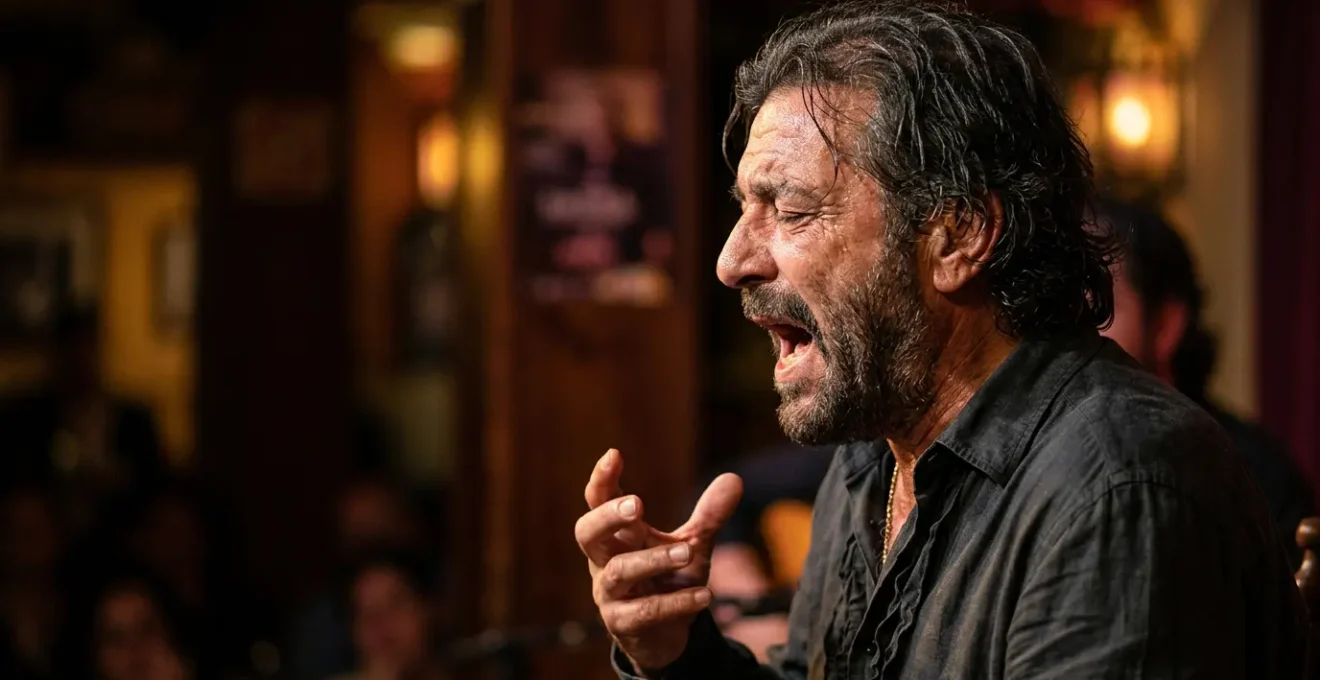
Many perceive flamenco as simply passionate Spanish music. This view misses the point entirely. The art’s true soul lies not in generalized emotion, but in a sophisticated cultural language built on complex rhythmic cycles, specific harmonic structures, and an untranslatable spirit of struggle called *duende*. This is not just performance; it is the living history of Andalusia, expressed through a grammar of profound depth.
Flamenco. The word itself conjures images of a woman in a swirling red dress, the sharp crack of a fan, and the fiery strum of a guitar. For many, it’s the quintessential soundtrack to Spain—a spectacle of raw, unbridled passion. This vision, while commercially popular, is a beautiful but dangerously thin veneer. It captures the fire but misses the furnace; it sees the tears but doesn’t understand the sorrow. True flamenco is not a performance to be passively watched; it is a profound artistic dialogue, a ritual of expression with a grammar as complex and a history as deep as any classical form.
The art is often associated with the Gitano (Roma) people of Andalusia, who were instrumental in shaping its voice. It became a vessel for their history of persecution, resilience, and fierce identity. To appreciate flamenco is to move beyond the tourist *tablao* and learn to listen. It requires understanding that its structure is a conversation between three pillars: the *cante* (song), the *baile* (dance), and the *toque* (guitar playing). When a performer achieves a moment of sublime, heart-stopping authenticity, the audience cries « ¡Olé! »—not for a trick, but as an affirmation of a shared, fleeting truth. This is the world we will explore.
This article will deconstruct the elements that make flamenco one of the world’s most misunderstood and emotionally potent art forms. We will move from its foundational rhythm to its spiritual core, unveiling the architecture of its soul.
Summary: Understanding the Soul of Flamenco
- The 12-Beat Cycle: Why It’s So Hard for Western Musicians to Feel
- What is Duende? The Untranslatable Spirit of Performance
- Cante, Baile, Toque: The Inseparable Trinity of Flamenco
- Soleá vs Alegrías: Identifying the Mood and Region of the Song
- Paco de Lucía: How Jazz Met Flamenco and Changed Everything
- Between the Notes: The « Ay » That Breaks Your Heart
- Harmonic Minor and Phrygian Dominant: Sounding « Spanish » or « Middle Eastern »
- The raw power of Cante Jondo: Understanding the voice of Flamenco
The 12-Beat Cycle: Why It’s So Hard for Western Musicians to Feel
The first barrier between a casual listener and a true flamenco aficionado is the rhythm. While much of Western music is built on predictable, symmetrical cycles of 4/4 or 3/4 time, flamenco’s heart beats to a different drum. This is the *compás*, a rhythmic framework that is more of a cyclical sentence than a simple metronome. The most iconic and challenging of these is the 12-beat cycle. It’s not just counting to twelve; it’s about where the accents fall, creating a feeling of syncopated tension and release that is the bedrock of the art’s rhythmic drive, or *soniquete*.
For a musician trained on rock, pop, or even classical music, the 12-beat *compás* feels inherently unstable. Instead of a steady 1-2-3-4, the accents are placed in a pattern that feels like it’s constantly tripping and recovering with defiant grace. In the *Soleá*, a foundational flamenco style, a detailed analysis reveals accents on beats 3, 6, 8, 10, and 12. This specific pattern (..3..6.8..10..12) is not arbitrary; it’s a rhythmic sentence that every performer—singer, dancer, guitarist—knows by heart. It is the invisible architecture that allows them to improvise and communicate non-verbally during a performance. This historical structure is not an invention of modern flamenco but an echo of the alternating groups of 2 and 3 beats common in Spanish folk dances of the 16th century.
Feeling this rhythm is not an intellectual exercise; it is a physical one. It is why you see performers marking the beat with intricate hand claps (*palmas*) or foot taps (*zapateado*). They are not just keeping time; they are living inside the *compás*. To understand flamenco, one must stop trying to find the « one » and instead learn to feel the entire twelve-beat phrase as a single, breathing entity.
What is Duende? The Untranslatable Spirit of Performance
If the *compás* is flamenco’s skeleton, then *duende* is its soul. The word has no direct translation in English. It is not talent, nor inspiration, nor technique. It is a darker, more profound force. It is the moment when a performance transcends technical perfection and touches upon a raw, mortal truth. It is a visceral, almost painful, moment of connection between the artist, the art, and the audience. The Spanish poet Federico García Lorca, who wrote extensively on the subject, described it not as a gift, but as a battle.
The duende is a power, not a work. It is a struggle, not a thought. I have heard an old maestro of the guitar say, ‘The duende is not in the throat; the duende climbs up inside you, from the soles of thefeet.’
– Federico García Lorca, In Search of Duende (lecture)
You cannot plan for *duende*. An artist can be technically flawless and leave an audience cold. Another, with a rougher voice or simpler steps, can summon it and shatter the room. *Duende* arrives unannounced, often in the presence of death, or the awareness of it. It’s in the crack of a singer’s voice, the spontaneous, grief-stricken arch of a dancer’s back, or a guitarist’s faltering note that communicates more than a thousand perfect ones. It is authenticity at its most primal, a confrontation with the limitations of life and the infinity of art.
The image below attempts to capture not the performer, but the feeling of this force—a visceral, unpolished expression that is the hallmark of a performance touched by *duende*.

This is why flamenco at its best is unsettling. It is not meant to be merely beautiful or entertaining; it is meant to be true. The search for this elusive spirit is the ultimate goal of the serious flamenco artist, a goal that favors lived experience over academic perfection and raw emotion over polished presentation.
Cante, Baile, Toque: The Inseparable Trinity of Flamenco
Flamenco is not a solo art form; it is a conversation. This dialogue unfolds between the three core elements: *Cante* (singing), *Baile* (dancing), and *Toque* (guitar playing). To a newcomer, the dancer might seem to be the star, or perhaps the guitarist with their lightning-fast fingers. However, in the traditional hierarchy of flamenco, all things spring from the *cante*. The song is the mother of the art. The human voice, expressing the primal lyric, is the source from which all other elements draw their meaning and purpose.
Historically, the guitar and dance developed to serve the singer. The guitarist’s role was to provide the harmonic and rhythmic context for the vocal line, and the dancer’s role was to physically interpret the emotion and narrative of the lyrics. According to the historical evolution of flamenco, this hierarchy is fundamental. The *toque* offers a harmonic bed, and the *baile* gives the song a body, but the *cante* gives it a soul. This dynamic is a live negotiation on stage. A guitarist listens intently to the singer’s breath, anticipating the end of a phrase. A dancer might take the lead, their percussive footwork demanding a response from the guitarist, who then throws a new rhythm back at them.
This interdependent relationship is what makes a great flamenco performance so electrifying. It is not a choreographed routine but a living, breathing organism. Each artist must be both a master of their own craft and a deeply empathetic listener. They are constantly engaged in a call-and-response, a delicate balance of supporting and challenging one another, all while staying within the strict confines of the *palo’s* *compás*. A misstep is not a mistake; it’s an invitation for a new direction. This is where the true drama of flamenco lies—not in a pre-written script, but in the spontaneous, high-stakes dialogue between its three core voices.
Action Plan: How to Listen to Flamenco Like an Aficionado
- Identify the Palo: Listen for the mood (is it tragic and minor, or festive and major?) and the underlying rhythmic cycle (the *compás*). This is the stylistic family of the song.
- Trace the Dialogue: Observe the call-and-response. Is the dancer responding to a line from the singer? Is the guitarist echoing a dancer’s footwork pattern? Who is leading the conversation at this moment?
- Feel the Compás: Try to clap along with the *palmas* (handclaps). Can you distinguish the strong, accented beats from the weaker ones? This is the heartbeat of the piece.
- Listen for the Jipío: Pinpoint the raw, untamed vocal cries (the « Ay ») and the coveted « cracked » vocal quality (*voz afillá*). These are markers of authentic, emotional delivery.
- Assess the Duende: Does the performance feel safe and rehearsed, or does it feel like something real is at stake? The search for this unpredictable spirit is the ultimate goal.
Soleá vs Alegrías: Identifying the Mood and Region of the Song
To say you are listening to « flamenco » is like saying you are listening to « rock music. » It’s too broad. The art form is divided into dozens of styles, or *palos*, each with its own unique *compás*, mood, harmonic structure, and lyrical theme. Think of them as different branches of a great family tree. Understanding the distinction between two fundamental *palos* like *Soleá* and *Alegrías* is a crucial step in learning to navigate this rich landscape. They represent two sides of the Andalusian soul: profound sorrow and defiant joy.
The *Soleá* is considered the « mother » of many *palos*. Its name derives from *soledad*, or solitude. It is a song of deep sorrow, existential angst, and heartbreak. It is slow, majestic, and somber, typically performed in a minor key. The traditional tempo for a *Soleá* is between 70 to 120 BPM, allowing the singer the space to dwell on each painful syllable. Its roots are often traced to the arid, inland regions of Andalusia around Seville.
In stark contrast are the *Alegrías*. As the name suggests (*alegría* means joy), this *palo* is festive, bright, and exuberant. It is born from the coastal city of Cádiz, and its rhythm feels like sunlight and sea spray. It uses the same 12-beat *compás* as the *Soleá* but is played much faster and in a major key. The *Alegrías* is part of the *cantiñas* group of *palos*, which are stylistically linked to their geographical origin in Cádiz. The dance is light and vibrant, and the lyrics often celebrate life, love, and the beauty of the city.
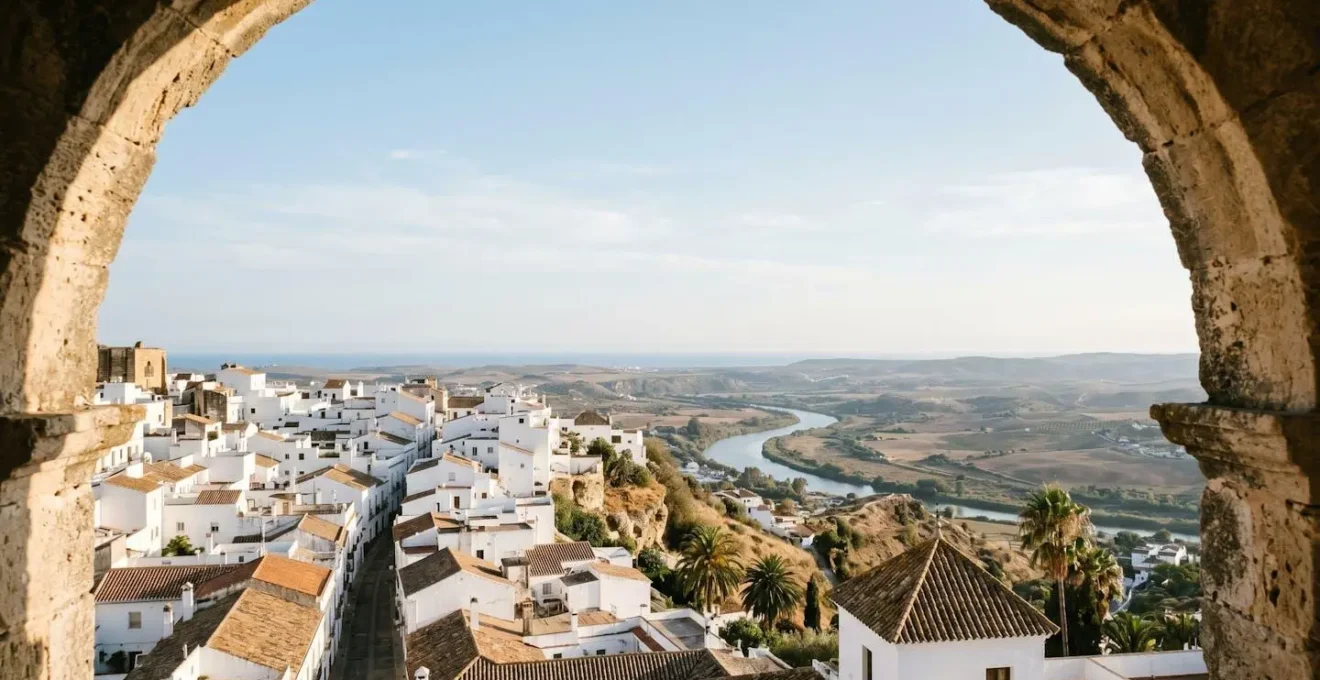
By learning to identify these key characteristics—tempo, major/minor key, emotional weight—you begin to understand the emotional and geographic DNA of flamenco. You can hear the difference between the sun-baked, introspective sorrow of inland Andalusia and the sparkling, extroverted joy of its coastline. It is a testament to the art’s depth that it uses a shared rhythmic grammar to express the entire spectrum of human experience.
Paco de Lucía: How Jazz Met Flamenco and Changed Everything
For much of its history, flamenco was a deeply traditional and insular art form. Then came Paco de Lucía. A child prodigy from Algeciras, Paco was a guitarist of impossible technique and boundless curiosity. While deeply rooted in the traditions of his masters, he refused to be confined by them. He is the single most important figure in the evolution of modern flamenco, a revolutionary who opened the art form up to the world by introducing new harmonies, new instruments, and a new level of technical virtuosity.
Paco’s most significant contribution was his dialogue with other genres, most notably jazz. His collaborations with guitarists like John McLaughlin and Al Di Meola were not simple fusions; they were intense conversations between musical equals. He brought a harmonic complexity and an improvisational freedom inspired by jazz into the strict rhythmic framework of flamenco. He introduced chords and voicings that were previously unheard of, expanding the harmonic palette of the flamenco guitar forever. This was not a betrayal of tradition, but a confident expansion of its boundaries.
The Accidental Revolution: Bringing the Cajón to Spain
Perhaps no story better illustrates Paco de Lucía’s innovative spirit than his introduction of the *cajón* (box drum). In 1977, during a tour in Peru, he heard the instrument and was struck by how its percussive sounds mirrored flamenco’s own—the deep bass tone like a dancer’s foot sole, the sharp treble like a heel. He brought the instrument back to Spain, and it became an overnight sensation, quickly establishing itself as an essential part of the modern flamenco ensemble. He felt, justifiably, « very proud » of this contribution.
This simple act of cultural borrowing was revolutionary. It gave flamenco a percussive heart that was portable, versatile, and perfectly suited to its rhythmic language. As Paco himself famously quipped, the integration was so natural and immediate that it felt like an overnight phenomenon.
Six months later, there was a cajón in every flamenco household in Spain.
– Paco de Lucía, Interview quoted in Tablao de Carmen
Paco de Lucía proved that flamenco was not a museum piece. He showed that it could absorb, adapt, and evolve without losing its soul. His legacy is a testament to the idea that true tradition is not static; it is a living river, fed by new streams.
Between the Notes: The « Ay » That Breaks Your Heart
In the most profound moments of *cante* (flamenco singing), the singer will often abandon words altogether and release a sound that is simply « Ay! ». To the uninitiated, this might sound like a simple, guttural cry of pain or exertion. But in the language of flamenco, this *jipío*, or vocal cry, is one of its most complex and meaningful tools. It is far more than just an emotional exclamation; it is a structural, melodic, and spiritual device that sits at the very heart of the vocal art.
Functionally, the initial « Ay » of a song serves a practical purpose. As vocal scholars note, it allows the singer to find their pitch, settle into the *compás*, and warm up their vocal cords before launching into the formal verse, or *tercio*. It is the singer’s way of testing the waters, of finding their place in the musical conversation before committing to a lyric. It is a moment of public vulnerability, a gathering of energy before the emotional storm of the verse begins.
But its power is far more than functional. The « Ay » is the sound of emotion that is too raw for words. It is the vessel for the *duende*. It is the place where the singer channels the collective memory of sorrow, loss, and longing that defines the deeper *palos*. The quality of a singer’s « Ay » is a key measure of their authenticity. Is it a genuine cry torn from the soul, or is it a theatrical affectation? An aficionado can tell the difference instantly. A great « Ay » can contain more emotional information than an entire poem. It is the sound of the human spirit pushed to its absolute limit, a crack in the veneer of civilization through which a profound and ancient truth emerges.
This single, extended syllable is where the singer connects to the deepest roots of the art form. It’s not about the notes that are sung, but the emotional weight carried in the spaces between them. It is the purest distillation of flamenco’s expressive power.
Harmonic Minor and Phrygian Dominant: Sounding « Spanish » or « Middle Eastern »
What gives flamenco its instantly recognizable « Spanish » sound? While rhythm and emotion are key, the answer also lies in a specific set of musical scales and harmonic progressions that are distinct from mainstream Western music. The sound is often described as exotic, with echoes of Middle Eastern or Jewish musical traditions. This is no accident. The harmonic DNA of flamenco is a direct result of centuries of cultural fusion in Andalusia.
The primary scale used in flamenco is the Phrygian mode, specifically a variation known as the Phrygian dominant scale. Unlike the standard major (« happy ») and minor (« sad ») scales of Western music, the Phrygian mode has a characteristic « lowered » second note. This creates a tense, dramatic, and somewhat dark interval right at the beginning of the scale, which is largely responsible for its « exotic » flavor. The Phrygian sound is the harmonic landscape of flamenco.
This scale is most famously expressed through a chord progression known as the Andalusian Cadence. This is a four-chord sequence that has a powerful gravitational pull toward its final chord, creating a feeling of dramatic resolution. In the key of A minor, the signature harmonic identifier is the progression i – VII – VI – V, which translates to the chords Am – G – F – E. That final E major chord, the dominant, creates an almost unbearable tension before resolving back to the Am. This progression is the harmonic signature of flamenco, heard in countless pieces from *Soleá* to modern flamenco pop.
As filmmaker Carlos Saura suggested, this unique sound is not simply Spanish, but distinctly Andalusian. It is the result of a long historical process where Visigothic, Byzantine, Sephardic (Spanish Jewish), and Moorish (North African) musical ideas were left to marinate for centuries on the Iberian Peninsula. This unique cultural alchemy is what gives flamenco its unmistakable harmonic flavor—a sound that is both tragic and defiant, ancient and alive.
Key Takeaways
- Flamenco is governed by the *compás*, a complex rhythmic cycle (often 12 beats) with specific accents that defies standard Western musical intuition.
- The ultimate goal of a performance is to summon *duende*, an untranslatable spirit of raw, authentic, and often painful emotion that transcends mere technical skill.
- The art form is a live dialogue between the *cante* (song), *baile* (dance), and *toque* (guitar), with the voice traditionally being the « mother » of the art.
The raw power of Cante Jondo: Understanding the voice of Flamenco
At the deepest, most ancient core of flamenco lies *Cante Jondo*, or « deep song. » This is not a specific *palo*, but a category of them—including the *Soleá*, *Seguiriyas*, and *Tonas*—that are considered the most serious, pure, and emotionally profound expressions of the art. *Cante Jondo* deals with the fundamental themes of life: love, death, anguish, and despair. It is the voice of flamenco at its most raw and unadorned, a direct line to the origins of the art form.
The vocal style of *Cante Jondo* is instantly recognizable. It avoids the smooth, pleasing tones of popular music, instead embracing a quality known as *voz afillá*—a « cracked » or « fissured » voice. This rough, raspy timbre is not a sign of a poor singer; it is a highly desired quality, seen as a mark of authenticity and lived experience. It is the sound of a voice that has been weathered by life, a voice that can carry the weight of tragedy. The performance is minimal, often just a singer and a guitarist, stripping away all spectacle to focus on the raw emotional core of the song.
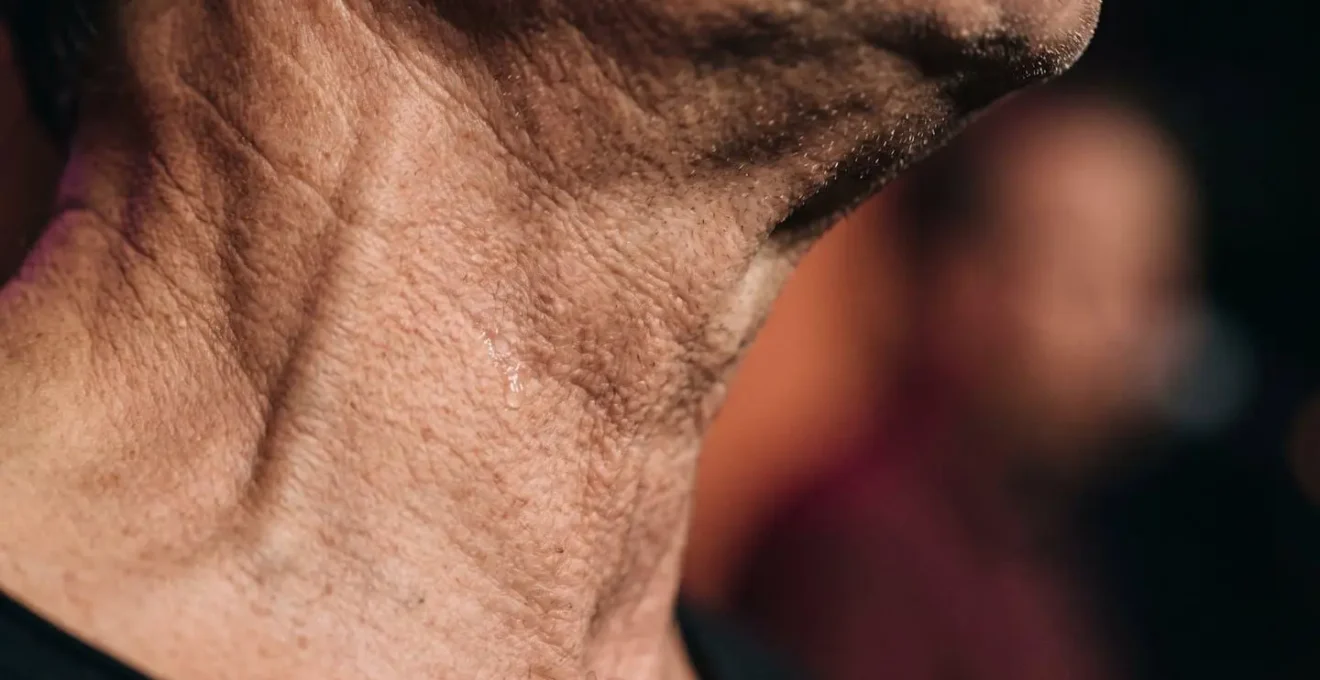
This rawness is not an aesthetic choice; it is a historical necessity. *Cante Jondo* is the voice of a marginalized people. As an art form shaped profoundly by the Gitano communities of Andalusia, flamenco became a vehicle for expressing the hardship and persecution they faced. As the history of flamenco’s association with the Gitano people shows, the music was a form of catharsis and cultural resistance. The « rawness » of *Cante Jondo* was an act of survival, a way to voice sorrow, document struggle, and preserve identity when all other avenues were closed. It is the sound of a soul laid bare.
To listen to *Cante Jondo* is to bear witness to something sacred. It requires patience and empathy. It is not meant to be comfortable. It is meant to be a profound and transformative experience, a reminder that the most beautiful art often comes from the deepest pain. This is the unfiltered, foundational voice of flamenco.