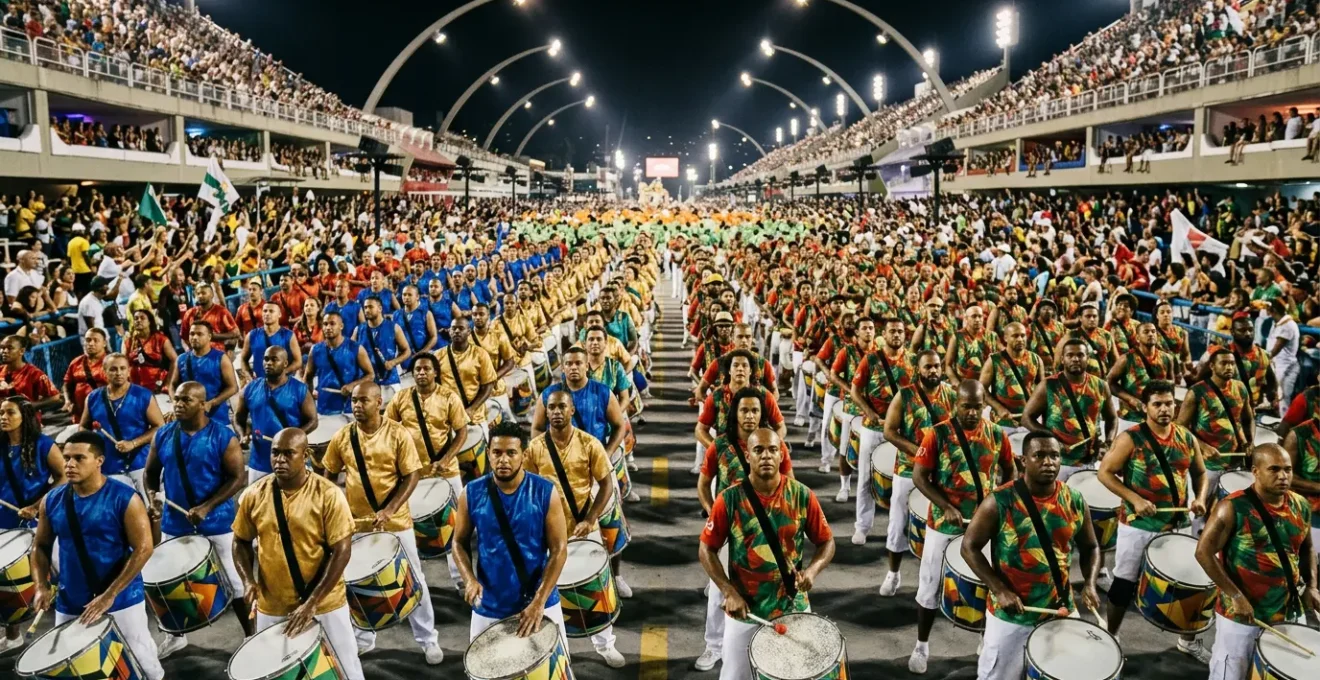
Rio Carnival’s iconic sound is no accident; it’s a meticulously engineered system of music, technology, and human endurance designed for sonic perfection.
- The parade is judged on microscopic details, where a single group singing out of sync can cost a school the championship.
- Performers are elite athletes, training for months to endure the grueling 80-minute parade often carrying heavy costumes.
Recommendation: To truly appreciate the spectacle, listen for the details—the whistle commands directing the drums, the cavaquinho’s melodic anchor, and the perfect unison of thousands of voices.
The first thundering crack of the drums echoes through the Sapucaí Sambadrome, a sound so powerful it vibrates in your very bones. For the millions watching, Rio Carnival is a dazzling explosion of color, energy, and joy. It’s easy to get lost in the sea of feathers, the glittering floats, and the seemingly spontaneous dancing. The common wisdom is to simply soak in the spectacle, to let the powerful samba rhythm wash over you.
But this perception of joyous chaos masks a breathtaking reality. The sound of Carnival is not a happy accident; it is one of the most ambitious feats of live musical engineering on the planet. It’s a symphony on a monumental scale, where every single element is calibrated with astonishing precision. While most guides focus on what to see, they miss the most fascinating story: how this perfect storm of sound is created and controlled. What if the true magic isn’t just in the pageantry, but in the sonic architecture that allows a tiny four-stringed guitar to be heard over 300 drums?
This is the story of that engineering. We will deconstruct the parade not as a party, but as a masterpiece of coordination. We’ll explore the technology used to balance the sound, the unforgiving criteria the judges use to score the music, the community engine that powers it all, and the incredible human athleticism required to perform for 80 non-stop minutes. Forget what you think you know about Carnival; you’re about to enter the mind of a Mestre de Bateria and hear the parade as it’s truly intended.
This guide unpacks the intricate layers of Carnival’s musical spectacle. The table of contents below outlines our journey from the technical challenges of the avenue to the very heartbeat of samba that fuels this global event.
Summary: The Sonic Architecture of Rio’s Grandest Show
- Amplifying Cavaquinho over 300 Drums: The Tech of the Avenue
- Harmony, Evolution, Battery: How Judges Score the Music
- The Favela Roots: Why Carnival Is Not Just for Tourists
- Practicing for Months: The Athleticism of a 80-Minute Parade
- The Little Giant: Providing Harmony in a Sea of Percussion
- The Apito: Directing 300 Drummers with a Whistle
- Why Uploading 4 Weeks in Advance Is Crucial for Playlist Pitching
- Samba: The heartbeat of Brazil and its polyrhythmic joy
Amplifying Cavaquinho over 300 Drums: The Tech of the Avenue
The Sambadrome is an 85,000-seat concrete canyon, a challenging acoustic environment by any measure. The central problem of Carnival’s musical engineering is one of dynamic range: how do you ensure the delicate melodic lines of the cavaquinho and the voices of the singers (the *puxadores*) aren’t completely swallowed by the percussive onslaught of the *bateria*? The solution is a sophisticated, moving sound system that travels the 700-meter parade route alongside the schools.
Sound towers and speaker arrays are strategically placed along the « Avenue, » but the real work is done by a mobile audio truck. This truck, armed with a mixing console and a team of engineers, follows the school, making real-time adjustments. Each key musical component, especially the lead singers and their string accompaniments, is equipped with high-quality wireless microphones. These signals are transmitted to the truck, where engineers frantically balance levels, applying compression and EQ to make the vocals and harmony instruments cut through the percussive wall of sound. This is live mixing at its most extreme.
Even the structure of the Sambadrome itself is part of the sonic architecture. The venue isn’t uniform; sectors 3, 8, and 10 offer the best acoustic experience for hearing the drummers, as they are positioned opposite the bateria’s designated performance areas, allowing the sound to travel and develop. Technical rehearsals are critical, as they allow schools to test not just their performance but also the complex technical integration, with even « last year’s champions testing amazing light and sound fittings » to gain a competitive edge. It’s a high-stakes fusion of raw musical power and advanced audio technology.
Harmony, Evolution, Battery: How Judges Score the Music
The Carnival parade is not a party; it’s a fierce competition where victory can be decided by a tenth of a point. The musical performance is dissected by a panel of judges with surgical precision. According to official Sambadrome judging protocols, a total of 36 judges, with four for each of the nine criteria, score each school on a scale from 5 to 10. Several of these criteria relate directly to the sonic and musical execution.
The three most crucial musical categories are *Bateria* (the drum section), *Samba-Enredo* (the theme song), and *Harmonia* (harmony). For the *Bateria*, judges assess rhythmic consistency, creativity, and the perfect execution of « breaks » (*paradinhas*) where the drums stop and restart in perfect time. The *Samba-Enredo* is judged on the quality of its melody and lyrics. But it is *Harmonia* that is often the most unforgiving. This criterion measures the perfect synchronization between the singing of the thousands of participants and the core melody played by the cavaquinho. A dreaded error judges listen for is the ‘crossing of the samba’ (*atravessamento do samba*), where one section of the school is singing a different part of the song than another. This single mistake can be fatal to a school’s championship hopes.
Case Study: Viradouro’s 2026 Championship Tiebreak
In the 2026 Rio Carnival, Viradouro won with a perfect score, but only after a tiebreak. Both they and their closest rivals had near-perfect scores across the board. The title was ultimately decided by the *Harmonia* criterion, where Viradouro had a fractional advantage. This case highlights how, at the highest level of competition, it is this absolute sonic unity—the flawless merging of thousands of voices into one—that separates a champion from the runner-up.
Action Plan: Auditing a School’s Musical Score
- Rhythmic Consistency: Record the Bateria’s tempo at the start and end of the parade. Is it identical? Analyze the execution of at least two *paradinhas* for perfect re-entry.
- Samba-Enredo Catchiness: Does the melody stick in your head? Evaluate if the lyrics clearly and poetically tell the story of the school’s theme.
- Harmonic Cohesion: Listen from different points along the parade route. Can you detect any ‘crossing of the samba’ where different sections are out of sync?
- Vocal Endurance: Focus on the lead singer (*puxador*). Does their vocal quality, pitch, and energy remain constant throughout the entire 80-minute performance?
- Instrumental Balance: Is the cavaquinho audible as the harmonic guide? Evaluate how well its sound is balanced against the massive percussion section.
The Favela Roots: Why Carnival Is Not Just for Tourists
To misunderstand the origin of the samba schools is to miss the soul of Carnival entirely. These are not commercial enterprises created for tourism. The *escolas de samba* were born in the favelas and working-class neighborhoods of Rio de Janeiro in the 1920s. They are, first and foremost, community organizations—the beating heart of their neighborhoods.
This community engine is what fuels the entire spectacle. As one analysis notes, « More than just musical groups, the schools are the neighborhood associations that cover a variety of community needs, such as educational resources and medical care. » The *barracão* (workshop) where the giant floats and costumes are built is a year-round hub of activity. It’s a place of belonging, social cohesion, and identity. For many, the samba school is an extension of their family, providing a support system and a sense of pride that transcends the few days of Carnival.
This community function is also an economic one. Throughout the year, the schools are major local employers. Artisans, welders, seamstresses, choreographers, and musicians all find work through the school. These are not just volunteers; they are skilled professionals whose livelihoods depend on Carnival. Official research documents that samba schools provide employment opportunities and organize fundraising initiatives all year long, often with corporate sponsorship, turning cultural passion into a sustainable economic model for the community.
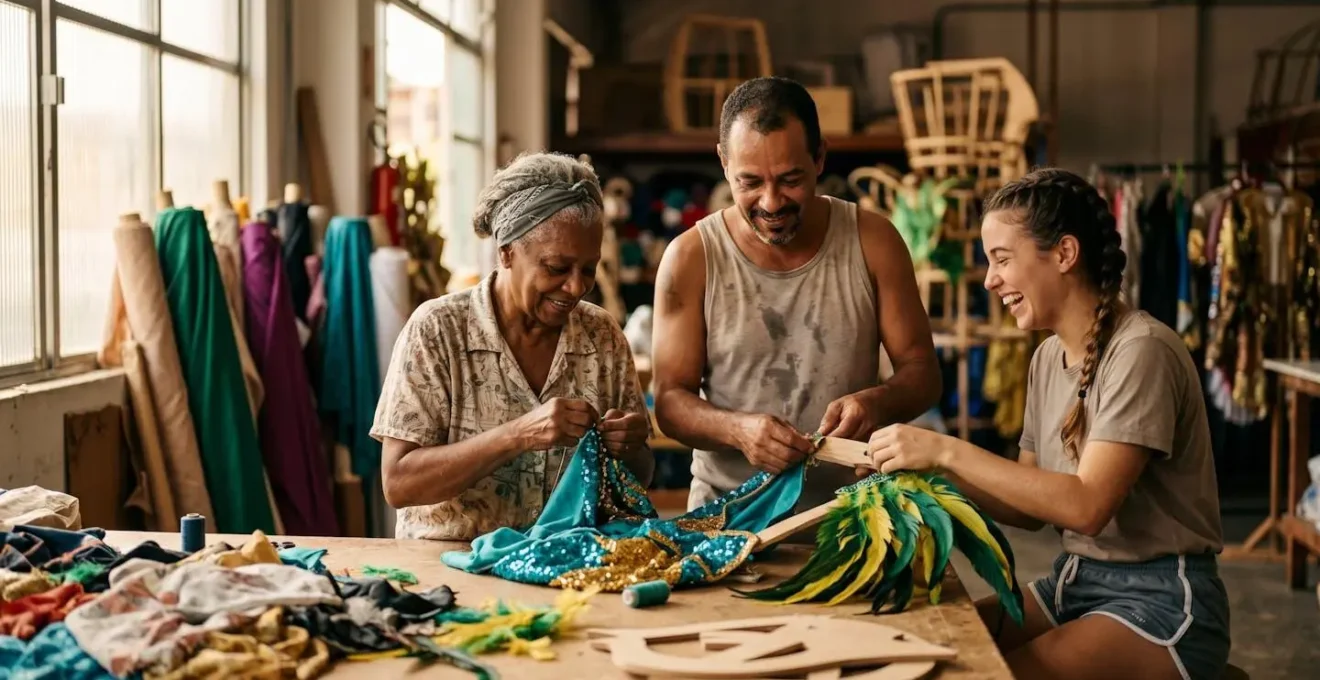
The image of community members from different generations working side-by-side in a workshop—sewing sequins, tuning drums, painting props—is the true face of Carnival. It is this collective effort, this shared sense of purpose rooted in the favela, that infuses the parade with its profound emotional power. It’s a celebration by the community, for the community, which they graciously share with the world.
Practicing for Months: The Athleticism of a 80-Minute Parade
The dazzling smiles and seemingly effortless dancing on the Sambadrome avenue conceal a brutal physical reality: the Carnival parade is an 80-minute, high-intensity endurance event. Participants are not just revelers; they are performance athletes who have trained for months to withstand the grueling demands of the show.
The physical toll is immense. Each participant must sing at the top of their lungs and dance with explosive energy for the entire duration, all while wearing elaborate and often heavy costumes. For key performers like the *Rainha de Bateria* (Queen of the Drums), the physical burden is even greater. In the 2026 Carnival, influencer Virginia Fonseca’s debut was marked by visible struggles with her 12-kilogram costume and headdress, a testament to the role’s difficulty. This is not an anomaly; it is the standard. Former queens have recounted wearing costumes weighing over 30kg while dancing non-stop in the intense Rio heat.
This level of performance is impossible without dedicated physical conditioning. According to an NPR report documenting the preparation, dedicated performers train for two hours a day, five days a week, with a regimen of weightlifting and running. This training builds the cardiovascular stamina and muscular strength necessary to maintain peak performance from the moment they enter the avenue until they cross the finish line 80 minutes later. A lapse in energy not only looks bad to the judges under the « Evolution » criterion (which scores the flow and energy of the parade) but also jeopardizes the school’s all-important *Harmonia*.
The Little Giant: Providing Harmony in a Sea of Percussion
In the vast ocean of rhythm created by the 300-strong *bateria*, one instrument stands as the vital harmonic anchor: the cavaquinho. This small, four-stringed instrument, similar to a ukulele, might seem hopelessly outmatched, a tiny voice against a thunderous roar. Yet, without it, the entire musical structure of the parade would collapse.
The cavaquinho is the primary instrument of harmony in samba. It is wielded by the lead singers, known as *intérpretes* or *puxadores*, who are responsible for leading the entire school in singing the *samba-enredo*. While the drums provide the rhythmic drive, the cavaquinho provides the melodic and harmonic roadmap. Its bright, percussive strums outline the chord changes of the song, acting as a constant reference point for the thousands of singers spread out along the 700-meter avenue. It is the « little giant » that ensures everyone, from the front wing to the very last float, is singing in the same key and following the same progression.
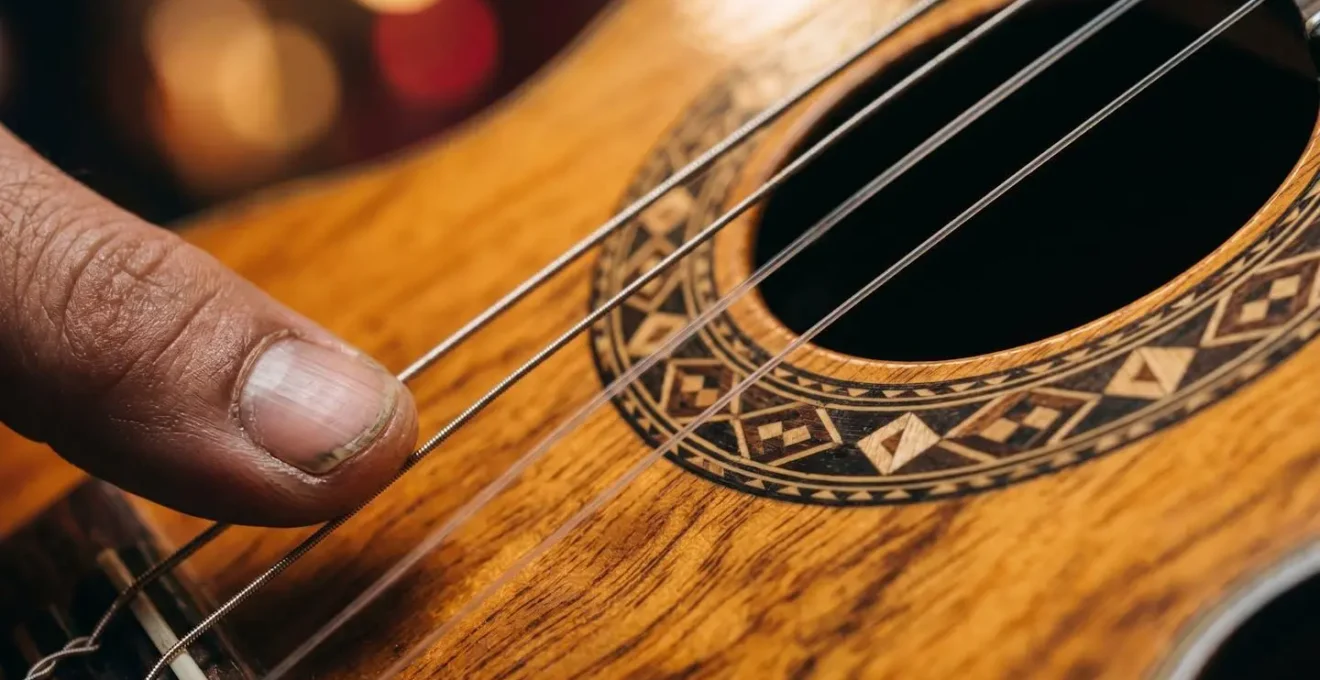
The role of the *intérprete* is therefore twofold: they are both the lead vocalist and the principal harmonist. They must have a powerful, indefatigable voice to be heard over the din, but they must also be a masterful cavaquinho player, maintaining a rock-steady harmonic pulse for over an hour. This dual skill is rare and highly prized. The microphone on the singer’s float doesn’t just amplify their voice; it amplifies their cavaquinho, feeding that essential harmonic information into the sound system and broadcasting it to every corner of the Sambadrome, guiding the entire school like a musical lighthouse.
The Apito: Directing 300 Drummers with a Whistle
At the heart of the samba school’s percussive engine—the *bateria*—is a single, powerful figure: the *Mestre de Bateria* (Drum Master). This commander stands before a force of, on average, about 300 percussionists who form the bateria, and directs this thunderous orchestra not with a baton, but primarily with an *apito*—a simple whistle.
The apito is the Mestre’s instrument of command. Through a complex series of short and long blasts, the Mestre cues every change, every break, and every flourish the bateria performs. This is the essence of rhythmic discipline. Each whistle pattern is a pre-rehearsed command that signals a specific action, whether it’s for the caixas (snare drums) to play a different pattern, the surdos (bass drums) to change their beat, or for the entire section to launch into a *paradinha*. These are intricate, choreographed breaks where the main rhythm stops, a complex percussive phrase is played, and the entire section returns to the original beat without losing a single millisecond of tempo.
According to judging criteria, « The rhythm should be varied and diverse but should be managed perfectly, especially around the breaks. » The ability to stop 300 musicians on a dime and bring them back in perfect unison is a hallmark of a top-tier bateria. This shows not only the skill of the drummers but also the absolute authority and clarity of the Mestre’s direction. The apito, combined with hand signals and sheer force of personality, is the control interface for this massive, living drum machine. It’s a breathtaking display of leadership and non-verbal communication, turning potential chaos into a precise, powerful, and exhilarating rhythmic statement.
Why Uploading 4 Weeks in Advance Is Crucial for Playlist Pitching
While the Sambadrome is an arena of live, visceral, and ephemeral performance, the life of a school’s *samba-enredo* doesn’t end when the parade is over. In the modern music industry, the winning theme song becomes a cultural artifact with commercial potential. For this music to find an audience beyond Brazil, it must navigate the world of digital streaming, a universe with its own set of unforgiving rules.
Just as a samba school plans its parade for an entire year, a musician or label must plan a digital release with similar foresight. A core principle in this world is preparation. The industry standard of pitching a song to editorial playlists on platforms like Spotify requires the track to be uploaded and submitted at least four weeks in advance. This lead time is not arbitrary; it’s the time needed for algorithms to process the data and for human curators to listen, evaluate, and potentially place the track in a high-traffic playlist like « Carnaval! » or « Samba Mania. »
This principle of advance planning is a direct parallel to Carnival itself. Rushing a release at the last minute is the digital equivalent of a school showing up to the avenue without having rehearsed its *paradinhas*. It guarantees the music will be lost in the noise. Therefore, a school’s success on the avenue and the subsequent success of its music online are both rooted in the same philosophy: meticulous, long-term preparation is the foundation of a flawless performance.
Key Takeaways
- Carnival is Engineered, Not Improvised: The sound is a highly controlled system using mobile sound trucks and advanced mixing to balance harmony and percussion.
- Judging is Ruthlessly Precise: Musical criteria like *Harmonia* and *Bateria* are scored to the decimal point, where a single misstep can cost a school the title.
- Performers are Athletes: The 80-minute parade is a grueling endurance event requiring months of intense physical training to perform at peak energy.
Samba: The heartbeat of Brazil and its polyrhythmic joy
Ultimately, all the technology, training, and competition serve one purpose: to deliver the purest, most powerful expression of samba. Samba is more than a genre; it is the cultural heartbeat of Brazil. Its polyrhythmic joy, born from Afro-Brazilian roots, is a declaration of resilience, identity, and an unbreakable spirit of celebration. The parade is the ultimate manifestation of this spirit, a living, breathing embodiment of the music’s power to unite and uplift.
The samba school’s role extends far beyond the parade’s 80 minutes. They are pillars of their communities, providing social structure and support. As noted in cultural analyses, « By offering these opportunities, samba schools help to uplift their communities and provide a sense of purpose and direction for young people. » This deep social function is the source of the profound emotion you witness on the avenue. Every drum beat is a pulse of community pride, every voice in the chorus a testament to collective identity.
So when you next watch the parade, listen past the initial roar. Hear the sonic architecture at play. Listen for the Mestre’s apito cutting through the drums, for the cavaquinho’s steady harmonic guidance, for the impossible unison of 3,000 voices locked in perfect harmony. You are witnessing more than a party. You are witnessing a year of passion, a century of tradition, and a monumental feat of musical engineering, all culminating in a transcendent, 80-minute symphony of polyrhythmic joy.
To experience this spectacle with a newfound appreciation, your next step is to plan your visit, not just as a tourist, but as a knowledgeable spectator ready to witness the intricate dance of music, culture, and engineering firsthand.