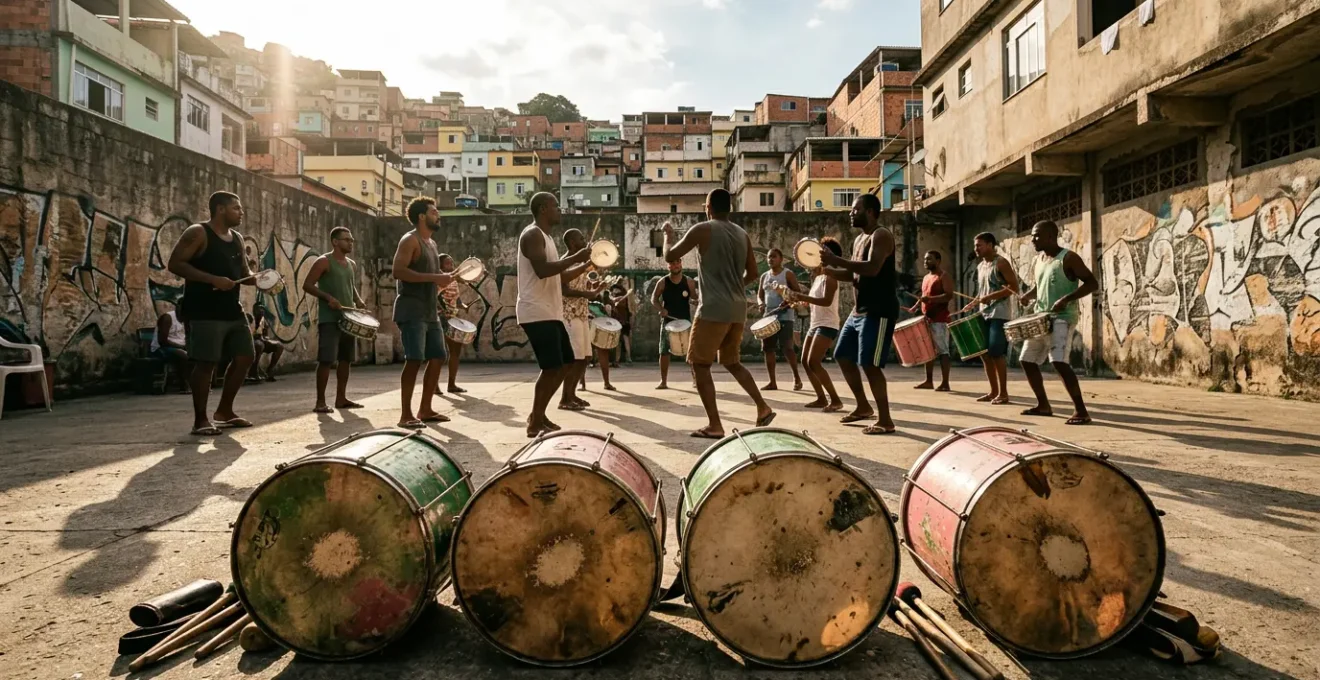
Most people think Samba is a simple, happy 2/4 party beat. They are wrong. Samba’s infectious energy is not accidental; it is a meticulously engineered system of rhythmic tension and release. This is not just music, it is a science of sonic manipulation. We will deconstruct the neural and physical mechanics behind the ‘swing,’ revealing how each instrument conspires to lock into your brain and propel you forward.
Listen. Close your eyes and feel that deep, resonant pulse. That is more than a drum; it is the foundation of an entire culture. As a Mestre de Bateria, I live inside this rhythm. I see percussionists and dancers from all over the world try to capture it. They learn the patterns, they buy the instruments, they watch the videos. But they often miss the soul of it. They chase the notes, but the secret of Samba is not in the notes themselves. It’s in the space *between* them. It’s in the microscopic push and pull that creates the swing, the *balanço*.
Many will tell you it’s about the « feel, » a mystical quality you either have or you don’t. That is a lazy explanation. The « feel » of Samba is a product of deliberate design, a form of acoustic engineering refined over generations. It’s about understanding how a deep bass frequency can physically move a crowd, how a specific hand technique on a drum can create rhythmic friction, and how a layered polyrhythm can hijack the listener’s brain through a process called neural entrainment. This isn’t just art; it’s a science of connection.
In this guide, we are not going to skim the surface. We will dissect the bateria, piece by piece. We will go from the foundational surdo beat to the complex interplay of clave patterns, from the conductor’s whistle to the narrative power of the rhythm. You will learn not just *what* we play, but *why* we play it that way. Prepare to have your understanding of rhythm rewired.
This article breaks down the complex engine of Samba into its essential components. Follow this guide to understand how thousands of musicians and dancers move as one, driven by a single, polyrhythmic heartbeat.
Summary: Deconstructing the Polyrhythmic Engine of Samba
- The Heartbeat: How the Deep Drum Controls the Parade
- The « Virado »: The Flip Technique That Defines the Swing
- The Shaker Drive: Why the 16th Notes Are Not Straight
- The Apito: Directing 300 Drummers with a Whistle
- Telling a Story: How the Music Fits the Parade Theme
- Paradiddles for Life: Why Hand Independence Fixes Your Feet
- Feeling the Clave: How to Listen to Afro-Cuban Polyrhythms
- Beyond the feathers: The musical engineering of Rio Carnival
The Heartbeat: How the Deep Drum Controls the Parade
Everything starts with the surdo. This is not negotiable. The surdo is the heart of the bateria, and its pulse is the law. We use three types: the *primeiro* (first) and *segundo* (second) which lock in a powerful, low-end conversation on beats 1 and 2, and the *terceiro* (third), which cuts through with syncopated patterns. But it’s the primeiro that truly commands the parade. Its deep, resonant tone produces low-frequency waves that you feel in your chest more than you hear with your ears. This is the physical anchor for the entire school.
This is not just poetry; it’s physics. The sound waves produced by the largest surdos verge on infrasound. Research on infrasound demonstrates that frequencies below 20 Hz, while often inaudible, are perceived by the human body as pressure and vibration. This is what aligns thousands of people along the Sambadrome. Before their brains even process the rhythm, their bodies are being physically moved by the surdo’s pulse. It creates a shared physical experience, a common ground upon which all other rhythmic complexity is built.
As a Mestre, my first job is to ensure this foundation is rock-solid. If the surdo section wavers, the entire structure collapses. The dancers lose their anchor, the smaller instruments lose their reference, and the energy dissipates. The surdo doesn’t just keep time; it exerts physical control. It is the gravitational center of our universe, and every other musician, dancer, and spectator is caught in its orbit. Understand this, and you understand the first law of Samba.
The « Virado »: The Flip Technique That Defines the Swing
Now that you feel the heartbeat, you must understand the swing. The ‘swing’ or *balanço* of Samba is born from tension, and the primary source of that tension is a hand technique called the *virado*. This is most prominent on the *caixa* (snare drum) and the *tamborim* (small hand drum). A beginner plays the notes on the beat. An expert plays with the space around the beat. The virado is a rapid wrist-flip motion that slightly delays or anticipates a note, creating a micro-timing friction against the steady pulse of the surdo.
This is not a mistake or sloppy playing. It is a highly controlled, intentional manipulation of time. This « rhythmic friction » is what separates a mechanical beat from a living, breathing groove. It’s the difference between a drum machine and a bateria of 300 drummers. This is where the individuality of the player meets the collective pulse of the group. As a researcher at Scientific Reports puts it when studying the brain’s reaction to rhythm:
Individual differences in rhythmic cortical entrainment correlate with predictive behavior in sensorimotor synchronization.
– Nozaradan, S., Peretz, I. & Keller, P. E., Scientific Reports
This means your brain’s ability to lock onto and predict a rhythm is unique. The virado exploits this, creating a pattern that is almost, but not quite, predictable. Your brain is constantly making micro-adjustments, which generates a state of active listening and physical engagement. This is the neural basis of swing. The technique makes your brain work harder, and that work feels like joy and an irresistible urge to move.
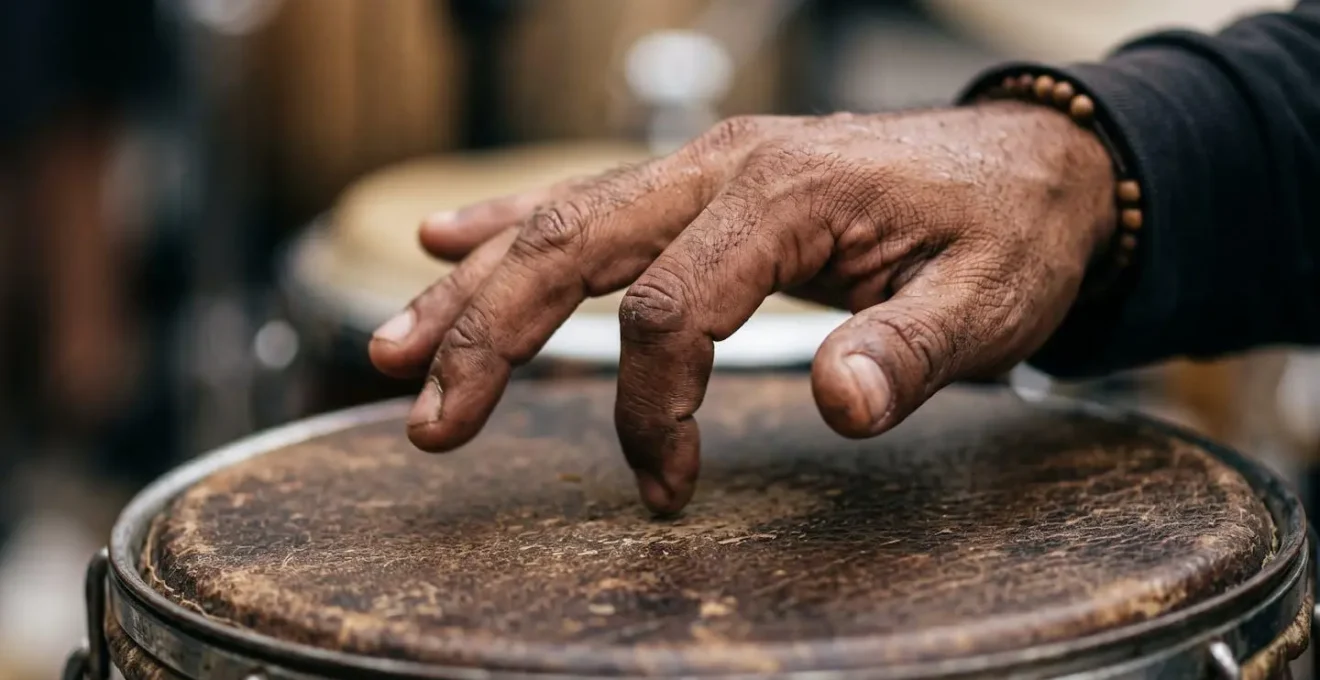
Look at the hands of a master *caixa* player. You will see a lifetime of this motion etched into their muscle memory. The virado is not just a technique; it is a philosophy. It teaches you that the most powerful moments in music often lie in the smallest, most subtle deviations from the norm. Master this, and you stop just playing notes—you start playing with time itself.
The Shaker Drive: Why the 16th Notes Are Not Straight
If the surdo is the heart and the virado is the swing, then the *chocalho* (shaker) is the engine. This wall of sound, produced by dozens of players shaking metal jingles, lays down a constant stream of 16th notes. A common mistake for outsiders is to assume this is a straight, metronomic pulse. It is not. The chocalho pattern is deliberately « lopsided, » with a specific accent pattern that creates a galloping, forward-driving motion. It’s a continuous wave of energy that propels the entire bateria forward.
This is not random noise; it’s a precisely crafted texture. The pattern is often described as a « long-short-long-short » feel, which creates a specific polyrhythmic relationship with the 2/4 pulse of the surdos. Your brain latches onto this dense, high-frequency information. This powerful drive is explained by neuroscience. A 2023 Journal of Neuroscience study found that the strongest rhythmic entrainment occurs in the 6 to 8 Hz range. A rapid 16th-note shaker pattern falls directly within this « sweet spot, » creating a powerful and almost hypnotic effect that makes it impossible to stand still.
The role of the chocalho player is one of endurance and precision. They are not just keeping time; they are generating the raw, high-frequency energy that fills every sonic space. Without the chocalho drive, the bateria would feel hollow and lack momentum. It’s the layer that connects the deep pulse of the surdo to the syncopated cuts of the smaller drums. It is the connective tissue of the rhythm, the constant current that flows through the entire ensemble.
The Apito: Directing 300 Drummers with a Whistle
Now, how do you conduct this thunderous force of 300 drummers? Not with a baton. You use an *apito de samba*—a three-toned whistle—and a series of hand signals. This is the command center. The apito is my voice, cutting through the immense volume of the bateria to signal changes, breaks (*paradinhas*), and calls to attention. Each Mestre has their own language of signals, a vocabulary of gestures and whistle patterns understood instantly by every member of the bateria.
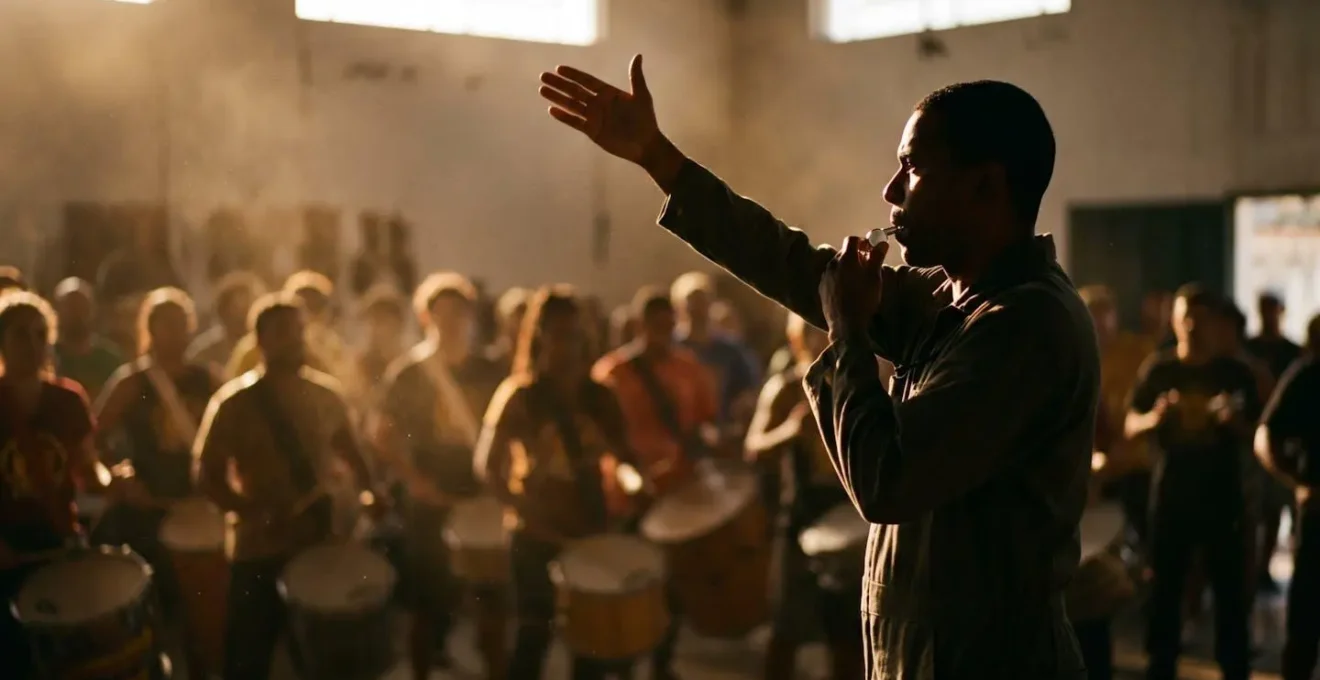
This system of non-verbal communication is brutally efficient. A long, high-pitched whistle blast might mean « attention, » a series of short trills could signal the start of a specific rhythmic break, and a sharp hand gesture commands an immediate stop or a dynamic change. We are coordinating a massive, moving organism in real-time, in a high-pressure environment. There is no room for ambiguity. The communication must be instantaneous and absolute.
The relationship between the Mestre and the bateria is one of deep trust. They trust me to guide them, to make the right calls that will impress the judges and ignite the crowd. I trust them to execute those calls with flawless precision and energy. This is leadership boiled down to its purest form: clear communication, shared purpose, and a deep, collective understanding of the mission. The apito is not just a tool; it is the symbol of that trust and the focal point of the bateria’s collective consciousness.
Telling a Story: How the Music Fits the Parade Theme
Why do we have these complex breaks and signals? Because we are not just playing a beat. We are telling a story. Every year, each samba school chooses a theme, the *samba-enredo*, which is a narrative told through song, costume, floats, and, crucially, rhythm. The bateria’s performance is a musical interpretation of this story. The rhythmic breaks, the solos, the changes in instrumentation—they all serve to highlight key moments in the narrative sung by the *puxador* (lead singer).
The music becomes a form of sonic semiotics, where specific rhythmic patterns become symbols. A sudden, aggressive break might represent a battle. A section featuring only the light, chattering sound of the tamborims could evoke the feeling of rain or whispers. A powerful call-and-response between the caixas and the surdos might dramatize a dialogue between characters in the story. We are painting pictures with sound.
A perfect example of this is the championship-winning performance by Mangueira in 2019, which transformed the parade into a powerful political statement.
Case Study: Mangueira 2019’s « História pra Ninar Gente Grande »
Mangueira’s 2019 parade, ‘Story to Lull Adults to Sleep,’ presented Brazilian history not from the perspective of the official, state-sanctioned heroes, but through the eyes of marginalized figures and popular heroes. The enredo honored figures like Dandara, Luiza Mahin, and the recently assassinated councilwoman Marielle Franco. The bateria, under the direction of Mestre Wesley, used its rhythmic breaks to musically interpret the verses that « official history had erased. » The drums didn’t just accompany the song; they became the voice of resistance, using powerful, defiant patterns to underscore the parade’s counter-narrative and solidify its cultural impact.
This is the ultimate purpose of the bateria. Our job is to give the enredo its emotional weight and dramatic punch. We provide the soundtrack to the school’s identity for that year. We are not just drummers; we are storytellers.
Paradiddles for Life: Why Hand Independence Fixes Your Feet
For a percussionist or a dancer, the ultimate goal is liberation: the ability for each limb to operate independently while contributing to a cohesive whole. This is the essence of polyrhythm. And the key to unlocking it is not some mystical secret, but relentless, disciplined practice. The foundation of this practice? The humble paradiddle (RLRR LRLL).
You may think paradiddles are just a simple hand exercise for drummers. You would be wrong. The paradiddle is a fundamental building block of intermodal skill transfer—the process by which your brain learns to coordinate separate motor tasks. By drilling these patterns with your hands until they are automatic, you are literally building and reinforcing neural pathways. Once your hands are on autopilot, you can begin to layer in conflicting rhythms with your feet. This is where the magic happens. You are forcing your brain to manage two or more independent rhythmic streams simultaneously.
This process is not just about muscle memory; it’s about rewiring your brain. For dancers, mastering this hand-to-foot independence is what allows you to maintain the intricate, rapid footwork of the *samba no pé* while your upper body remains fluid and expressive. For percussionists, it’s what allows you to hold down a steady pattern with one hand while improvising complex syncopations with the other. This isn’t just a Samba skill; it’s a life skill for any rhythmic artist.
Your Action Plan: Rewire Your Brain for Polyrhythmic Independence
- Isolate and Conquer: Practice basic paradiddles (RLRR LRLL) with your hands only, at a very slow tempo. Focus on clean, even strokes. This establishes clean motor patterns in your primary motor cortex.
- Introduce the Pulse: While maintaining the hand paradiddles, add a simple, steady quarter-note pulse with your feet (tapping one foot, then the other). This creates the initial pathway for independence.
- Create Conflict: Introduce conflicting rhythms. Keep your hands in a 4/4 paradiddle pattern while your feet walk a simple 3/4 pattern (ONE-two-three, ONE-two-three). This forces true intermodal skill transfer.
- Decouple and Integrate: Play paradiddles with your hands, walk a polyrhythmic pattern with your feet, and try to sing a simple melody in a different meter. This fully engages spike timing-dependent plasticity to rewire neural pathways for multi-stream rhythmic processing.
Feeling the Clave: How to Listen to Afro-Cuban Polyrhythms
To truly understand Samba’s rhythmic identity, you must understand what it is not. A frequent point of confusion for musicians is the relationship between Brazilian rhythms and Afro-Cuban rhythms. Both have African roots, but their structural philosophies are fundamentally different. The core of this difference lies in the concept of the *clave*.
In Cuban music like Son or Salsa, the clave is a specific, unchanging two-bar pattern (often 3-2 or 2-3) that acts as a rhythmic « key. » Every instrument in the ensemble must align with it. The clave is the rigid skeleton of the music. If you play against the clave, you are wrong. It is an explicit, foundational timeline that dictates the structure for everyone.
Brazilian music, particularly Samba, does not have a rigid, explicit clave in the same way. Instead, it has what some call the *partido alto* pattern. This is a more flexible, cyclical pattern that is often implied rather than played explicitly. It’s more like a flowing river than a rigid skeleton. Musicians play *around* it, they converse with it, they decorate it. There is a deep, shared understanding of this underlying pulse, but there is more freedom to interpret it. The identity of the rhythm lives in the conversational interplay, especially between the guitar and the pandeiro, not in strict adherence to a fixed pattern.
This table breaks down the fundamental philosophical differences between these two great rhythmic traditions, a distinction that is crucial for any dancer or percussionist to understand. According to a study in Frontiers in Psychology, these differences can be traced back to distinct historical and cultural influences.
| Characteristic | Cuban Clave | Brazilian Partido Alto |
|---|---|---|
| Structural Function | Rigid foundational ‘key’ that dictates rhythm | Flexible cyclical pattern implied and played around |
| Metaphor | Skeleton—fixed framework | River—flowing, adaptive current |
| Historical Influence | Spanish colonial + Catholic syncretism fostering code-based structure | Portuguese influence + Candomblé encouraging improvisational fluidity |
| Player Adherence | Strict synchronization required | Conversational interplay with pattern |
| Entrainment Type | Phase alignment to periodic force (rigid) | Phase coherence with adaptive synchronization |
| Listening Strategy | Listen for wooden sticks marking the timeline | Listen to conversation between guitar and pandeiro—identity lives in the spaces |
The Core Rhythms to Remember
- Samba is not a single rhythm, but a polyrhythmic system built on tension between a steady bass pulse and syncopated layers.
- The « swing » comes from the ‘virado’ technique, a deliberate micro-delay that creates rhythmic friction and engages the brain.
- The entire performance is a form of acoustic engineering, designed to tell a story (the enredo) and physically move tens of thousands of people.
Beyond the feathers: The musical engineering of Rio Carnival
Finally, we arrive at the grand spectacle: the Rio Carnival parade in the Sambadrome. Forget the images of feathers and glitter for a moment and see it for what it truly is: a monumental feat of musical and logistical engineering. A single parade involves coordinating the movement, music, and performance of up to 3,000 performers or more from a single school, all moving in perfect sync down a 700-meter concrete runway.
The Sambadrome itself is a unique acoustic challenge. Its canyon-like architecture creates significant sound delays and phase-cancellation issues. A sound played at the front of the bateria can take nearly two seconds to reach the back. My job as Mestre is not just to conduct the music but to act as a real-time acoustic engineer. We strategically place certain instruments in specific sections of the bateria to combat slap-back echo and ensure the sound is coherent for the judges, who are placed at specific points along the parade route.
Each school has approximately 85 minutes to complete its procession. Every second is calculated. The flow of thousands of people, the deployment of massive floats, and the dynamic performance of the bateria are all choreographed with military precision. With over 90,000 nightly spectators watching, the pressure is immense. The sonic clarity of the bateria directly impacts the school’s final score. What you witness is the culmination of a year of planning, rehearsal, and engineering, all exploding in a single, unified wave of polyrhythmic joy. It is the ultimate expression of our art form—where community, story, and rhythm become one.
Now you have the map. The next step is to walk the path. Pick up your instrument, step onto the dance floor, and start deconstructing the rhythm, one layer at a time. The heartbeat is waiting.