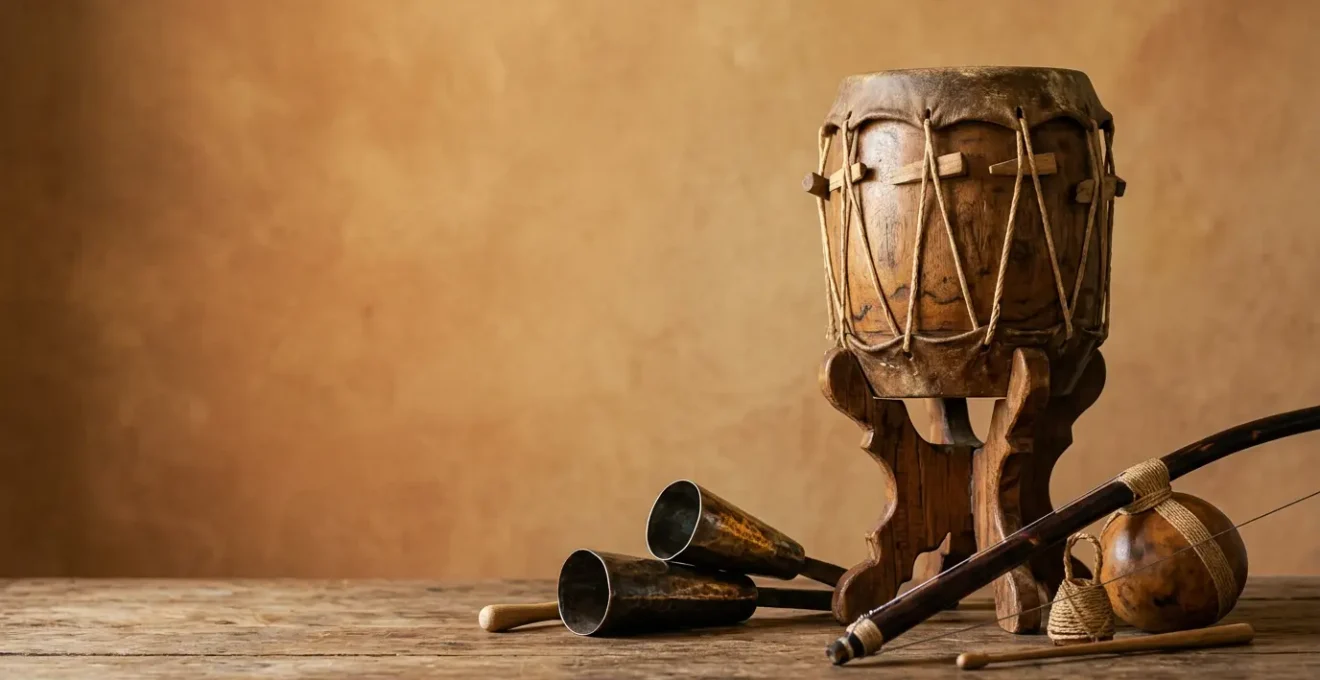
The vibrant, complex soundscape of Brazil is often superficially described as a syncretic mix of European, Indigenous, and African contributions. While not inaccurate, this « melting pot » narrative fails to capture the dynamic and often defiant process through which African musical DNA became the very backbone of Brazil’s most iconic genres. The story of Brazilian music is a story of memory, resistance, and transformation, where the spiritual pulse of Africa was not diluted but purposefully reshaped into a powerful declaration of cultural identity. It is a history written not in books, but in the polyrhythmic language of drums, the call of the one-string bow, and the collective joy of the dance circle.
This exploration moves beyond the cliché to uncover the specific lineages of this transmission. We will investigate how the sacred toques for the Orixás in Candomblé became the rhythmic source code for popular music, and how instruments carried from Africa became symbols of cultural survival. Instead of seeing a simple mixture, we will see a process of ingenious adaptation—of rhythmic syncretism where African sensibilities didn’t just survive but actively reinterpreted and claimed European forms. This was not a fusion of equals, but an act of profound cultural affirmation in the face of immense pressure.
This journey will trace the threads from the sacred spaces of the terreiros, through the defiant communities of the quilombos, and into the burgeoning urban centers where genres like Maxixe and Choro were born. By understanding these foundational elements, the eventual explosion of Samba is revealed not as a sudden phenomenon, but as the culmination of centuries of spiritual and cultural work. We will see that to listen to Brazilian music is to hear an echo of an ancestral voice, a testament to the enduring power of rhythm to preserve a soul and forge a nation’s heartbeat.
To fully appreciate this rich history, this article will guide you through the key musical and cultural milestones that define the African-Brazilian musical experience. The following sections break down this evolution, from its sacred origins to its most famous secular expressions.
Summary: Tracing the African Rhythmic Lineage in Brazil
- Toques for the Orixás: How Religious Rhythms Became Pop Music
- Music for Fight/Dance: The One-String Bow That Leads the Circle
- The First Fusians: How European Polka Met African Rhythm
- The Brazilian Jazz: Virtuosity Before Bossa Nova
- Quilombo Drums: Music as a Tool for Freedom and Identity
- Cante, Baile, Toque: The Inseparable Trinity of Flamenco
- Feeling the Clave: How to Listen to Afro-Cuban Polyrhythms
- Samba: The heartbeat of Brazil and its polyrhythmic joy
Toques for the Orixás: How Religious Rhythms Became Pop Music
The deepest taproot of African musical influence in Brazil lies in the sacred context of Candomblé, an Afro-Brazilian religion. Here, music is not performance but theology in motion. It is the primary vehicle for communicating with the divine pantheon of Orixás, or deities. As ethnomusicological research from the Massa Podcast explains, this is the core function of the music:
Through music and dance, humans communicate with orixás, who are the guardians of axé.
– Massa Podcast ethnomusicology research, Massa: Brazilian Music & Culture – Candomblé episode
Each Orixá has a specific set of rhythms, or « toques, » played on consecrated drums (atabaques), which act as a summons. The goal is to channel axé, the sacred life force, and to facilitate trance and communion. This sacred rhythmic vocabulary, developed and preserved over centuries within the secluded temple communities (terreiros), did not remain isolated. It became a foundational rhythmic library for secular Brazilian music. Musicological research has documented how the Candomblé Ijexá rhythm is a distinct feature of both Samba and Bossa Nova, a clear example of sacred patterns being adapted for popular enjoyment.
Case Study: Gilberto Gil’s ‘Refavela’ and the Afoxé Revival
In 1977, musician and cultural icon Gilberto Gil released the seminal album Refavela. The album was deeply influenced by his participation in the Second World Black and African Festival of Arts and Culture (FESTAC) in Nigeria. A key track, « Patuscada de Gandhi, » explicitly invokes several Orixás and is built upon the Ijexá rhythm. This album marked a pivotal moment, consciously bringing the sounds of Afoxé—a secular carnival procession that uses Candomblé rhythms—into the mainstream of Música Popular Brasileira (MPB). It demonstrated how sacred music could be re-contextualized for a secular audience while retaining its deep spiritual and cultural resonance, sparking a broader « re-Africanization » movement in Brazilian arts.
Music for Fight/Dance: The One-String Bow That Leads the Circle
The story of African musical lineage in Brazil is perfectly encapsulated by a single instrument: the berimbau. This one-string musical bow, made from a wooden pole, a steel wire, and a gourd resonator, is the undeniable heart of Capoeira, the Afro-Brazilian art form that blends martial arts, dance, and acrobatics. The berimbau’s sound dictates the rhythm, style, and speed of the « game » (jogo) played inside the circle (roda). It is the master of ceremonies, a musical conductor for a kinetic, ritualized dialogue.
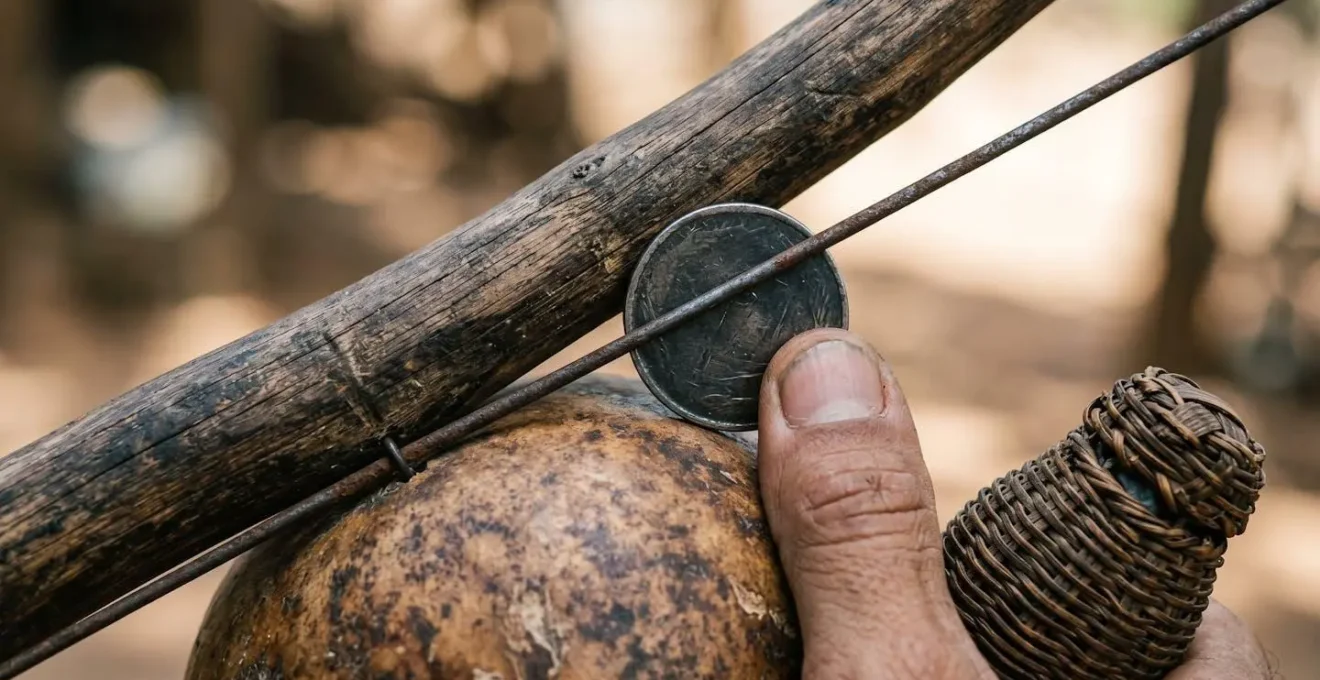
Its musical language is deceptively complex. An organological analysis from Britannica confirms the berimbau is capable of producing three fundamental sounds: a low pitch, a high pitch, and a buzzing noise, created by manipulating a stone or coin (dobrão) against the wire and moving the gourd (cabaça) to and from the player’s body. The combination of these sounds, along with the shaker (caxixi), creates the hypnotic, driving patterns that are instantly recognizable. The instrument’s origin is a direct and undeniable link to the African continent.
The berimbau is an adaptation of African gourd musical bows, as no Indigenous Brazilian or European people use musical bows.
– Wikipedia musicological research, Berimbau – Wikipedia
The berimbau is more than an instrument; it is a symbol of survival. It represents a direct, unbroken technological and cultural thread to Central Africa. Its presence in the roda de capoeira—a circle of shared energy and history—demonstrates how music was not just an accompaniment to resistance but an integral part of its practice, providing the pulse for a « fight/dance » that was itself a form of cultural preservation and physical liberation.
The First Fusians: How European Polka Met African Rhythm
While some African musical traditions were preserved in more direct forms like Candomblé and Capoeira, others engaged in a dynamic process of fusion in Brazil’s burgeoning cities. The emergence of Maxixe in Rio de Janeiro is a prime example of this rhythmic syncretism. Known as the « Brazilian Tango, » Maxixe flourished during the 1870-1920 period of popularity, representing one of the first truly urban Afro-Brazilian musical forms. It was born from the encounter between the structure of European ballroom dances, particularly the polka, and the syncopated rhythms and body movements of the Afro-Brazilian Lundu.
This was not a gentle blending but a cultural takeover. The stiff, formal structure of the polka was injected with a powerful dose of African sensuality and rhythmic complexity. The result was a dance considered scandalous by the elite society of the time precisely because of its overt African characteristics. The close embrace and the characteristic hip movements, known as requebradas, were a direct affront to European Victorian sensibilities.
Case Study: The Scandalous Rise of Maxixe
Emerging around 1870 in Rio’s working-class Cidade Nova district, the Maxixe was a direct product of post-abolition social mixing. It combined the 2/4 time signature and footwork of European polka with the heavily syncopated and hip-driven movements of the Lundu. Initially confined to the city’s red-light districts and lower-class dance halls (gafieiras), its infectious energy proved irresistible. Despite being condemned by the upper classes as immoral and vulgar due to its close-body contact, Maxixe eventually infiltrated elite salons. By the time it reached Europe and the United States around 1914, it was presented as the « Brazilian tango, » a testament to its journey from a marginalized cultural statement to an international dance craze.
Maxixe is therefore a crucial milestone. It demonstrates the assertive nature of African musical aesthetics. It didn’t just add « flavor » to a European form; it fundamentally transformed it, creating something entirely new and distinctly Brazilian. It set a precedent for future genres, proving that the African rhythmic sensibility was not a subordinate element but the dominant, defining force in Brazil’s popular music.
The Brazilian Jazz: Virtuosity Before Bossa Nova
Long before Bossa Nova introduced the world to its cool, sophisticated harmonies, Brazil had its own form of virtuosic, improvisational urban music: Choro. Emerging in Rio de Janeiro in the mid-19th century, Choro is considered Brazil’s first independent national music, a genre born from the creative energy of the city’s musicians. At first glance, Choro’s instrumentation—flute, guitar, and cavaquinho (a small, four-string guitar)—and its complex, contrapuntal melodies can sound decidedly European, drawing comparisons to classical chamber music or early jazz.
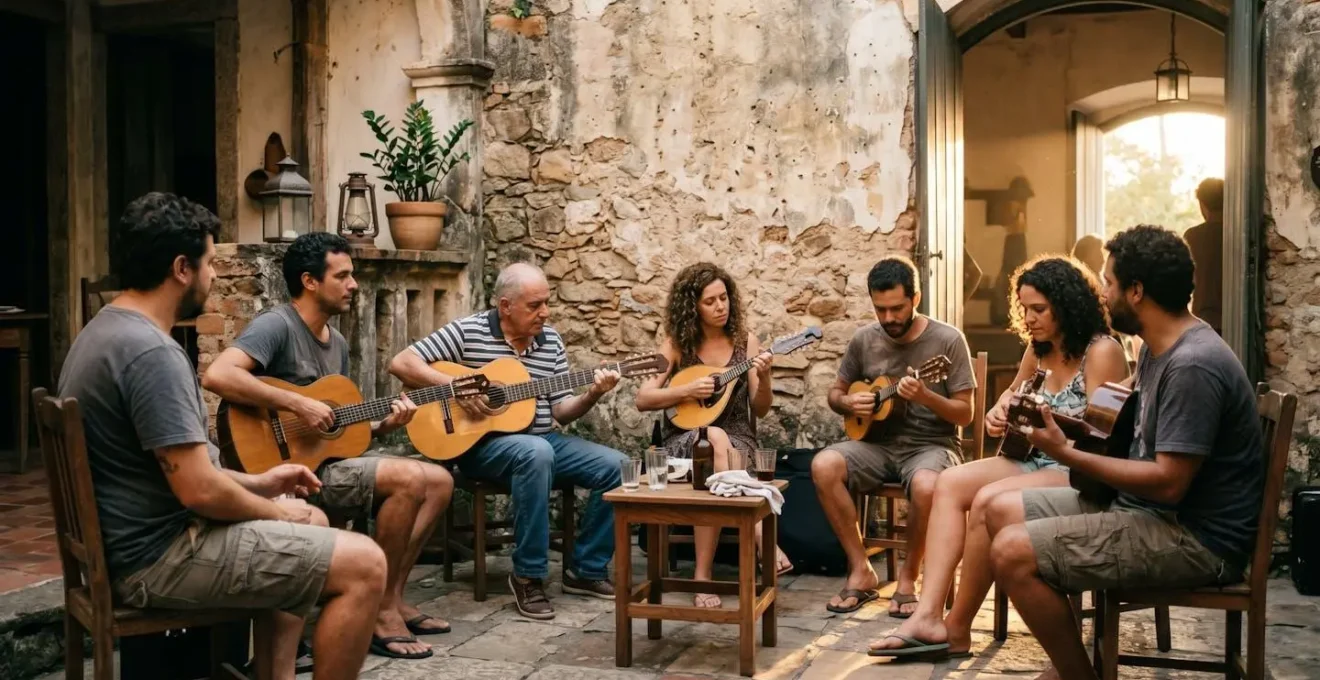
However, to hear Choro as purely European is to miss its African soul. The « swing » and syncopation that give Choro its characteristic lilt and drive are a direct inheritance from Afro-Brazilian rhythmic traditions like the Lundu. Musicians would take European forms like polka, waltz, and schottische and « contaminate » them with this syncopated feel. The informal, circular gathering in which it is traditionally played, the roda de choro, also mirrors the communal structure of the roda de samba and roda de capoeira. This was a musical laboratory where virtuosity and improvisation flourished. One of its greatest innovators was Alfredo da Rocha Viana Filho, known as Pixinguinha.
Pixinguinha merged the traditional music of 19th-century composers with modern jazz-inspired harmonies, sophisticated arrangements, and Afro-Brazilian rhythms.
– Wikipedia music history, Pixinguinha – Wikipedia
Pixinguinha’s work in the 1920s and 30s was pivotal. He formalized arrangements, introduced new harmonies, and importantly, further emphasized the Afro-Brazilian rhythmic elements, laying the groundwork for all modern Brazilian music that followed, including Samba and Bossa Nova. Choro, therefore, stands as a testament to the subtle but powerful ways in which African rhythmic concepts provided the essential foundation for even the most complex and instrumentally virtuosic Brazilian genres.
Quilombo Drums: Music as a Tool for Freedom and Identity
In the history of Brazil, quilombos were communities founded by escaped African slaves. These settlements were more than just refuges; they were centers of resistance and the crucibles in which African culture was fiercely preserved and reconstituted. In this context, music was not a leisure activity; it was an essential tool for survival, communication, and identity. The percussive traditions carried from Africa, particularly from the Bantu-speaking regions of Angola and Congo, became the voice of these freedom-seeking communities. A powerful example of this is Jongo, a tradition that thrived in the quilombos of southeastern Brazil.
Jongo, which combines drumming, dance, and poetic, sung call-and-response, was practiced during slaves’ feasts and served a dual purpose. On the surface, it was entertainment. Beneath the surface, it was a vehicle for coded communication. The lyrics were often rich in metaphors and allusions that were indecipherable to the slave owners, allowing for the sharing of news, the planning of escapes, or the simple expression of collective resistance and hope. This function of music as a form of coded messaging is a direct legacy of practices from slavery.
Case Study: Coded Communication in Quilombo Music
Within the quilombos and on the plantations, music served as a clandestine channel of information. Metaphorical language was a primary tool for conveying messages of resilience, mocking slave owners, or signaling danger under the guise of song. This tradition of protest through music has deep roots, transforming call-and-response songs and intricate percussion patterns into essential tools for rebellion and survival. The « visiting » and « demanding » Jongo drums, known as Caxambú and Candongueiro, would hold a dialogue, with the sung poetry (pontos) carrying hidden meanings understood only by the community, creating a protected space for free expression.
The music of the quilombos, therefore, represents one of the most vital functions of African musical traditions in Brazil. It was the sound of freedom itself. These drum-centered practices, built on call-and-response and interlocking rhythmic patterns, not only preserved a cultural memory of Africa but also served a direct, strategic purpose in the fight for liberation. This legacy of music as a voice for the marginalized and a tool for social commentary continues to be a powerful force in Brazil today.
Cante, Baile, Toque: The Inseparable Trinity of Flamenco
To better understand the integrated nature of Afro-Brazilian performance, it is useful to look at a comparative example from another diaspora: the Flamenco tradition of Andalusia, Spain. Flamenco is famously built upon an inseparable trinity: the cante (song), the baile (dance), and the toque (the guitar playing). These three elements are not separate disciplines performing together; they are three facets of a single, unified expression of emotion and storytelling. The guitarist follows the singer’s lament, the dancer translates the rhythm and emotion into physical form, and the singer’s voice is spurred on by the percussive footwork of the dancer. There is a constant, improvisational dialogue between all three.
This concept of an inseparable trinity provides a powerful analytical lens for viewing Afro-Brazilian cultural forms. The Western idea of a concert, with a clear separation between musician, dancer, and audience, often fails to capture the holistic nature of these practices. In a Candomblé ceremony, the toque (drumming), the singing of sacred verses, and the dance of the initiates are all part of a single ritual act designed to summon the Orixás. One cannot exist without the others; they are a unified whole.
Similarly, in a roda de capoeira, the toque of the berimbau, the call-and-response songs sung by the circle, and the baile—the fight/dance of the two players in the center—are inextricably linked. The music dictates the dance, and the energy of the dance feeds back into the music. Even in a Samba de Roda, the percussive toque, the sung cante, and the solo dance (baile) in the center of the circle form a single, cohesive community event. This parallel reveals a common structural principle in powerful folk traditions: the integration of music, movement, and voice into a single, indivisible act of cultural expression.
Feeling the Clave: How to Listen to Afro-Cuban Polyrhythms
To truly hear the African heart in Brazilian music, one must understand the concept of polyrhythm—the simultaneous use of two or more conflicting rhythms. While the term may sound academic, its feel is intuitive and is the engine of most music of the African diaspora. A classic and clear example to help train the ear is the Afro-Cuban clave. The clave is a five-stroke rhythmic pattern that functions as a structural core, a rhythmic key around which all other instruments in a salsa or rumba ensemble are organized. It is both a pattern and a physical instrument (two wooden sticks).
The most common son clave pattern can be felt as a « three-side » and a « two-side, » creating a rhythmic tension and release that propels the music forward: *ONE, two, three, FOUR, five* | *ONE, two, THREE, four, five*. Once you learn to identify this underlying pulse, you can hear how the conga drums, the bassline, and the piano montuno all « lock in » to it, each playing their own pattern that complements and converses with the clave. It is a system of interlocking parts, a rhythmic democracy where each instrument has a distinct voice that contributes to a unified, complex whole.
This same principle of interlocking polyrhythms is fundamental to Brazilian music, though the specific patterns are different. In Samba, for instance, you have the steady pulse of the surdo drum, the high-pitched, syncopated line of the tamborim, the metallic drive of the agogô bells, and the scraping rhythm of the ganzá shaker. Each part is relatively simple on its own, but together they create a dense, irresistible rhythmic fabric. Learning to listen for the clave in Cuban music can thus be a gateway to hearing the equally complex, but differently structured, polyrhythmic conversations happening in Samba, Maracatu, and Candomblé music.
Action Plan for Active Listening: Identifying the African Rhythmic Core
- Isolate the Bass Pulse: First, find the lowest, most foundational drumbeat (like the surdo in samba). This is the anchor, the heartbeat of the rhythm.
- Identify the High-Pitched Pattern: Next, listen for a repeating, high-pitched metallic or wooden sound (like the agogô bells or clave). This is often the key signature pattern.
- Find the « In-Between » Rhythms: Listen for the shaker (ganzá) or other percussion filling the spaces. Notice how it creates a continuous texture or a syncopated « off-beat » feel.
- Listen for Call-and-Response: Pay attention to the vocals or instrumental solos. Does one phrase get « answered » by the group or another instrument? This is a core African musical trait.
- Feel the Tension: Instead of counting, try to feel which rhythms seem to push the beat forward and which seem to pull it back. This feeling of rhythmic tension and resolution is the essence of polyrhythm.
Key Takeaways
- Brazilian music’s African roots go beyond a simple « mix, » originating in sacred Candomblé rituals where music is a bridge to the divine.
- Music served as a vital tool for resistance and coded communication in quilombos, making it integral to the fight for freedom.
- Rhythmic syncretism, where African rhythmic sensibilities transformed European forms like the polka, was an act of cultural assertion, not passive blending.
Samba: The heartbeat of Brazil and its polyrhythmic joy
If all the streams of African musical influence in Brazil converge into a single, mighty river, that river is Samba. Born in the Afro-Brazilian communities of Rio de Janeiro and Salvador (Bahia) in the late 19th and early 20th centuries, Samba is the grand synthesis of the elements we have explored: the sacred call-and-response of the terreiros, the communal circle of the roda, and the defiant spirit of resistance. Its oldest and most foundational form is the Samba de Roda from Bahia, a tradition so vital that it was granted 2008 UNESCO recognition as Intangible Cultural Heritage of Humanity.
Like Capoeira, the Samba de Roda is a holistic event: a circle of participants clap and sing in a call-and-response format while musicians play percussion, and individuals take turns dancing with virtuosic flair in the center. It is communal, participatory, and deeply rooted in the social life of the community. When this tradition migrated to the urban environment of Rio de Janeiro with Bahian migrants, it evolved into the urban samba (samba-carioca) that would eventually become a national symbol. Yet, its early years were marked by persecution. As a cultural expression of Black Brazilians, it was associated with vagrancy and crime, forcing its practitioners into hiding.
The re-appropriation of African identity within Samba has been a recurring theme, most powerfully seen in the Bloco Afro movement in Salvador, Bahia, in the 1970s. This was a conscious « re-Africanization » effort, as groups like Ilê Aiyê and Olodum rejected the commercialized, Europeanized aesthetics of Rio’s carnival. They created new musical forms like Samba-Reggae, using their music and carnival parades to celebrate Black history, denounce racism, and forge explicit connections with pan-African identity. This movement shows that the African root of Samba is not just a historical fact but a living, evolving source of political and cultural power.
Understanding this lineage—from the sacred to the secular, from resistance to national celebration—is essential. To listen to Samba is to hear the resilience of the quilombo, the spirituality of the orixá, and the unshakeable joy of a people who turned rhythm into a testament of their enduring soul. The next step is to listen with these new ears, to seek out these layers in the music, and to recognize the profound history contained within every beat.