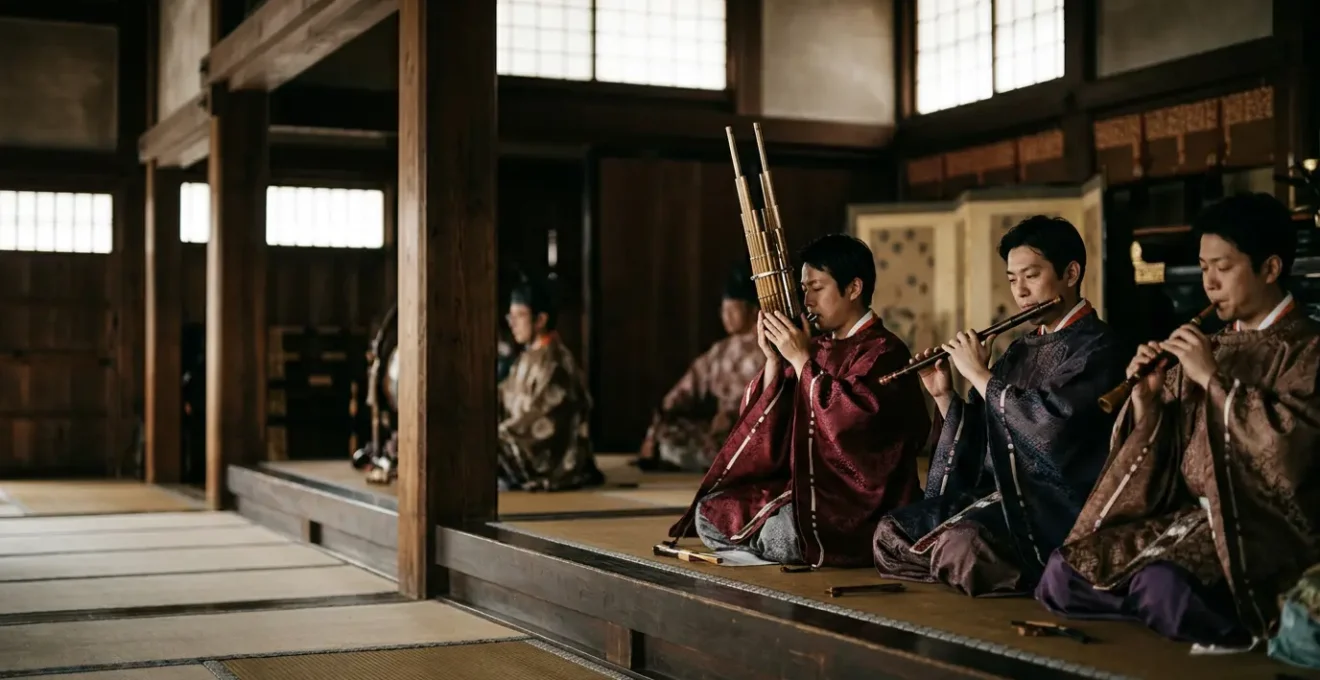
Many hear Gagaku as merely slow, strange, or ‘out-of-tune’ music. This perception misses its true essence. Gagaku is not a performance to be passively heard, but a ritual to be experienced—a profound meditation on the flow of time (Jo-ha-kyū) and the power of silence (Ma). It is a cosmological map where each instrument has a spiritual voice, inviting the listener into an ancient worldview, not just an ancient melody.
To the uninitiated ear, the first encounter with Gagaku can be a disorienting experience. The sounds seem to hang in the air, suspended in a time outside our own. Melodies stretch and bend in unfamiliar ways, while vast oceans of silence separate shimmering clusters of harmony. It is a world away from the rhythmic drive and melodic resolutions of Western music. This is the Imperial Court Music of Japan, a tradition with roots stretching back over 1,300 years, making it the oldest continuously performed orchestral music in the world.
One might be tempted to simply label it « meditative » or « ceremonial » and move on. Yet, to do so is to admire a painted screen without understanding the story it tells. The true key to appreciating Gagaku lies not in comparing it to what we already know, but in embracing a completely different aesthetic philosophy. It is an art form built not on entertainment, but on ritual; not on linear progression, but on cyclical breathing; not on the notes themselves, but on the space between them.
This journey into Gagaku is an invitation to perceive music differently. We will explore the fundamental principles of Japanese time and space that shape its structure. We will uncover why its unique scales are a source of profound expression, not dissonance. We will witness its role as a sacred offering in Shinto shrines and learn how this ancient art is kept alive by modern « Living Treasures. » Ultimately, we will come to understand that to listen to Gagaku is to witness a living piece of history—a sound that is both ancient and eternally present.
This article will guide you through the core tenets of this profound musical tradition, revealing the deep aesthetic and spiritual principles that govern its sound. We will explore the architecture of its composition, the symbolic role of its instruments, and its enduring place in Japanese culture.
Summary: Gagaku: The Sacred Heartbeat of Japan’s Imperial Court Music
- Introduction, Break, Rapid: The Structure of Japanese Time
- Empty Space: Why Silence Is as Important as Sound in Japan
- Non-Western Scales: Why It Sounds « Out of Tune » to You
- Music for the Gods: Performing at Shinto Shrines
- Living Treasures: How the Imperial Household Keeps the Art Alive
- 432Hz vs 440Hz: Can You Really Hear the Difference?
- Graphic Scores: When Standard Notation Fails
- The Shō: The sound of heavenly light in Japanese music
Introduction, Break, Rapid: The Structure of Japanese Time
The perception of Gagaku as « slow » is a common one, but it stems from a misunderstanding of its temporal philosophy. Western music often marches forward, driven by a consistent beat and a clear sense of progression towards a climax. Gagaku, however, breathes. It ebbs and flows according to a principle known as Jo-ha-kyū (序破急), a concept that governs not only music but also theatre, martial arts, and even the tea ceremony. This aesthetic ideal shapes the entire experience, creating a sense of organic, natural development rather than mechanical momentum.
Jo-ha-kyū can be understood as a three-part structure. The jo (introduction) is a slow, quiet beginning, where the atmosphere is established and the instruments enter one by one, feeling their way into the sonic space. The ha (break or development) sees a gradual increase in tempo and complexity, as the composition unfolds and the melodic lines interact more freely. Finally, the kyū (rapid or climax) is a swift acceleration towards a sudden, clean end. This structure is not rigid but elastic, allowing a piece to feel as though it is gathering energy naturally before releasing it.
As Wikipedia contributors note in their analysis of the concept, this principle dictates a universal rhythm. It is, as they state:
Roughly translated to ‘beginning, break, rapid’, it essentially means that all actions or efforts should begin slowly, speed up, and then end swiftly.
– Wikipedia contributors, Jo-ha-kyū article
This is why Gagaku lacks a driving « beat. » It is not music for dancing or marching; it is music for contemplation and ceremony. Its pulse is that of a deep breath, a slow dawn, or the turning of seasons. Understanding Jo-ha-kyū is the first step toward shifting from a passive listener, waiting for something to « happen, » to an active participant, experiencing the deliberate and graceful unfolding of time itself.
Empty Space: Why Silence Is as Important as Sound in Japan
If Jo-ha-kyū is the architecture of time in Gagaku, then Ma (間) is the architecture of its space. In Japanese aesthetics, Ma refers to the interval, the gap, the empty space between things. It is not an absence or a void, but an active, meaningful presence. In a painting, it is the unpainted canvas that gives form to the subject. In architecture, it is the empty room that makes a building usable. In Gagaku, it is the silence that gives power and definition to the notes. This is a profound departure from much of Western music, which often fears silence and seeks to fill every moment with sound.
In a Gagaku ensemble, the long pauses between phrases, the decay of a single koto note into nothingness, or the breath before a flute melody begins are all integral parts of the composition. This deliberate use of silence creates a palpable tension and a heightened sense of anticipation. It allows each individual sound to be appreciated in its full purity, without being crowded by others. The listener’s attention is drawn not just to the notes, but to the resonance that lingers in the air after they have faded. The music breathes, and the silence is its exhalation.

As the image above so powerfully suggests, emptiness is not nothingness; it is a canvas for potential. The great violinist Isaac Stern, when speaking of music, perfectly captured this idea, which is the very soul of Ma. He described music as being made not by the notes, but by « the silence between the notes which make the music. » This philosophy is the heart of Gagaku’s serene power. It invites the listener to lean in, to focus, and to find meaning not just in what is played, but in what is left unplayed.
Non-Western Scales: Why It Sounds « Out of Tune » to You
For many listeners accustomed to the Western system of equal temperament, Gagaku can sound « out of tune. » Pitches seem to slide and bend, and harmonies don’t resolve in expected ways. This is not a flaw in performance but a fundamental feature of its tonal system, which predates and operates independently of Western standardization. Gagaku music is not built on the familiar major and minor scales but on a modal system rooted in ancient Chinese theory. This system gives the music its characteristic ethereal and otherworldly quality.
The foundation of this system rests on what an analysis from Stanford University describes as the Japanese modal system divided into 2 primary modes: the ryo scale and the ritsu scale. These scales are not rigid sets of fixed pitches. They are more like melodic frameworks, each with its own central tones and characteristic melodic patterns. The ryo scale is often compared to the Western Mixolydian mode, giving it a brighter, more open feeling, while the ritsu scale is closer to the Dorian mode, lending it a more somber and profound character. The choice between Tōgaku (Music of the Left) and Komagaku (Music of the Right) repertoires also dictates which mode and instrumentation are used.
What truly sets Gagaku apart are the microtonal inflections. Performers, particularly on wind instruments like the hichiriki and ryūteki, use subtle shifts in pitch and embouchure to create expressive ornamentation. These deviations are not errors; they are the soul of the melody, adding a human, breath-like quality that a perfectly standardized pitch cannot achieve. It is a system of relative tuning, where the relationship between the notes matters more than their adherence to an external standard like A440. This is music that values expressive color over mathematical precision.
A Listener’s Guide: How to Approach Gagaku Music
- Set the Scene: Find a quiet space. Do not treat Gagaku as background music; give it your full, undivided attention as you would a ceremony.
- Listen for Texture, Not Melody: Instead of trying to follow a tune, focus on the shimmering clusters of the shō, the piercing cry of the hichiriki, and the breathy flight of the ryūteki.
- Embrace the Silence: Notice the pauses (Ma). Feel the tension they create and the way they make each returning sound more impactful. Do not wait for the silence to end; listen to it.
- Observe the Flow: Pay attention to the Jo-ha-kyū structure. Feel the slow introduction, the gradual acceleration, and the swift conclusion. Let go of the need for a constant beat.
- Release Expectations: Forget what you know about Western harmony and resolution. Allow the sounds to be what they are, without judging them as « in » or « out » of tune. Listen for their expressive quality.
Music for the Gods: Performing at Shinto Shrines
Gagaku is not concert music in the Western sense; its origins and primary function are deeply rooted in ritual and ceremony. It is an offering, a form of communication between the human and divine realms. Performed at Shinto shrines, Buddhist temples, and for official ceremonies of the Imperial Court, its sound is meant to create a sacred atmosphere, to purify a space, and to accompany rituals that mark the passage of time and seasons. This spiritual context is essential to understanding the music’s solemnity and deliberate pace.
The instrumentation of the ensemble is itself a cosmological map. Each instrument carries a profound symbolic weight, representing a different layer of the universe. This « cosmological trinity » is at the heart of the Gagaku soundscape. As described in educational materials from Smithsonian Folkways, this symbolism is central to the tradition. A commonly held view within the tradition is that:
The shō represents heavenly light, the ryūteki (dragon flute) represents the dragon soaring between heaven and earth, and the hichiriki represents the voice of humanity on the ground.
– Gagaku tradition, Smithsonian Folkways educational materials
This trinity forms the melodic core, supported by string instruments like the biwa (lute) and koto (zither) that provide rhythmic and harmonic structure, and percussion like the massive taiko drum that marks the time. When listening, one is not just hearing a flute and an organ; one is hearing a conversation between heaven, earth, and humanity.
The repertoire itself is divided into two main categories, each with its own origin and character. Tōgaku (« Music of the Left ») includes pieces of Chinese and Indian origin and is characterized by smoother, more elegant melodic lines. Komagaku (« Music of the Right ») derives from Korean and Manchurian traditions and tends to have a brighter, more vigorous sound. These are not merely stylistic choices; they are tied to specific ceremonial functions, with different costumes and dance styles for each, reinforcing Gagaku’s role as a complete, multi-sensory ritual art form.
Living Treasures: How the Imperial Household Keeps the Art Alive
The remarkable survival of Gagaku for over a millennium is no accident. It is the result of one of the world’s oldest and most successful cultural preservation efforts, centered on the Music Department (Gakubu) of the Japanese Imperial Household Agency. For centuries, this institution has been the official custodian of the tradition, with its musicians and dancers descending from families who have performed this art for generations. These artists are not just performers; they are living repositories of an ancient body of knowledge, passing down techniques and repertoires from master to disciple.
Official recognition has cemented Gagaku’s status as a cornerstone of Japanese culture. As noted by the Imperial Household Agency, in 1955, Gagaku performed by the Court musicians was designated as an Important Intangible Cultural Property of Japan. This national protection was followed by global acknowledgment when, in 2009, Gagaku was inscribed on the Representative List of the Intangible Cultural Heritage of Humanity by UNESCO. These designations honor the tradition’s historical significance and the continuous efforts of its practitioners.
However, « preservation » in the modern era has evolved beyond simple, static replication. While the core mission remains the faithful transmission of ancient pieces, there is a growing recognition that for a tradition to remain alive, it must also breathe. Until the mid-20th century, the focus was almost exclusively on preservation in its purest form. Since then, musicians from within the tradition, such as the late Sukeyasu Shiba, have pioneered efforts to reconstruct lost pieces from ancient manuscripts and even compose new works within the Gagaku aesthetic. This demonstrates a vital shift: preservation is not about freezing an art form in time, but about ensuring its continued vitality and relevance for future generations.
Today, the musicians of the Imperial Household Agency are often referred to as « Living National Treasures. » They are the guardians of this sacred sound, balancing the immense responsibility of preserving its ancient spirit with the need to ensure it continues to resonate in the modern world. Their dedication ensures that the sound of heavenly light, the dragon’s call, and the voice of humanity will not fall silent.
432Hz vs 440Hz: Can You Really Hear the Difference?
In certain corners of the modern music world, a passionate debate rages around tuning standards, particularly the difference between A=440Hz (the international standard) and the supposedly more « natural » A=432Hz. Proponents of 432Hz claim it has healing properties and aligns better with cosmic frequencies. When listening to the fluid, sliding pitches of Gagaku, one might wonder where it fits into this debate. The answer is simple and revealing: it does not. The entire 432Hz vs. 440Hz argument is a product of a specifically Western preoccupation with fixed, standardized concert pitch, a concept that is foreign to the Gagaku tradition.
Gagaku operates on a system of relative pitch. There is no tuning fork or electronic tuner setting a universal « A. » Instead, the pitch of the entire ensemble is traditionally based on the lead hichiriki (a double-reed pipe), whose pitch can vary slightly depending on the instrument, the reed, and even the ambient temperature and humidity. The other instruments then tune themselves relative to that first note. This creates a living, breathing tonality that is unique to each performance.
The very idea of a single, objective frequency standard is antithetical to the Gagaku aesthetic. As scholars at the Stanford Gagaku Project have noted, « Gagaku’s modal scales use microtonal shifts and are not standardized to a fixed concert pitch like A440. » The music’s expressive power comes precisely from these subtle deviations and the fluid relationships between the notes. The goal is not mathematical perfection but expressive color and spiritual resonance. Asking whether Gagaku uses 432Hz or 440Hz is like asking a master of calligraphy which font he uses; the question misunderstands the very nature of the art form.
Therefore, the debate is entirely irrelevant here. Gagaku’s tuning is not about finding a single « correct » frequency, but about creating a harmonious and expressive soundscape based on the internal logic of its modes and the unique conditions of each sacred performance. It is a powerful reminder that music can be profound and highly structured without adhering to the scientific standards that have come to dominate the Western musical world.
Key takeaways
- Gagaku’s structure is defined by Jo-ha-kyū, an aesthetic principle of slow introduction, gradual development, and rapid conclusion, creating an organic, breathing rhythm.
- The concept of Ma, or meaningful negative space, makes silence as crucial a component as the notes themselves, creating tension and focus.
- Gagaku uses non-Western scales (ryo and ritsu) with microtonal inflections, valuing expressive color over the fixed-pitch precision of A440 tuning.
Graphic Scores: When Standard Notation Fails
How has a musical tradition of such complexity been transmitted across more than a thousand years? The answer lies in a system of notation that is as unique as the music itself. Long before the five-line staff became the global standard, Japanese court musicians developed their own forms of notation. These scores look less like modern sheet music and more like abstract calligraphic art, using a system of symbols to guide the performer through a piece. They are not a precise, prescriptive set of instructions but rather a sophisticated memory aid for an initiated musician.
For wind instruments like the hichiriki and ryūteki, the notation is a form of neumatic tablature. It consists of columns of Japanese characters and symbolic markings next to them. The characters indicate the main notes of the melody, while the squiggles and lines—the neumes—indicate the complex fingerings, breathing techniques, and microtonal ornamentations that give the music its expressive life. As noted by Britannica, these early systems served a specific purpose: « Buddhist notation systems used neumes, squigglelike signs that, like those of the early Christian traditions, served primarily as memory aids with which an initiate could recall the details of a given melody. »

These scores cannot be sight-read by an untrained musician. The knowledge they contain is unlocked only through years of oral transmission, where a master demonstrates the techniques that the symbols represent. The score provides the skeleton of the piece; the master provides its soul. This method ensures that the tradition remains a living, human art form, passed directly from one person to another, rather than a sterile set of data that can be perfectly replicated by anyone. It prioritizes the continuity of a shared aesthetic understanding over the simple transfer of information.
The Shō: The sound of heavenly light in Japanese music
Of all the instruments in the Gagaku ensemble, none is more iconic or enigmatic than the shō. A handheld mouth organ made of 17 slender bamboo pipes, its form is said to resemble a phoenix with folded wings. Its sound is equally otherworldly. The shō does not typically play melodies but produces shimmering, ethereal chord clusters known as aitake. These chords hang in the air, creating a harmonic foundation that is both static and intensely vibrant. In the cosmological landscape of Gagaku, the shō represents the light of heaven, a constant, celestial presence above the earthly activities of the other instruments.

The instrument’s physics are as unique as its sound. It is a free-reed instrument, and unlike most wind instruments, it produces sound upon both inhalation and exhalation. This allows a skilled performer to create a truly continuous, unbroken stream of harmony, a sound that seems to emanate from the air itself. This unending breath further reinforces its symbolism as a timeless, heavenly light. The aitake chord clusters it plays are not chosen for harmonic progression in the Western sense, but are built on cosmological principles, intended to create a stable, meditative atmosphere.
Yet, this ethereal sound is grounded in a deeply tangible and human ritual. The shō is a delicate instrument. The metal reeds inside its bamboo pipes are sensitive to moisture from the player’s breath, which can prevent them from vibrating. To counteract this, musicians must constantly warm the instrument throughout a performance, traditionally over a small, charcoal-filled brazier called a hibachi. This constant, careful act of warming connects the player to their instrument in a physical, almost parental way. It is a beautiful paradox: to produce the sound of heavenly light, one must engage in a humble, earthly ritual of care and maintenance.
The shō perfectly encapsulates the spirit of Gagaku—an art form where the abstractly spiritual is realized through disciplined physical practice, where sound and silence are given equal weight, and where time itself seems to slow, inviting the listener into a state of profound and serene contemplation.
To truly understand Gagaku is to listen with more than just your ears. It requires an open mind, a patient spirit, and a willingness to step into a different frame of reference. The next step in this journey is not just to listen, but to experience it with this newfound understanding.