
Contrary to popular belief, solfège isn’t just for singers or reading sheet music; it’s a physical training system to calibrate your internal ear, making your instrument an extension of your voice.
- It directly corrects your intonation by forcing you to pre-hear and physically produce the pitch before your fingers touch the instrument.
- It allows for instant transcription by training your brain to recognize melodic patterns and harmonic functions, not just isolated notes.
Recommendation: Start treating your voice as your primary instrument. If you can’t sing it, you can’t truly play it.
As an instrumentalist, you’ve dedicated thousands of hours to your fingers, your embouchure, your posture. You practice scales, arpeggios, and etudes. But when you miss a note, struggle with intonation on your fretless bass, or can’t quite play the melody you hear in your head, what do you blame? Your fingers? Your instrument? The common advice is to practice more, to drill the mechanics. We’re told that singing is for vocalists, and that aural skills are an abstract, academic pursuit.
This is where the fundamental misunderstanding lies. Many musicians see solfège—the system of assigning syllables like Do, Re, and Mi to notes—as a tedious chore for sight-reading. They learn a few « reference songs » to identify intervals and call it a day. But what if the true purpose of solfège isn’t about reading music on a page, but about writing music directly onto your brain? What if the key to unlocking your instrumental potential wasn’t in your hands, but in your throat?
This is the core philosophy of the Kodály method: music literacy begins with the voice. Your ability to physically produce a pitch by singing is the most direct and honest feedback loop you will ever have. It’s the ultimate tool for calibrating your « inner ear. » This article will guide you through the process of connecting your voice to your instrument. We won’t just tell you to « train your ear »; we will show you how to embody pitch, to hear with your entire being, and to finally make your instrument a seamless extension of your musical mind.
To guide you on this path from abstract hearing to concrete playing, this article is structured to build your understanding step by step. We will explore the tools, the benefits, and the advanced concepts that turn a good musician into an intuitive one.
Summary: Why mastering solfège (Do-Re-Mi) improves your instrument playing?
- Which System Helps You Hear Key Relationships Better?
- Singing Before Playing: How It Fixes Your Intonation
- From Brain to Paper: Using Solfège to Write Down What You Hear
- Associating « Maria » with Augmented 4th: Does It Really Work?
- Dorian vs Aeolian: Hearing the Mood Difference in Minor Scales
- Audiation: Hearing the Music in Silence Using Solfège
- The Feedback Loop: Connecting Your Throat to Your Instrument
- How to develop « big ears » to identify chords and melodies instantly?
Which System Helps You Hear Key Relationships Better?
Before we can build our house of sound, we need to choose the right tools. When it comes to solfège, there are two primary systems: Fixed-Do and Movable-Do. Understanding their difference is not academic; it is fundamental to what you are trying to achieve as a musician. Fixed-Do assigns the solfège syllables to specific, absolute pitches. « Do » is always the note C, « Re » is always D, and so on, regardless of the key you are in. This is excellent for developing perfect pitch and navigating complex, atonal music.
However, for most instrumentalists working within tonal music, this is like learning the names of all the streets in every city without understanding what a « main street » or a « side street » feels like. The Movable-Do system, by contrast, is about function. In Movable-Do, « Do » is always the tonic, or the « home base, » of whatever key you are in. This simple shift is revolutionary. It teaches your ear not to identify isolated pitches, but to understand the gravitational pull of notes within a key. You learn what « So » (the fifth degree) feels like in relation to « Do » (the tonic), and that feeling is identical in C Major, F# Major, or Eb minor. You are learning the universal language of tonal relationships, which is the essence of functional hearing.
The following table breaks down the functional differences, making it clear why Movable-Do is the superior tool for internalizing tonal music and making your instrument feel intuitive in any key.
| Aspect | Movable-Do System | Fixed-Do System |
|---|---|---|
| Primary Function | Emphasizes scale degree relationships and tonal function | Maps syllables to absolute pitches (Do = C always) |
| Best For | Relative pitch development, transposition, improvisation | Perfect pitch development, complex modulations, atonal music |
| Harmonic Understanding | Trains functional hearing (V-I cadences, tension/resolution) | Provides constant chromatic reference across 12-tone system |
| Key Changes | Syllables stay consistent (always sing the same intervals) | Syllables change with each key (maintains absolute pitch) |
| Pedagogical Focus | Interval personality and contextual function | Pitch memory and score reading in multiple clefs |
Choosing Movable-Do is choosing to understand the story that music tells, rather than just memorizing the names of the characters.
Singing Before Playing: How It Fixes Your Intonation
Here is a truth that many instrumentalists resist: your intonation problems are not in your fingers. They are in your ear. When a violinist’s finger lands slightly sharp, or a trumpet player’s note is a little flat, it’s because the internal target pitch was fuzzy. You cannot accurately hit a target you cannot clearly see, or in this case, hear. The most direct way to clarify this internal target is to sing it first. Singing forces you to create the pitch from within, using the most sensitive instrument you own—your body. It bypasses the mechanical interface of your instrument and connects you directly to the sound.
This isn’t just a pedagogical theory; it’s a scientifically validated method. Your voice provides an immediate, kinesthetic feedback loop. You feel the vibration, the placement, the tension required to produce a specific pitch. When you then play that same note on your instrument, your brain already has a precise, embodied memory of the target. Your fingers or embouchure are no longer searching for a vague pitch in the dark; they are simply executing a command for a pitch you have already created and experienced internally.
This practice is transformative for players of fretless instruments, brass, and woodwinds, but it benefits all musicians. In fact, a 2021 study published in Frontiers in Psychology demonstrated that 50 trumpet students showed significantly higher gains in pitch accuracy when using a combination of mental, vocal, and physical practice compared to those who only practiced physically. The act of singing wasn’t an extra step; it was the catalyst that made the physical practice effective. It solidifies the ear-voice-finger connection, turning a guess into a certainty.
Stop thinking of singing as a separate skill. It is the calibration process for your primary skill: making beautiful, in-tune music on your instrument.
From Brain to Paper: Using Solfège to Write Down What You Hear
Every instrumentalist has experienced this frustration: you hear a brilliant melody in your head or in a recording, but by the time you fumble for the notes on your instrument, the magic is gone. The process of transcribing feels like a slow, painful game of trial and error. This is because you are trying to translate sound directly to mechanics, skipping the most crucial step: comprehension. Solfège provides the missing linguistic layer. It allows you to name what you hear, not as a series of random frequencies, but as a structured musical sentence.
When you hear a melody and can instantly sing it back as « Do-Mi-So-Mi-Do, » you have captured its relative structure. You’ve understood its internal logic. From there, finding the absolute pitches becomes trivial. You only need to identify one single note—the « Do »—and the entire melody snaps into place. This is infinitely more efficient than hunting for each note one by one. The cognitive load is drastically reduced because you’ve already done the heavy lifting of understanding the relationships. This visual representation of the process clarifies the mental workflow.
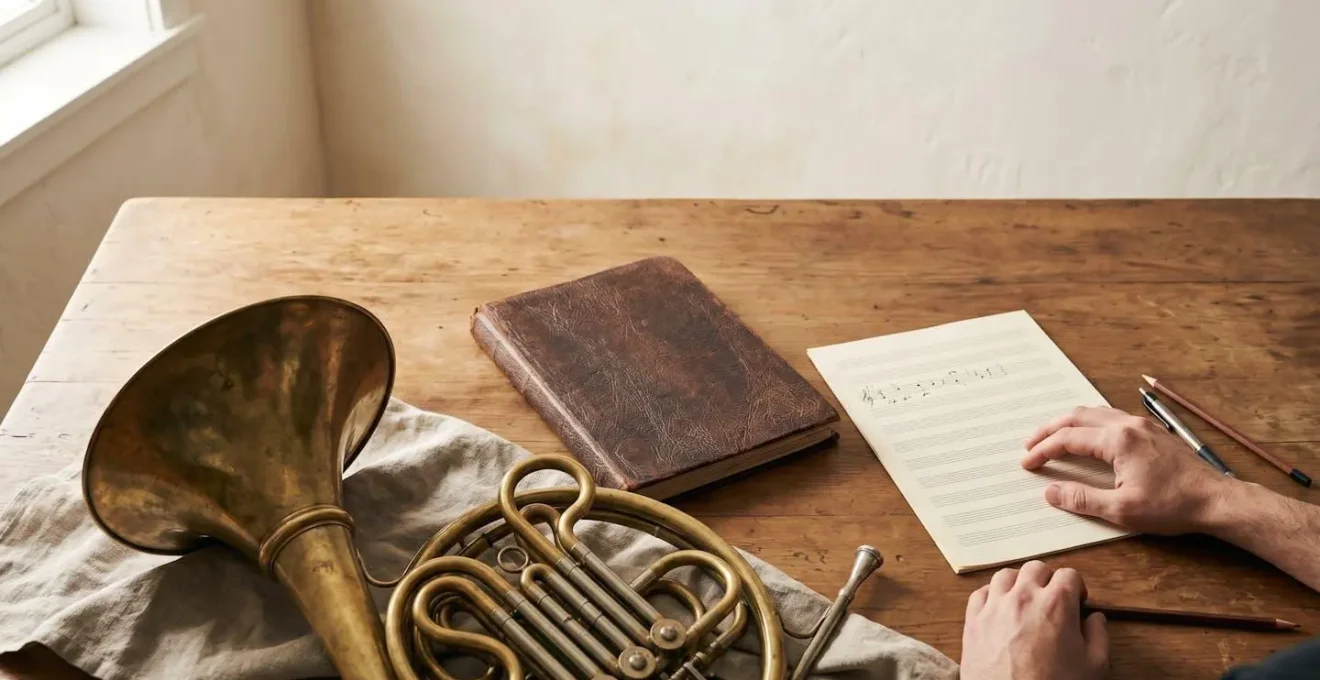
As this workspace illustrates, transcription is a cognitive act before it is a mechanical one. The process, which I call the « Relative First, Absolute Second » workflow, is a powerful framework that moves from understanding to notation. By internalizing this method, you stop being a passive listener and become an active decoder of musical language. Chords become « Do-Me-So » (minor) or « So-Ti-Re-Fa » (dominant 7th) arpeggios that you can sing, identify, and write down with confidence.
Your Action Plan: The ‘Relative First, Absolute Second’ Transcription Workflow
- Phase 1 – Capture Relative Structure: Listen to the melody and immediately sing it back using movable-do solfège. Don’t worry about the actual key yet—focus solely on identifying the interval relationships (e.g., ‘Do-Mi-So-Mi-Do’).
- Phase 2 – Lock In One Pitch: Use your instrument or a tuner to find just one absolute pitch from the melody. This single reference point anchors the entire relative structure you’ve captured.
- Phase 3 – Instant Key Translation: Once you know one note’s absolute pitch, the entire solfège pattern you’ve already internalized automatically ‘locks in’ to the correct key. Notate the full melody with accurate pitches.
- Pro Tip for Harmony: When transcribing chords, sing the arpeggio using solfège (e.g., ‘Do-Mi-So’ for major, ‘Do-Me-So’ for minor). This immediately reveals chord quality and root, bypassing trial-and-error.
This is the difference between simply copying and truly understanding. It is the path to musical fluency.
Associating « Maria » with Augmented 4th: Does It Really Work?
The « reference song » method is one of the most common tricks for learning intervals. We are told to associate the first two notes of « Maria » from West Side Story with an augmented 4th, or « Somewhere Over the Rainbow » with an octave. While this can be a helpful first step for absolute beginners to put a name on a sound, it is a pedagogical crutch that ultimately hinders true musical understanding. It teaches you to recognize intervals in a vacuum, completely divorced from their musical function.
The problem is that the « sound » of an interval is not static; it is entirely dependent on its harmonic context. An augmented 4th is not just a distance; it is a character in a story, and its role changes dramatically depending on the scene. Solfège teaches this context inherently. The pedagogical advantage is clear: as Wikipedia’s entry on solfège notes, the movable-Do system helps students infer melodic and chordal implications through their singing because a tonic is always established. This is a level of understanding that reference songs can never provide.
Contextual Interval Recognition: Why the Augmented 4th Changes Function
Research on tonal perception demonstrates that the same interval produces different sonic sensations depending on harmonic context. The augmented 4th interval ‘Do-Fi’ (C to F#) in a major key sounds dissonant and directionless, creating tension that lacks clear resolution. However, the identical interval spelled as ‘Fa-Ti’ (F to B in C major) feels like a powerful leading-tone pull toward the tonic (‘So-Do’ resolution). Reference songs like ‘Maria’ fail to capture this contextual dimension because they present intervals in isolation. Solfège training, by contrast, embeds each interval within its functional tonal context, allowing musicians to internalize not just the distance between pitches but their gravitational relationships within a key—an essential skill for improvisation, composition, and advanced harmonic understanding that reference-song methods cannot develop.
Relying on reference songs is like learning a language by memorizing a phrasebook. You can ask where the bathroom is, but you can’t hold a conversation. Solfège, on the other hand, teaches you the grammar. It allows you to understand not just what the notes are, but what they are *doing* and where they are *going*. This functional hearing is the key to unlocking improvisation and deep musicality.
It’s time to put away the crutches and learn to walk, run, and dance through the landscape of harmony.
Dorian vs Aeolian: Hearing the Mood Difference in Minor Scales
Once you begin to hear in terms of function and context, you unlock a new level of emotional nuance in music. Take the minor scale, for instance. For many, « minor » simply means « sad. » But this is a gross oversimplification. The world of minor is rich with different shades of emotion, best exemplified by comparing two common modes: Aeolian (the natural minor scale) and Dorian. They are nearly identical, differing by only a single note—the sixth degree. Yet that one note completely changes their character.
In the Aeolian mode, the sixth degree is minor (‘Le’ in solfège). This « Le » is what gives natural minor its classic somber, melancholic, and introspective quality. It pulls downward, reinforcing the feeling of sadness. Think of the iconic melody of « Mad World. » In contrast, the Dorian mode features a major sixth degree (‘La’ in solfège). This raised « La » is the character note that injects a surprising lift and hopefulness into the minor tonality. It fights against the gravitational pull of the minor tonic, creating a sound that is often described as groovy, optimistic, or even heroic. Santana’s « Oye Como Va » is a classic example of Dorian’s bright, danceable feel.
Solfège makes this distinction something you can feel. When you sing « So-Le-So » over a minor chord, you physically experience the downward, somber pull. When you sing « So-La-So, » you feel the uplifting, brighter quality of the major sixth. You are no longer just intellectually aware of the difference; you have embodied the emotional quality of each mode. This is the power of functional hearing. It moves you beyond simple theory into the realm of true musical expression.
This comparative table highlights how a single note, identified and internalized through solfège, can completely transform the emotional landscape of a piece.
| Modal Aspect | Dorian Mode | Aeolian Mode (Natural Minor) |
|---|---|---|
| Character Note (6th degree) | Major 6th (‘La’ – raised) | Minor 6th (‘Le’ – lowered) |
| Emotional Quality | Bright, hopeful, uplifting despite minor tonality | Somber, melancholic, classic ‘sad’ minor sound |
| Practice Exercise | Sing ‘So-La-So’ over a minor chord – hear the brightness | Sing ‘So-Le-So’ over a minor chord – hear the darkness |
| Musical Example | ‘Oye Como Va’ (Santana) – groovy, optimistic Dorian | ‘Mad World’ (Gary Jules) – introspective, sad Aeolian |
| Improvisational Strategy | Target the ‘La’ (F# in Am Dorian) to brighten the harmony | Target the ‘Le’ (F in Am Aeolian) to deepen melancholy |
By internalizing these modal colors, you gain a richer palette to paint with on your instrument.
Audiation: Hearing the Music in Silence Using Solfège
We now arrive at the pinnacle of musicianship, the skill that separates the good from the great: audiation. Coined by music learning theorist Edwin E. Gordon, audiation is the ability to hear and comprehend music in your mind when no sound is physically present. It is the musical equivalent of thought. As Gordon himself famously put it:
Audiation is to music what thought is to language.
– Edwin E. Gordon, Gordon music learning theory – Wikipedia
This is your « inner ear » in its most developed form. It is not just remembering a tune; it is the ability to manipulate musical ideas—to improvise, compose, and analyze—entirely within the silent theater of your mind. Solfège is the language that makes this inner dialogue possible. When you can audiate « Do-Re-Mi, » you are not just hearing three abstract pitches; you are hearing a stable beginning, a step up, and another step up, all with their inherent relationships to the tonic. This is the skill that allows a jazz musician to hear a complex new melody over a chord progression before their fingers ever touch the keys.
Developing audiation requires deliberate practice. It’s about closing your eyes and turning the focus inward, learning to trust the sounds you can generate mentally. The musician in this image is not resting; they are engaged in the deep, focused work of internal hearing, a practice that builds the foundation for all external musical expression.

The ability to pre-hear is a superpower. It means that when you do pick up your instrument, you are not exploring or searching; you are executing a fully-formed musical idea. You play with intention, precision, and confidence because you have already performed the piece perfectly in your mind. This is the ultimate goal: to make the physical act of playing a mere formality, a confirmation of the rich musical world that already exists within you.
It is in this silent practice that a musician’s true voice is found.
The Feedback Loop: Connecting Your Throat to Your Instrument
The connection between your internal musical understanding and your external performance is not just a mental concept; it is a physical reality. We must build a neurological bridge, a seamless feedback loop that connects what you hear in your mind, what you feel in your throat, and what you produce with your fingers. The goal is to eliminate any delay or translation error between intention and execution. The instrument should feel as natural and direct as your own voice.
How do we forge this connection? Through exercises that force the systems to work in unison, on a single breath. When you sing a phrase and immediately play that same phrase on your instrument without pausing, you are training your brain to recognize them as the same act. The pitch intention formed for your vocal cords is transferred directly to your fingers or embouchure. The physical sensation of the sung pitch is still resonating in your body as you replicate it on your instrument, creating a powerful, embodied learning experience.
This practice breaks down the artificial barrier between « singer » and « instrumentalist. » You are simply a musician, and you have two tools for expressing pitch: your voice and your instrument. By practicing their integration, you make the instrument a resonant extension of your body. An adult can absolutely learn this; in fact, adults often have the advantage of focused, deliberate practice. The key is consistency and a focus on the physical sensation of pitch. The « One Breath » exercise is a perfect starting point for creating this unified system of pitch production.
Your Action Plan: The ‘One Breath’ Exercise for Seamless Voice-Instrument Integration
- Setup: Stand or sit in optimal playing posture with your instrument ready. Choose a simple 3-note solfège phrase (e.g., ‘Do-Re-Mi’ or ‘So-La-So’).
- Execution: Take a single full breath. In one continuous exhalation, sing the solfège phrase aloud (first half of the breath), then immediately transition to playing the exact same phrase on your instrument (second half of the breath) without pausing or taking another breath.
- Focus: Eliminate the mental boundary between voice and instrument. The goal is to feel that the instrument is simply an extension of your vocal cords—the pitch intention remains identical throughout the single breath.
- Variation: Once comfortable, reverse the order (play first, then sing) or alternate (sing-play-sing-play) within the same breath to reinforce the unified physical sensation of pitch production.
Through this practice, your instrument ceases to be a foreign object and becomes your second voice.
Key takeaways
- Solfège is a functional tool for understanding musical relationships, not just a system for naming notes.
- Singing a pitch before playing it is the most effective way to improve intonation by creating a clear, internal pitch target.
- True aural skill lies in hearing context and function (what notes are *doing*), a depth that reference songs cannot provide.
How to develop « big ears » to identify chords and melodies instantly?
Developing « big ears »—the ability to hear a piece of music and instantly understand its melodic and harmonic structure—can seem like a magical talent reserved for a gifted few. In reality, it is a skill that can be systematically developed through disciplined practice. It’s not about learning thousands of songs; it’s about building a mental framework for understanding the language of music. The process may take time, but research by Reifinger demonstrates that even young students show significant and lasting improvement in pitch accuracy through focused solfège training. This skill is built upon four distinct pillars, each one reinforcing the others.
The first pillar is recognizing scale degrees, training your ear to hear « So » instead of just « the fifth note. » The second is mastering the unique emotional quality of intervals within their tonal context, feeling the pull of « Ti-Do » rather than just naming a « major seventh. » The third pillar extends this hearing vertically, learning to audiate the quality of chords by singing their arpeggios. A major chord becomes a singable « Do-Mi-So » in your mind. Finally, the fourth and most crucial pillar is the breakthrough to functional hearing. This is where you stop hearing notes in isolation and start recognizing their jobs within the harmonic story. A « So-Do » bass movement is not just two notes; it is a V-I cadence, a powerful statement of arrival and resolution.
Mastering these four pillars through the language of solfège demystifies music. It turns a chaotic wash of sound into a clear, predictable structure. It is the key to confident improvisation, effortless transcription, and a deep, intuitive connection to the music you play. This is how you build the « big ears » that all musicians strive for.
Your Action Plan: The 4-Pillar Framework for Developing ‘Big Ears’
- Pillar 1 – Scale Degree Recognition: Practice identifying single notes within a key by their solfège syllable. Listen to a melody and sing it back using movable-do. This trains your brain to hear ‘Do-So-Mi’ instead of just ‘three random notes.’
- Pillar 2 – Interval Quality Mastery: Move beyond reference songs. Internalize the unique ‘personality’ of each solfège interval pair (e.g., ‘Do-Mi’ = stable major 3rd, ‘Ti-Do’ = urgent resolution, ‘Fa-Ti’ = active tritone). Sing these dyads daily until they become automatic.
- Pillar 3 – Chord Quality Audiation: When you hear a chord, immediately sing its arpeggio using solfège. Major chord = ‘Do-Mi-So’, minor = ‘Do-Me-So’, dominant 7th = ‘So-Ti-Re-Fa’. This trains vertical harmonic hearing.
- Pillar 4 – Functional Hearing Breakthrough: Stop hearing notes in isolation. Using solfège, train yourself to hear function. ‘So-Do’ isn’t just two notes—it’s a V-I cadence, a resolution, a sense of arrival. Sing common progressions: ‘Do-Fa-So-Do’ (I-IV-V-I) until you can predict harmonic motion.
Start today by integrating these pillars into your daily practice, and you will begin the journey of transforming your relationship with sound.