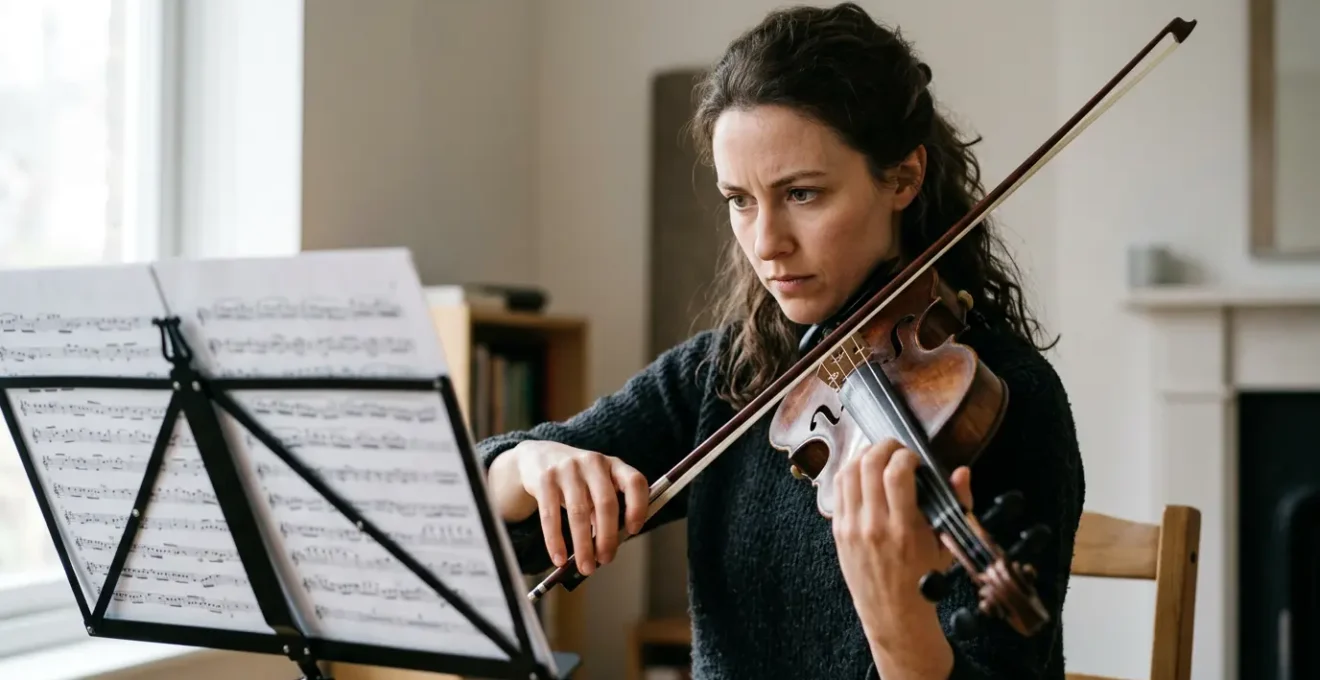
The common belief that sight-reading demands note-perfect accuracy from the start is the very thing holding you back.
- True fluency comes from prioritizing an unbroken rhythmic pulse over chasing individual correct pitches.
- Short, consistent practice sessions build reflexive skills far more effectively than long, draining ones.
- Stopping to correct mistakes actively destroys momentum and prevents your brain from learning to look ahead.
Recommendation: Adopt a « forward-motion » mindset. Your primary goal is to finish the piece without stopping, treating mistakes as data for later analysis, not as failures in the moment.
The moment a new piece of sheet music is placed on the stand, a familiar wave of panic can wash over even seasoned pianists. The cascade of dots, lines, and symbols feels like an impossible code to crack in real-time. The common advice— »practice more, » « learn your notes, » « start slow »—often misses the core of the issue. These are outcomes, not strategies. While some might suggest memorizing music is a better use of time, sight-reading is a distinct and crucial skill for session players, accompanists, and any musician wanting to explore a vast repertoire with freedom. The anxiety stems from a misconception about what sight-reading truly is.
This is not a test of perfection. It’s a skill of cognitive efficiency and priority management. The secret to overcoming the overwhelm isn’t about trying harder to be perfect; it’s about systematically training your brain to see music differently. It’s about learning what to focus on, what to ignore in the moment, and how to build a calm, forward-moving momentum that keeps the music flowing, even when imperfections arise. This approach transforms sight-reading from a high-pressure performance into a low-stakes, repeatable process of pattern recognition and rhythmic interpretation.
This guide will deconstruct the sight-reading process into manageable, systematic components. We will explore why rhythm is your anchor, how to practice effectively in short bursts, and why the most counter-intuitive advice—to not stop for mistakes—is the most powerful. By the end, you’ll have a clear framework for building a true reading reflex, turning panic into poised, confident musicianship.
To guide you through this systematic process, this article is structured to build one concept upon the next. The following summary outlines the key stages of our journey from panic to fluency, giving you a roadmap of the skills you are about to develop.
Summary: How to Build Sight-Reading Fluency Systematically
- Looking Ahead: Spotting Scales and Arpeggios Before You Play Them
- Why Getting the Rhythm Right Is More Important Than the Pitch
- Consistency vs Duration: Why Short Sessions Build Reading Reflexes
- Why Stopping to Correct Mistakes Destroys Your Sight-Reading Growth
- Guideposts on the Staff: Using Reference Notes to Read Faster
- Pen and Paper: Why Writing Notes by Hand Helps Memory
- Reading Above the Staff: How to Stop Counting Lines
- Demystifying the Grand Staff for pianists and composers
Looking Ahead: Spotting Scales and Arpeggios Before You Play Them
The first fundamental shift in sight-reading is to stop seeing individual notes and start seeing musical shapes. Your brain can only process a few single data points at a time, which is why reading note-by-note leads to stumbles and panic. The key is to engage in cognitive chunking: training your eyes to recognize groups of notes as a single, coherent unit. A C major scale is not eight separate notes; it’s one « C major scale » shape. An arpeggiated G7 chord is one « G7 arpeggio » pattern. By looking ahead, you give your brain precious milliseconds to identify these patterns before your fingers need to play them.
This skill is known as developing your eye-hand span. It’s the distance between what your eyes are currently reading and what your hands are playing. Beginners have a very short span, often looking at the exact note they are playing. Advanced sight-readers, however, look several beats or even a full measure ahead. This is not magic; it’s a trained skill. Indeed, research using eye trackers shows that highly skilled musicians look ahead further in the music, storing and processing notes until they are played. They aren’t reading faster; they are reading *smarter* by processing information in larger, more meaningful chunks.
To build this skill, you must consciously practice looking ahead. As your left hand plays the first beat of a measure, your eyes should already be scanning the third and fourth beats, or even the next measure. Start with very simple music. The goal isn’t to play complex pieces, but to train your eyes to stay ahead of your hands. This creates a buffer of processing time, which is the single most effective way to reduce the feeling of being rushed and overwhelmed.
Why Getting the Rhythm Right Is More Important Than the Pitch
Here is one of the most critical and liberating truths in sight-reading: an audience can forgive a wrong note, but they cannot forgive a broken rhythm. Rhythm is the rhythmic skeleton of the music; it provides the structure, pulse, and forward momentum. If the rhythm is correct, the music retains its character and feel, even with a few errant pitches. If the rhythm collapses, the entire performance falls apart. When you prioritize maintaining a steady beat above all else, you give yourself and the listener a coherent musical experience.
This isn’t just a philosophical preference; it’s rooted in how we perceive music. Our brains are wired to detect patterns, and rhythm is the most fundamental pattern. A predictable rhythmic pulse makes music easier to process. In fact, a 2025 study published in Annals of the New York Academy of Sciences found that over 75% of participants showed more variable and inaccurate tapping when a rhythm was unpredictable compared to when it was part of a clear, tonal context. This shows that a strong, predictable rhythm acts as an anchor for our musical processing.
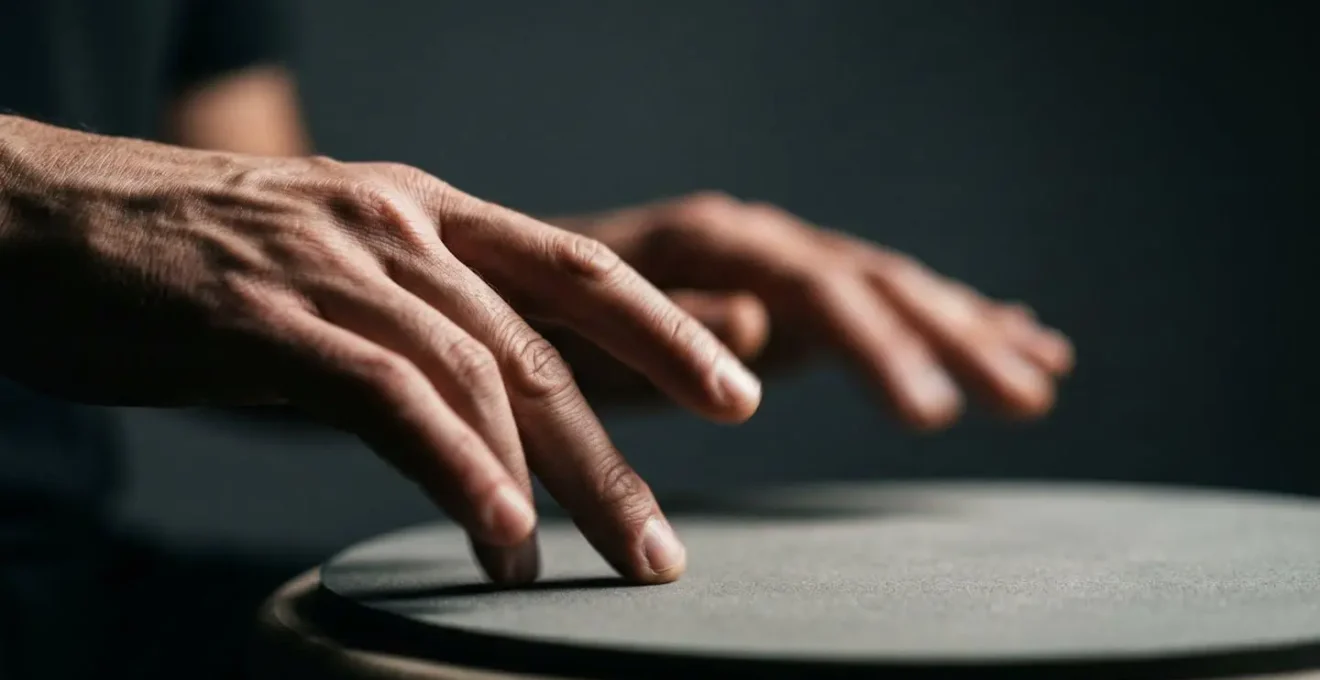
Therefore, your first job as a sight-reader is to become a human metronome. Before you play a single note, tap the rhythm of the first few bars. If you encounter a difficult passage, simplify it: play only the rhythm on a single note. This internalizes the pulse and makes it the non-negotiable element of your playing. When you’re reading and you feel overwhelmed, your default action should not be to find the right note, but to ensure the next beat happens on time, even if you have to omit a note or play a wrong one to do it. This « rhythm-first » mindset is the foundation of confident, continuous playing.
Consistency vs Duration: Why Short Sessions Build Reading Reflexes
The path to sight-reading mastery is paved with frequent, short sessions, not infrequent, marathon cramming sessions. The goal is to build a reading reflex—an automatic, subconscious connection between the symbol on the page and the motor action of your fingers. Reflexes are not built through brute force; they are cultivated through consistent, repeated exposure. Trying to practice for an hour when you’re already mentally fatigued is not only unproductive, it can actually reinforce anxiety and bad habits.
Instead, aim for focused, high-quality practice in small doses. This approach is backed by significant research. A study from the University of Chicago Music Department shows that 5-10 minutes of practice daily can transform a struggling sight-reader into a master. The key is the daily reinforcement. This strategy, known as spaced repetition, is one of the most well-documented and effective learning techniques. It works by introducing information and then re-visiting it at increasing intervals, forcing your brain to work slightly harder to retrieve it each time, which strengthens the neural pathway.
The power of this method is quantifiable. A meta-analysis of over 100 studies on the topic found that the average person using spaced practice remembers material better than approximately 67% of people using « massed » training (cramming). This effect is considered substantially meaningful in education research. For a pianist, this means that practicing sight-reading for 10 minutes every day for a week is exponentially more effective than one 70-minute session on a Sunday. It allows the brain time to consolidate the learning overnight and makes the process feel manageable, which is crucial for overcoming the initial panic and building long-term consistency.
Why Stopping to Correct Mistakes Destroys Your Sight-Reading Growth
This is the most difficult but most important rule to follow: do not stop. The instinct to halt and fix a wrong note is deeply ingrained in every musician. In the context of learning a piece for performance, this instinct is valuable. In the context of sight-reading, it is catastrophic. Every time you stop, you destroy the two most critical elements you are trying to build: rhythmic continuity and the « look-ahead » eye-hand span. Stopping reinforces a start-and-stop mentality, trains your brain to focus on the past (the mistake) instead of the future (the upcoming notes), and shatters any sense of musical flow.
Adopting a « forward-motion » mindset is the primary goal. You must treat the flow of time as sacred and unbroken. As the MakeMusic Educational Research Team states, « Fluency matters more than perfection. » Train yourself to push forward, even when you know you’ve made an error. This builds performance readiness and the psychological resilience to continue playing under pressure. The goal of a sight-reading session is not to produce a perfect rendition; it is to practice the skill of continuous reading.
This doesn’t mean you ignore your mistakes. It means you deal with them systematically, after the fact. After you’ve played through the piece without stopping, go back and identify the measures where you stumbled. This is where you turn mistakes into data. By analyzing these trouble spots, you can identify recurring patterns (e.g., « I always miss leaps of a 6th, » or « I get lost in fast 16th-note runs ») and design targeted exercises to address them in a separate, deliberate practice session.
Your Action Plan: The Error Logging Method
- Resist the impulse to stop and fix mistakes during sight-reading — continue playing to maintain forward momentum.
- After completing the piece, circle the measures where you stumbled to create an objective error log.
- Analyze your mistake log for recurring patterns (e.g., ‘I always miss leaps of a 4th’).
- Use these patterns as data for targeted deliberate practice sessions separate from your sight-reading practice.
- Before your next session, review your error log to prime your brain for the patterns you need to watch for.
Guideposts on the Staff: Using Reference Notes to Read Faster
While you train your brain to see larger patterns, you also need a system for quickly identifying individual notes without counting lines and spaces. The most efficient method is to establish structural guideposts on the staff—a few key notes that you can recognize instantly—and then read all other notes by their intervallic relationship to these anchors. Instead of thinking « This note is on the fourth line from the bottom, » you’ll think, « This note is a third above my anchor G. » This relational reading is vastly faster and more musical than absolute note identification.
For pianists, the most common and effective guideposts are:
- Middle C: The ultimate anchor, sitting on its own ledger line between the staves.
- Treble G: The note that wraps around the curl of the G-clef (treble clef).
- Bass F: The note that sits between the two dots of the F-clef (bass clef).
- The Outermost Lines: Train yourself to instantly recognize the notes on the top and bottom lines of each staff (E/F in treble, G/A in bass).
These notes become your « home bases » on the vast map of the grand staff.
Once your anchors are solidified, the next step is to get equally fast at recognizing basic intervals—seconds (step), thirds (skip), fourths, and fifths. A « skip » from a line note always lands on the next line note. A « step » from a space note always lands on the next line note. By combining instant recognition of your guidepost with instant recognition of the interval, you can deduce any note in a fraction of a second. This method also helps in spotting chords, as a C major triad will always have the same visual « line-line-line » or « space-space-space » shape, regardless of where it appears on the staff.
Pen and Paper: Why Writing Notes by Hand Helps Memory
One of the most effective ways to improve your reading is to step away from the piano. The act of physically writing music by hand engages a different part of your brain, creating a stronger, multi-sensory connection between the visual symbol, the sound, and the motor action. This process helps to solidify your understanding of musical structures and intervals in a way that simply playing them cannot. It forces you to slow down and consciously process every detail of the notation.
Simple hand-writing exercises can have a profound impact. Try taking a simple melody you know and transposing it to a new key on staff paper. This forces you to think purely in terms of intervals, strengthening the relational reading skills we discussed earlier. Another powerful exercise is daily dictation: listen to a short, simple melody from a recording or an app, and try to write it down. This builds the crucial two-way street between hearing music in your head and representing it on the page. This skill is called audiation, the ability to hear music internally before it is played.
Indeed, according to research from the National Association for Music Education, strong sight-readers possess highly developed audiation skills. They can « hear » what the music on the page will sound like before they play it, which allows them to anticipate the music’s direction and catch potential errors before they happen. Writing music by hand is one of the most direct and effective ways to cultivate this internal ear. Spending just five minutes a day « doodling » with notes—copying patterns, writing out scales, or creating your own simple phrases—can dramatically accelerate your reading comprehension.
Key takeaways
- Prioritize a steady, unbroken rhythm above all else; it is the skeleton that holds the music together.
- Build a « forward-motion » mindset by practicing without stopping to correct mistakes, turning errors into data for later analysis.
- Use short, daily practice sessions (5-10 minutes) to build a reading reflex through the principle of spaced repetition.
Reading Above the Staff: How to Stop Counting Lines
Ledger lines—the short lines used to write notes above or below the staff—are a common source of panic for many readers. The familiar territory of the five-line staff disappears, and we revert to the slow, painful process of counting lines: « Middle C is here, so the next line is E, the next is G… » This method is too slow for fluent reading. The key to conquering ledger lines is to treat them not as a separate, scary region, but as a natural extension of the staff and to apply the same principles of guideposts and relational reading.
One of the most effective techniques is using octave anchors. You likely know the notes on the top line of the treble clef (F) and the bottom line of the bass clef (G) instantly. The note an octave above that top-line F is also an F. The note an octave below that bottom-line G is also a G. These high and low F’s and G’s become your new, advanced guideposts. When you see a note three ledger lines above the treble staff, don’t count up from Middle C. Instead, find the F on the top line, jump up an octave to the F two ledger lines up, and recognize the target note is just a step above it—a G.
Furthermore, continue practicing your cognitive chunking on ledger lines. Common chords and arpeggios appear just as frequently in these upper and lower registers. Practice recognizing the visual shape of a C major triad or a G7 chord when they fall on ledger lines. They retain their fundamental shape. By familiarizing yourself with how common patterns look in these extended ranges, you replace slow counting with instant recognition. The goal is to make the ledger lines feel as familiar as the main staff, a seamless extension of your musical map.
Demystifying the Grand Staff for pianists and composers
For pianists, true fluency requires one final mental leap: to stop seeing the grand staff as two separate entities—a treble staff for the right hand and a bass staff for the left—and start seeing it as one unified, 11-line system. The two staves are connected by the « invisible » Middle C ledger line. This integrated view is essential for reading music where the hands cross, or where the melodic line moves fluidly between the clefs. The rigid « right hand = treble » association is a beginner’s shortcut that must eventually be unlearned.
This is where vertical reading becomes critical. As you scan the music horizontally to read ahead, you must also practice scanning vertically on each beat to understand the harmonic relationship between the hands. At any given moment, you should know the interval between your left and right hand. Are they a third apart? A tenth? An octave? This vertical awareness helps you read harmonically, not just melodically, and provides a powerful self-correction mechanism. If you know the harmony should be a major third and you play a fourth, you’ll feel the error instantly.
Case Study: Integration Through Cross-Staff Notation
Educational piano repertoire such as Bartók’s Mikrokosmos and Schumann’s Album for the Young deliberately uses cross-staff notation where the right hand must read in the bass clef or vice-versa. This intentionally breaks the conventional ‘right hand equals treble’ association and trains the brain to see the Grand Staff as one unified 11-line system rather than two separate entities, permanently demystifying the relationship between the clefs for developing pianists.
To build this skill, actively seek out music that forces this integrated reading. Practice pieces where the hands cross over frequently. Work on four-part chorales (like those by Bach), assigning two voices to each hand, which forces you to read multiple lines in both clefs simultaneously. The ultimate goal is to develop a direct physical link between any note on the grand staff and its corresponding key on the piano, regardless of which hand is meant to play it. This demystifies the grand staff, transforming it from two separate domains into one seamless musical universe.
By systematically integrating these strategies—prioritizing rhythm, practicing consistently, maintaining forward motion, and building a mental map of the staff—you can methodically dismantle the panic associated with sight-reading. The journey is one of process over perfection. Start today by applying these principles in a short, focused practice session to transform your relationship with the written page.