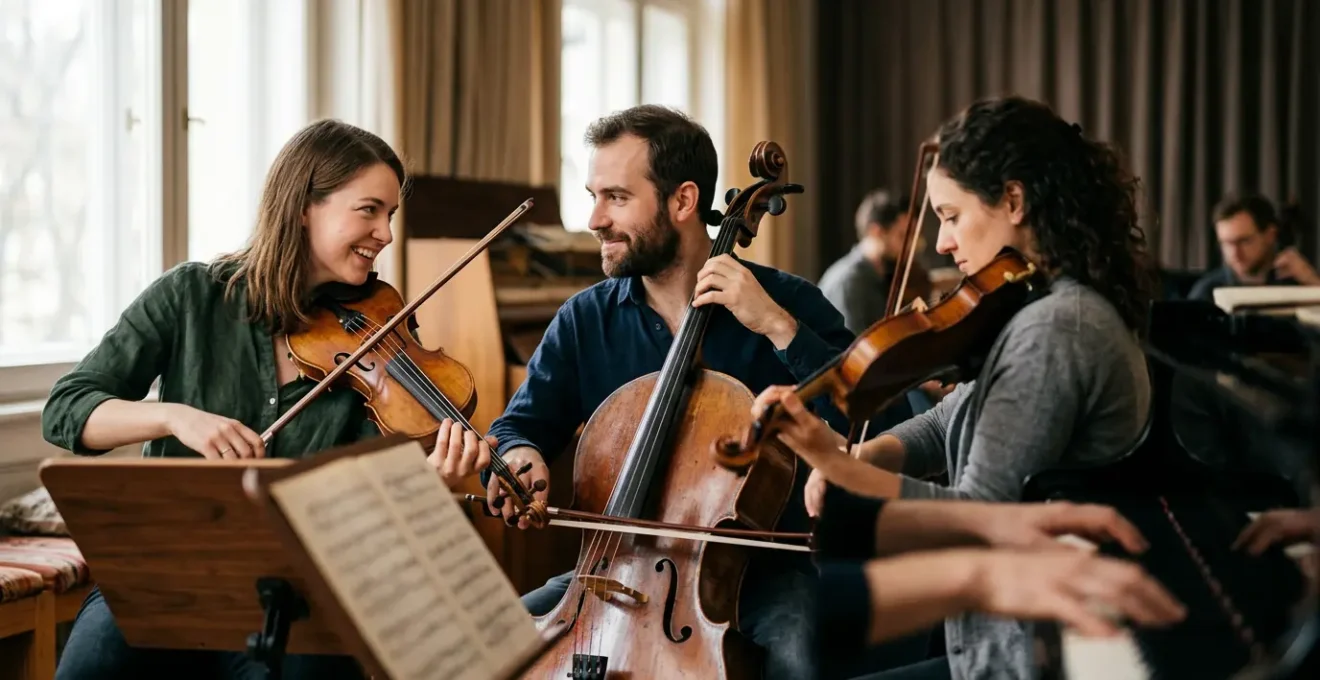
For the solo musician, the transition to group playing often feels frustrating. The issue isn’t a lack of technical skill, but a missing collaborative mindset. Playing in an ensemble requires a fundamental shift from a ‘me’ perspective to a ‘we’ perspective, transforming music from a monologue into a dynamic, non-verbal dialogue. This article breaks down the essential, often unspoken, skills that bridge that gap, teaching you how to listen, react, and create as part of a cohesive whole.
If you’re a musician who has spent countless hours honing your craft alone, you know the satisfaction of mastering a difficult passage or perfecting your tone. Your bedroom or practice space is your kingdom, a controlled environment where you are the sole musical authority. But the moment you step into a rehearsal room with other musicians, that control vanishes. Suddenly, your perfectly practiced part either drowns everyone out or gets lost in the mix. The timing feels off, endings are a mess, and the communication seems to operate on a level you can’t quite grasp.
The common advice— »just listen more » or « follow the drummer »—feels frustratingly vague. You *are* listening, but it’s not clicking. This struggle is universal for soloists because the skills required for ensemble playing are rarely taught in isolation. They aren’t about playing notes correctly; they’re about interacting with the people playing those notes. The challenge isn’t technical; it’s social and perceptual. It’s a complete rewiring of your musical brain.
But what if the key wasn’t just to listen, but to learn the *language* of group playing? The secret lies in shifting your focus from a solo performance to a shared musical dialogue. It’s about understanding that your role is not to simply add your sound, but to actively shape a collective creation in real-time. This guide will deconstruct the core, often invisible, skills that separate a group of individuals playing at the same time from a true, cohesive ensemble.
We’ll explore the specific techniques and mindset shifts needed to navigate the dynamic world of group music. From managing your sonic space to communicating without words, these are the lessons you can only learn when you make music with others. This structured approach will give you a clear roadmap to becoming a confident and sought-after collaborative musician.
Summary: Unlocking the Collaborative Skills of Ensemble Playing
- Self vs Group: Adjusting Your Volume to Blend, Not Dominate
- The Nod and The Look: How to End a Song Together Without Counting
- When to Lead and When to Support: Switching Hats Mid-Song
- The « Keep Going » Rule: Why You Never Stop for a Wrong Note in a Band
- Being on Time and Prepared: Respecting the Group’s Time
- Feeling the Downbeat: Why Counting Isn’t Enough for Groove
- Fast, Slow, Key Change: Avoiding Listener Fatigue
- How to choose and maintain a repertoire that showcases your strengths?
Self vs Group: Adjusting Your Volume to Blend, Not Dominate
For a solo performer, volume is a tool for personal expression. In an ensemble, it becomes a tool for collaboration. The goal is no longer to be heard, but to be heard *in context*. This is the first and most critical mindset shift: from « my sound » to « our sound. » The common mistake is simply turning down. True blending is more sophisticated; it’s about actively managing your sonic space. Every instrument occupies a specific frequency range—a deep bass, a punchy mid-range guitar, shimmering cymbals. Dominating isn’t just about being loud; it’s about occupying someone else’s space, creating a muddy and competitive soundscape.
Effective blending is a form of musical conversation. You learn to listen for the « holes » in the sound and decide whether your part is meant to fill them or leave them open. According to research on ensemble techniques, balance requires adjusting individual volume with proper sound ratios between parts to prevent disruption. It’s a constant, active process of giving and taking sonic real estate.

This visual concept of layered frequencies is key. Your goal is to find your layer and complement the others, not cover them. This requires active listening—not just to your own instrument, but to the entire sonic tapestry. Ask yourself: « Is my part the melodic focus right now, or am I providing harmonic support? » The answer dictates your dynamic level. Mastering this skill transforms you from a soloist playing alongside others into a true member of the band.
The Nod and The Look: How to End a Song Together Without Counting
One of the most telling signs of an inexperienced ensemble is the messy, uncertain end of a song. While counting can provide a framework, the truly tight, professional-sounding endings are executed through non-verbal communication. This is the « musical dialogue » in its purest form. It’s about developing a shared intuition and a language of gestures—the subtle head nod, the shared glance, a raised eyebrow, or a shift in posture. These cues become the punctuation marks of your musical conversation, signaling everything from a final chord to a sudden stop.
This isn’t magic; it’s a learned skill of predictive coordination. You learn to watch the leader of the moment—often the singer or lead instrumentalist—for physical cues. Their breath before a final note or the way they lift their guitar neck becomes a more reliable signal than a shouted « one, two, three, four! » This physical communication is deeply ingrained in how musicians synchronize. In fact, studies on nonverbal communication in musical performances reveal that information flow is significantly greater when performers can see each other.
Case Study: The Science of Body Sway
This intuitive connection has been scientifically validated. Researchers at McMaster University used motion capture to study how musicians coordinate non-verbally. A study published in Scientific Reports found that musicians’ body sway is not random; it reflects a joint emotional expression and allows them to synchronize their movements. By watching each other’s bodies, they can silently predict how the music will be expressed, enabling them to play as a single, cohesive unit. This proves that watching and moving together is as crucial as listening.
For the bedroom musician, this means lifting your eyes from your instrument. You must make visual connection part of your practice. Arrange your rehearsal space so everyone can see each other. Learning to read this silent language is what separates a mechanical performance from one that feels alive and connected.
When to Lead and When to Support: Switching Hats Mid-Song
In a solo performance, you are always the leader. In an ensemble, leadership is fluid. The spotlight moves, and your role must change with it. One moment, you’re playing the main riff or solo, driving the song forward. The next, you’re receding into the background, providing a steady rhythmic or harmonic foundation for the vocalist or another soloist. This ability to switch hats mid-song—what we call role fluidity—is a hallmark of a mature musician. It requires ego-less awareness and a commitment to serving the song, not yourself.
Recognizing the moment to step forward or pull back is a listening skill. It’s about identifying who has the melodic or rhythmic focus and adjusting your own part to support them. If the singer is delivering a powerful verse, a busy or loud guitar part underneath will only create conflict. A simple, supportive chord progression, however, will elevate their performance. Conversely, when it’s your turn to solo, you expect the rest of the band to create a stable platform for you, not compete for attention.
Case Study: The Conductorless Orchestra
The Stanford Collaborative Orchestra (SCOr) takes this concept to its logical extreme. Inspired by the Orpheus Chamber Orchestra, this ensemble performs complex classical works without a conductor. As detailed in a report from Stanford News, leadership roles are distributed among the 24 musicians, often rotating for each piece. Success depends on every member developing « collective awareness, » opening their eyes and ears to everyone else. This democratic model forces musicians to take ownership and develop real leadership and support skills, proving that a hierarchical structure isn’t necessary when role fluidity is mastered by all.
This dynamic interplay is what makes ensemble music so exciting. It’s a constant dance between leading and following. For the soloist accustomed to being the permanent center of attention, learning to be a great supporter is just as important—and often more difficult—than learning to be a great leader.
The « Keep Going » Rule: Why You Never Stop for a Wrong Note in a Band
In your practice room, a wrong note is a signal to stop, rewind, and fix it. In a live performance or rehearsal, stopping is the single worst thing you can do. A flubbed note might be noticed by a few astute listeners, but the entire band grinding to a halt is a train wreck that nobody can miss. This is the unbreakable « Keep Going » rule: the forward momentum of the song is more important than individual perfection. The collective experience of the band and the audience depends on that continuous flow.
This requires a radical shift in your relationship with mistakes. Instead of viewing them as failures, you must learn to see them as minor bumps in the road. Your job is to recover instantly and seamlessly. Often, this means just jumping back in on the next downbeat. The audience’s memory is short, and if you carry on with confidence, they will follow your lead and forget the error in seconds. Fixating on the mistake, wincing, or looking apologetic only draws more attention to it. As the great cellist Yo-Yo Ma puts it, the music has a purpose beyond perfect execution.
Whatever you practice for that fails is all right, because we have a greater purpose. The greater purpose is that we’re communing together and we want this moment to be really special for all of us.
– Yo-Yo Ma, Interview on accepting mistakes in performance
This philosophy is liberating. It allows you to take risks and play with expression, knowing that the band’s shared momentum will carry you through any minor stumbles. The goal is not a flawless performance, but a connected and compelling one. Forward motion is everything.
Action Plan: Recovering from a Mistake Mid-Song
- Look & Listen: Immediately look up at your bandmates, especially the drummer or lead vocalist, to find visual and auditory cues for your place.
- Find the Downbeat: If you’re completely lost, focus only on the drummer’s kick and snare to identify the « one » and prepare to rejoin on the next measure.
- Maintain the Pulse: Don’t try to go back. Keep your body moving to the beat and focus on the forward motion of the music. Tapping your foot can help you stay in the groove.
- Project Confidence: Even if you’re silent for a bar, maintain confident body language. Don’t broadcast your error with facial expressions. Your positive air keeps the performance energy high.
- Let It Go: Once you’re back in, stay engaged with the present moment. Do not fixate on the mistake; let it dissolve into the past and focus on the music happening now.
Being on Time and Prepared: Respecting the Group’s Time
While the previous skills are about in-the-moment interaction, this one is foundational: the work you do *before* rehearsal begins. As a solo musician, your practice time is your own. In a band, rehearsal time is a shared, finite, and valuable resource. Being on time and prepared is the most fundamental way to show respect for your fellow musicians and their commitment. It’s the bedrock upon which all musical trust is built.
Being « on time » doesn’t mean walking through the door at the scheduled start. It means being set up, tuned up, and ready to play the first note when the clock strikes. It means handling your personal setup—unpacking your instrument, arranging your pedalboard, doing a quick sound-check—before the collective work begins. Wasting the first 15 minutes of every rehearsal with setup and tuning is a silent momentum killer and a source of deep frustration for those who came prepared.
Likewise, being « prepared » means you’ve done your homework. You have listened to the songs, learned your parts, and worked through any tricky sections on your own time. Rehearsal is not the place to learn a song from scratch. It is the place to refine how the parts fit together, to work on dynamics, and to practice the collaborative skills we’ve been discussing. Coming unprepared forces the entire group to a halt while you stumble through your part, effectively disrespecting the preparation everyone else did. As music leadership resources state, consistency and dependability are how you build trust within an ensemble.
Feeling the Downbeat: Why Counting Isn’t Enough for Groove
Every musician learns to count time, but a band that grooves together operates on a deeper level. They share an internalized, physical sense of the beat—a shared pulse. While a metronome provides a mathematically perfect click, groove has a human feel. It can push slightly ahead of the beat (playing « on top ») for excitement or pull back slightly behind it (playing « in the pocket ») for a relaxed, heavy feel. Counting « 1-2-3-4 » is a necessary starting point, but it can’t capture this organic, elastic quality.
This is why you see musicians moving when they play. It’s not just for show; they are physically embodying the pulse. Nodding your head, tapping your foot, or swaying with your body helps internalize the beat and lock it in with what your bandmates are feeling. When the whole band is physically connected to the same pulse, the music starts to breathe and feel alive. This shared physicality is what allows a band to navigate tempo changes and rhythmic pushes and pulls as a single unit, without ever needing to count out loud.
This physical synchronization is more than just keeping time; it’s a form of communication. Research from McMaster University’s LIVELab has shown that musicians coordinate their movements to express the same emotions, allowing them to play exactly in time as one. This requires them to predict what fellow musicians will do next, using body language as a key signal. When you stop rigidly counting in your head and start feeling the rhythm in your body, you open yourself up to this higher level of rhythmic communication and truly begin to groove.
Fast, Slow, Key Change: Avoiding Listener Fatigue
A musical set or even a single song that stays at the same intensity level from start to finish is exhausting for an audience. As an ensemble, one of your key responsibilities is to manage the listener’s energy by creating a dynamic journey. This means consciously manipulating tempo, volume, and texture to create contrast and emotional arc. A great band doesn’t just play songs; they craft an experience. This is a skill that simply doesn’t apply to a soloist practicing alone, but it’s vital for audience engagement.
Variation is the primary tool for avoiding listener fatigue. This can happen on a macro level—arranging a setlist with a mix of fast and slow songs, or placing a quiet ballad after a high-energy rocker. But it also happens on a micro level, within a single piece of music. Techniques like a crescendo (gradually getting louder) can build immense tension and excitement, while a decrescendo (gradually getting softer) can create a sense of intimacy or resolution. Dropping out instruments to leave just a vocal and a single instrument for a verse, then bringing everyone back in for a powerful chorus, is a classic and highly effective dynamic trick.
As one study guide on ensemble performance notes, « Balance changes throughout a piece as different instruments take on melodic or accompanying roles. » This constant shifting of texture and focus keeps the music interesting. Does the song need a key change for the final chorus to give it a lift? Should the bridge be quieter and more spacious? These are the arrangement questions a band must answer together. Learning to think like an arranger, and not just a player, is a crucial skill developed through group collaboration.
Key Takeaways
- Ensemble playing is a dialogue: Shift your mindset from a solo « me » performance to a collaborative « we » creation.
- Listen with your eyes: Non-verbal cues like head nods and body language are as important as sound for synchronization and endings.
- Serve the song, not your ego: Be prepared to switch fluidly between leading and supporting roles as the music demands.
How to Choose and Maintain a Repertoire that Showcases Your Strengths
Finally, the songs a band chooses to play are the foundation of its identity. A repertoire is more than just a list of tunes; it’s a collective statement. For a solo artist, the choice is simple: « What do I want to play? » For an ensemble, the question becomes: « What do *we* play well together? » This requires a collaborative process of selection that balances individual tastes, showcases collective strengths, and serves the overall vision of the band.
A great repertoire should feel like a custom-fit suit, not a random collection of songs. Does the singer have a powerful, bluesy voice? Find material that lets it shine. Is your drummer a master of funk grooves? Incorporate songs that highlight that rhythmic pocket. The goal is to build a set of songs where every member has a chance to contribute meaningfully. This process involves negotiation, compromise, and a shared understanding of the band’s musical identity. It’s also a powerful team-building exercise.
Furthermore, a repertoire is a living entity. It needs to be maintained and evolved. Songs can be retired, new ones added, and existing ones re-arranged to keep them fresh. This collaborative curation ensures the band doesn’t grow stagnant. Some successful ensembles even involve members in leadership roles for choosing music, fostering a deeper sense of ownership and investment from everyone. When the whole band is passionate about the material they are playing, that energy becomes infectious and translates directly to the audience, transforming a performance from a recital into a shared, exciting event.
The journey from a solo musician to a confident ensemble player is a transformative one. It teaches you a new language of collaboration, empathy, and shared creation. The next logical step is to put these concepts into practice. Find a local jam session, reach out to other musicians online, or simply start a weekly get-together with friends. Begin the dialogue.