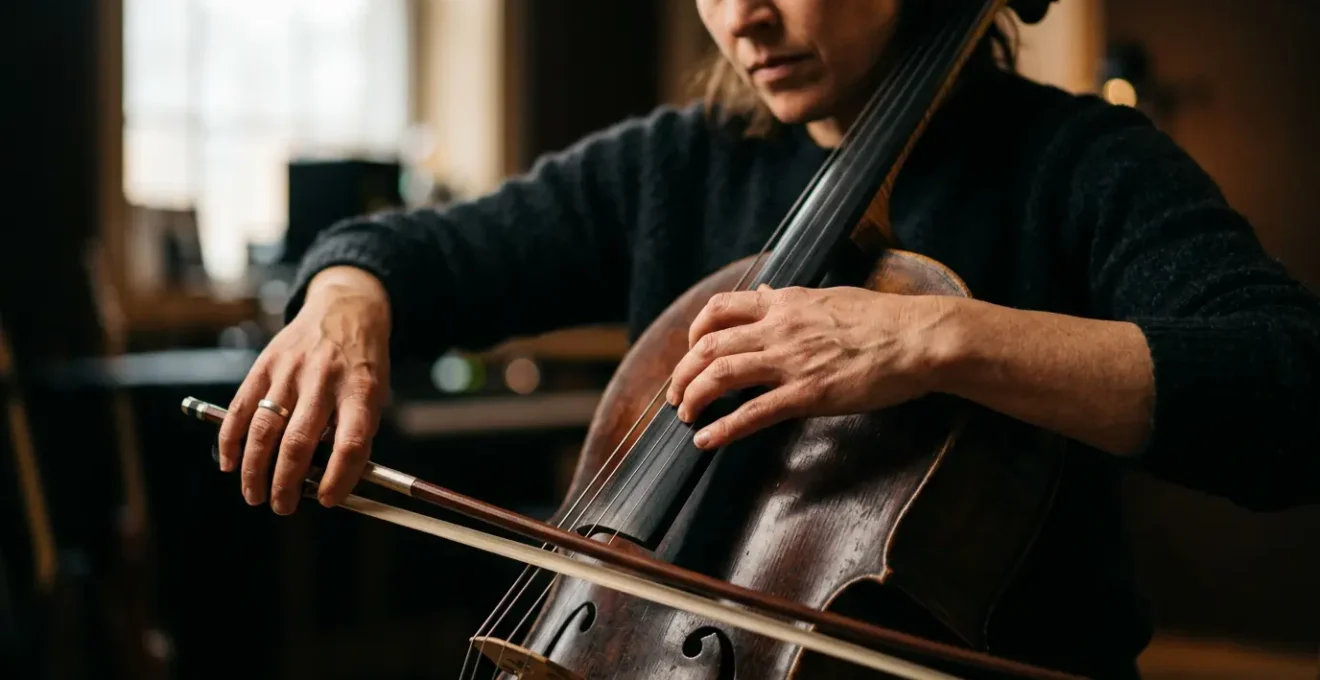
Most musicians believe the path to greater musicality is paved with more hours of technical practice. This is a myth. The real transformation happens not by playing more notes, but by fundamentally changing your internal perception of rhythm, dynamics, and harmony. This guide shifts the focus from mechanical execution to a profound, internal understanding, turning your playing from a technical exercise into a form of authentic storytelling.
For many intermediate musicians, a frustrating plateau arrives. You can read the music, your fingers know where to go, and you can play in time with a metronome. Yet, something essential is missing. You might listen back to a recording and feel your playing is sterile, lifeless—like a human player piano executing a program. You have the technique, but you feel you lack the elusive qualities of « feel, » « soul, » or true « musicality. » The common advice is to practice more scales, drill more arpeggios, and lock yourself to a metronome, but this often just reinforces the mechanical approach that created the problem.
The truth is, the skills that separate a competent technician from a compelling artist are rarely found on the printed page. They are cultivated through a deeper, more holistic form of listening and internal awareness. What if the key wasn’t about the precision of the notes, but the space between them? What if volume wasn’t just about loud and soft, but about creating a narrative arc? The shift required is not external, but internal. It’s about moving from simply reproducing sounds to truly speaking the language of music.
This journey requires us to re-examine the very foundations of our craft. We will explore how to develop an embodied sense of rhythm that transcends simple counting, how to use dynamics as a storytelling tool, and how to listen with an analytical ear that deconstructs the magic to understand its architecture. Ultimately, you will learn to hear, feel, and think like a musician, not just a player.
To guide you on this path of deeper musical understanding, this article is structured to build these core perceptual skills one by one. The following summary outlines the key areas we will explore to transform your playing from the inside out.
Summary: Beyond the Notes: A Guide to Holistic Musicianship
- Feeling the Downbeat: Why Counting Isn’t Enough for Groove
- The Power of Whisper: Using Volume to Tell a Story
- Analysing, Not Just Hearing: Dissecting a Mix While Commuting
- Why Playing with « Soul » Means Accepting Some Dirt
- Internalizing Structure: How to Memorize a 3-Minute Piece Securely
- Hearing the « Color » of Degrees: Why the 3rd Feels Different from the 5th
- The Swell: Creating Motion in a Long Note
- How to develop « big ears » to identify chords and melodies instantly?
Feeling the Downbeat: Why Counting Isn’t Enough for Groove
The metronome is a tool, not a deity. While essential for developing a stable tempo, an over-reliance on its mechanical click can kill the very thing we seek: groove. True rhythmic feel doesn’t come from perfectly aligning with a grid; it comes from internalizing the pulse and learning to play with the space around it. This is the difference between counting and having an embodied rhythm. It’s the subtle push ahead of the beat in a driving rock song or the relaxed, behind-the-beat feel of a classic soul ballad.
This « human » element isn’t a mistake; it’s the source of life in music. A groundbreaking 2023 Cambridge study on shaping rhythm, timing, and sound in five groove-based genres revealed that professional musicians across jazz, samba, and hip-hop consistently use micro-timing variations—minuscule deviations from the perfect grid—to create their signature feel. They found that groove is a conversation between timing and timbre, where the shape of a note’s attack can change our perception of its placement.
To develop this, you must shift your practice. Instead of just playing *to* a metronome, try to make the metronome disappear. Set it to click only on beats 2 and 4 (the backbeat). Can you keep time and feel the ‘1’ and ‘3’ in your body? This forces you to develop your own internal clock. This is the first profound step away from being a note-executor and toward becoming a groove-maker.
The Power of Whisper: Using Volume to Tell a Story
Many intermediate players think of dynamics as simple instructions on a page: p for soft, f for loud. This is a profound misunderstanding. Dynamics are not about volume; they are about energy, emotion, and narrative. A whisper can be more intense than a scream. The masterful use of your dynamic range is what allows you to guide your listener on an emotional journey, to build tension, and to create moments of breathtaking release.
Think of a musical phrase as a sentence in a story. Does it end with a question (a slight crescendo)? A firm statement (a strong, sustained note)? A trailing thought (a decrescendo into silence)? Every choice you make in volume and intensity shapes the meaning. The journey from a barely audible pianissimo to a powerful fortissimo is not a simple increase in volume; it’s the narrative arc of your musical story unfolding, from rising action to climax and resolution.
To move beyond a mechanical approach to dynamics, you must start thinking like a storyteller. Map out the emotional journey of the piece you are playing. Where are the moments of tension, release, surprise, and intimacy? Use your dynamics to bring these moments to life. This is where music transcends sound and becomes a language of feeling.
Action Plan: Dynamic Storytelling
- Map your phrase structure: Identify the narrative arc (rising action, climax, resolution) within each musical phrase, not just across the entire song.
- Use extreme contrasts: Practice sudden shifts from pianissimo to fortissimo to create dramatic « plot twists » in your musical narrative.
- Leverage silence strategically: Allow quiet spaces between loud moments to give the audience time to absorb emotional content.
- Shape phrase endings: Experiment with different dynamic curves (crescendo vs. decrescendo) to change how a phrase resolves emotionally.
- Consider the acoustic context: Adjust your dynamic range based on the performance space, using more subtle variations in intimate settings and broader contrasts in large halls.
Analysing, Not Just Hearing: Dissecting a Mix While Commuting
Every musician listens to music, but few truly *analyze* it. As recording engineer Michael White notes in a guide on critical listening and how to train your ears, « Most people do this naturally by listening to loads of music, but fail to study as deep as what is necessary. » To develop your musicality, you must transform passive listening into active listening. Your daily commute, a workout, or household chores can become your classroom.
The goal is to deconstruct the wall of sound into its constituent parts. Instead of hearing a « song, » learn to hear the interplay of individual elements. Where is the bass sitting in relation to the kick drum? How does the reverb on the vocal create a sense of space? How do the guitars pan left and right to create width? This practice trains your brain to recognize the architectural choices that make a track compelling, giving you a bigger toolbox for your own music.
This visualization of the 3D soundstage—where instruments live in a three-dimensional field of left-to-right, front-to-back, and low-to-high—is a key skill. The image below represents this concept of a layered, deep sonic environment.

By mentally mapping this sonic space, you begin to understand music not as a linear sequence of notes, but as a living, breathing environment. This deep listening practice is one of the most powerful (and convenient) ways to develop your musical intuition and a sophisticated harmonic ear.
Your Auditory Training Ground: The One-Instrument Method
- Select a familiar song: Choose a track you know well for your first focused listening session.
- First pass – Listen only to the bass line: Play the song, consciously blocking out all other instruments and focusing exclusively on the bass.
- Second pass – Isolate the drums: Listen again, concentrating solely on the drum patterns, fills, and rhythmic choices.
- Third pass – Focus on rhythm guitar or keys: Track the harmonic support instruments and their interaction with the rhythm section.
- Fourth pass – Follow the lead vocal or melody: Analyze phrasing, dynamics, and how the melody sits in the mix.
- Final pass – Visualize the 3D soundstage: Map out pan positions, depth (reverb), and frequency height of each element.
Why Playing with « Soul » Means Accepting Some Dirt
In our quest for technical perfection, we often develop a fear of mistakes. We polish our playing until it’s clean, sterile, and utterly devoid of humanity. But « soul » and « feel » often live in the imperfections. The slight squeak of a bass drum pedal, the faint buzz of a string, the way a voice cracks on an emotional note—these aren’t errors; they are signs of life. This is the Japanese aesthetic concept of Wabi-sabi: finding beauty in imperfection and authenticity.
Iconic recordings are filled with this beautiful « dirt. » The squeaky pedal on Led Zeppelin’s « Since I’ve Been Loving You » is now an inseparable part of the song’s raw emotion. Bon Iver’s albums deliberately include the sounds of creaking chairs and background noise to preserve the intimacy of the performance. These artists understood that sanitizing their music would strip it of its power. They embraced expressive imperfection as a compositional tool.
Science backs this up. Dr. Diana Omigie, a cognitive neuroscientist, explains that what we might consider flaws, such as » slightly irregular timing in music for instance, are often perceived by listeners as being more ‘expressive’. » This expressivity, she notes, is a major contributor to the aesthetic appeal of a piece. The takeaway is profound: stop chasing an unattainable, robotic perfection. Give yourself permission to be human. Your most « imperfect » moments might just be your most musical ones.
Internalizing Structure: How to Memorize a 3-Minute Piece Securely
For many musicians, memorization is a terrifying prospect, often relying on fragile « muscle memory. » This is why a single slip can cause a catastrophic train wreck on stage. Secure memorization isn’t about your fingers knowing the way; it’s about your brain understanding the map. It’s the difference between driving by rote and having a complete, internalized GPS of the entire city. This is architectural memory.
Instead of memorizing a linear sequence of thousands of notes, you should memorize a handful of structural blocks: Intro, Verse, Chorus, Bridge. Within each block, you don’t just memorize notes, you memorize the harmonic function. The verse is a stable I-IV-V progression; the pre-chorus builds tension with a minor chord; the bridge modulates to a new key. When you understand the « why » behind the chords, the « what » becomes infinitely easier to recall.
A powerful technique for this is the « Memory Palace, » where you associate each section of the song with a room in a familiar building. The true test of this deep understanding is the Random Access Test: can you start the piece from the middle of the bridge? Can you play the last two bars of the verse and jump directly into the chorus? If you can, you don’t just know the piece—you *understand* it. This security frees up your mental energy to focus on expression and performance.
Blueprint for Memorization: The Memory Palace Technique
- Create your architectural map: Visualize a familiar building. Assign each room to a specific song section (intro = entrance hall, verse = living room).
- Memorize harmonic function, not just notes: For each section, identify the chord progression’s purpose (e.g., ‘pre-chorus creates tension’).
- Anchor transitional moments: Pay special attention to the ‘doorways’ between rooms. Memorize the last bar of one section and the first bar of the next as a single unit.
- Practice the Random Access Test: Use a random number generator to select a section and practice starting from its middle.
- Verbalize the structure: Speak aloud the form: ‘After the second chorus, there’s a modulation up a whole step into the bridge.’
- Test backwards navigation: Practice playing the piece in reverse order (outro, chorus, verse) to break reliance on sequential muscle memory.
Hearing the « Color » of Degrees: Why the 3rd Feels Different from the 5th
Music theory often feels like math, but its true purpose is to describe emotion. To develop a sophisticated ear, you must learn to hear the « color » or « flavor » of each note within a key. This is about understanding tonal gravity—the feeling that every note is pulled toward a central « home, » the root. Each scale degree has a unique relationship to this center, and thus, a unique emotional quality.
The root (1st degree) feels like « home, » stable and resolved. The 5th degree is also very stable, a strong pillar supporting the root. In contrast, the 3rd degree is what defines the key’s primary emotion—major (bright, happy) or minor (dark, sad). The 7th degree feels intensely unresolved, like a question hanging in the air, desperate to resolve up to the root. The 4th degree often feels like it wants to « fall » back down to the 3rd. Learning to identify this emotional pull is the essence of functional ear training.
This abstract relationship between notes—their tension and resolution, their consonance and dissonance—is the very fabric of musical expression. The image below evokes this dialogue between stable and unstable elements, mirroring the emotional push and pull of musical intervals.

When you stop hearing « C » and « G » and start hearing « the root » and « the stable 5th, » your musical understanding becomes portable to any key. You begin to recognize patterns and functions, not just isolated notes. This is the foundation for improvisation, songwriting, and playing by ear, as you start to anticipate the emotional logic of the music.
The Swell: Creating Motion in a Long Note
A sustained note is a canvas, not a destination. One of the most common signs of an intermediate player is a long note played with a flat, unchanging tone. A master musician knows that a long note is an opportunity to create a world of interest, motion, and emotion. This can be achieved through two primary means: dynamic shaping and timbral shaping.
The most obvious method is the dynamic shape, or a swell—a crescendo followed by a decrescendo (or vice-versa) within the note’s duration. This gives the note a sense of breath and life. But a more subtle and powerful technique is the timbral swell. This involves changing the tonal quality, or timbre, of the note over time. A saxophonist might start a note with a dark, « sub-tone » and gradually add more overtones to make it brighter and more intense, all while keeping the volume constant.
As shown in the Cambridge study on groove, an EDM producer can create this effect by slowly opening a filter, transforming a sound from dull to bright. On a string instrument or with the voice, this motion is often created with vibrato, a subtle and rapid oscillation in pitch that adds warmth and movement. This concept is visualized in the image below, capturing the wave-like motion that gives a single pitch life.

The lesson is clear: never treat a long note as a moment of rest. It is an active space for expression. Practice infusing your sustained notes with subtle swells in volume, changes in tone color, or the gentle pulse of vibrato. This attention to detail will elevate your phrasing and add a new layer of sophistication to your playing.
Key takeaways
- Groove is a human quality felt in micro-timing variations, not mechanical perfection.
- Dynamics are a primary tool for narrative storytelling, shaping the emotional arc of the music.
- Secure memorization is built on understanding a piece’s architecture, not just fragile muscle memory.
How to develop « big ears » to identify chords and melodies instantly?
Developing « big ears »—the ability to identify chords, melodies, and progressions instantly—can seem like a magical power reserved for the gifted. In reality, it is a skill that can be systematically trained. The secret is to stop trying to learn the names of all twelve notes in all twelve keys. Instead, you must learn to recognize the *function* and *feeling* of the seven notes within a single key. This is called functional ear training.
Your brain is a pattern-matching machine. Most popular music is built from a very small handful of common chord progressions (I-V-vi-IV, ii-V-I). By learning to recognize these patterns by their « sound » and « emotional journey » regardless of the key, you are learning the grammar of music. You begin to anticipate where the music is going next because you understand the rules of the language. This is infinitely more powerful than being able to identify a single, out-of-context « C# minor » chord.
This is not a mystical gift, but a trainable skill. And the time investment is more manageable than you might think; according to professional audio education research, significant progress in listening skills can be made with consistent effort. The key is consistent, focused practice, turning all listening into an active, engaging process.
Functional Ear Training: Your Path to « Big Ears »
- Learn chord function, not chord names: Train to recognize the I (home), IV (preparation), and V (tension) chords by their emotional role in any key.
- Memorize the common progressions: Focus on recognizing cliché patterns by ear, such as I-V-vi-IV (pop), ii-V-I (jazz), and I-IV-I-V (blues).
- Play the ‘What’s Next?’ prediction game: While listening, pause and try to sing the next chord or melody note before it happens to train anticipation.
- Practice interval recognition with reference pitches: Work from a reference root note to practice identifying seconds, thirds, fifths, etc., by their relative sound.
- Transcribe by function first, notes second: When learning a song by ear, identify the progression first (‘this sounds like a I-vi-IV-V’), then find the key and the specific notes.
The journey to profound musicality begins now. It starts not with your instrument, but with your ears and your mind. Start today by choosing one song and dedicating ten minutes to applying the « One-Instrument Method. » This is your first step on the path from playing notes to making music.