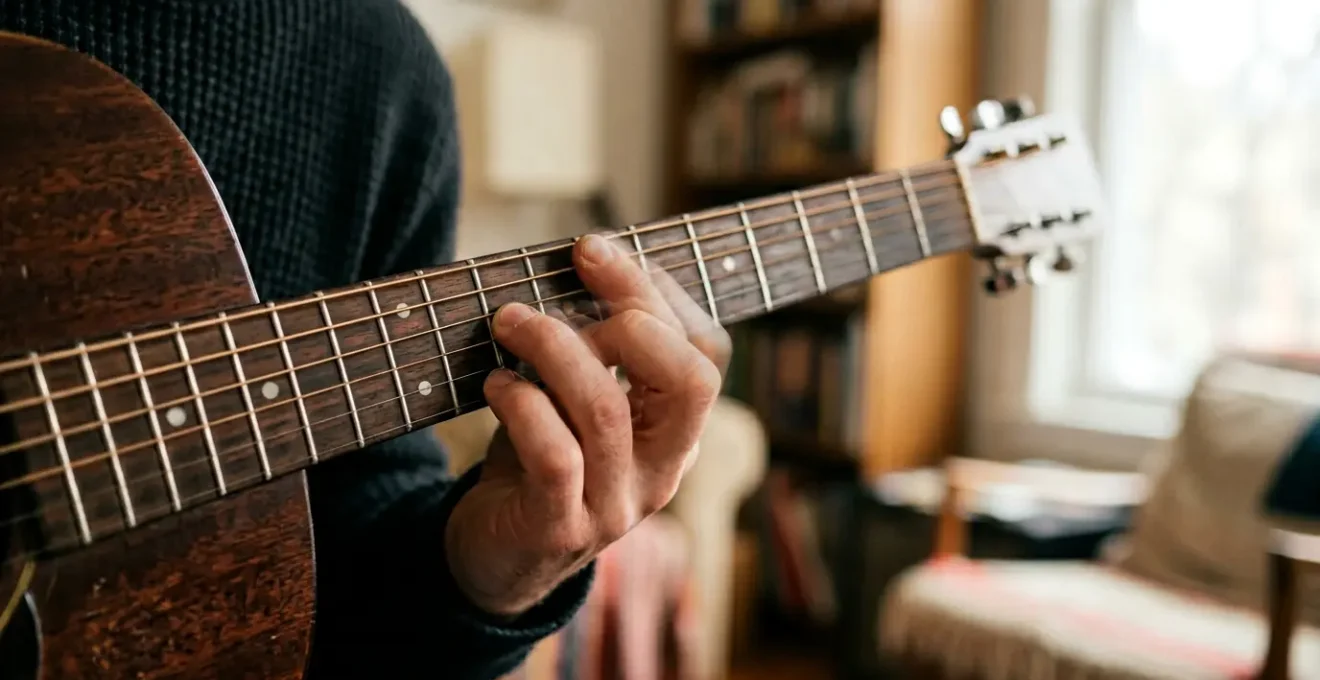
The secret to breaking free from scale-like solos isn’t learning more patterns—it’s learning to ‘speak’ through your instrument.
- Connect your musical ideas to your inner voice by singing them first.
- Use silence and small melodic fragments (motifs) to build a compelling musical narrative.
- Think of scales not as rules, but as palettes of emotional color to paint your story.
Recommendation: Before your next practice session, try this: put your instrument down, hum a simple 4-note melody, and only then find it on your instrument. This is the first step.
You’ve done the work. You’ve memorized the scales, practiced the arpeggios, and run the patterns until your fingers ache. You know the theory, you can name the modes, and you can navigate a chord chart. Yet, when the moment comes to take a solo, something feels off. The notes are correct, but they feel hollow, disconnected—a series of technical exercises rather than a moment of genuine expression. You sound like someone reciting a dictionary instead of telling a story. It’s a common frustration that traps countless passionate musicians in a creative halfway house, knowing the words but unable to form a sentence.
The standard advice often doubles down on what got you here: learn more scales, more licks, more complex theory. But what if the path to freedom isn’t about adding more, but about connecting differently? What if the key to unlocking meaningful improvisation lies not in your fingers, but in your throat? This isn’t about becoming a vocalist; it’s about acknowledging a fundamental truth: the most direct line to your musical soul is your own voice. The real challenge is not a lack of knowledge, but a broken bridge between what you can hear in your head and what you can say with your instrument.
This guide offers a different perspective. We will explore how to rebuild that bridge, transforming your instrument from a technical apparatus into a true extension of your musical intention. We’ll shift the focus from what you play to *why* you play it, turning scales into colors, silence into punctuation, and solos into compelling stories that only you can tell.
This article will guide you through a series of foundational concepts and practical exercises designed to transform your playing. Follow along to discover how to turn abstract scales into a powerful toolkit for expression.
Summary: From Scales to Stories: A Guide to Meaningful Improvisation
- Singing Your Solo: If You Can’t Hum It, Don’t Play It
- Space is Music: Using Silence to Make Your Notes Matter
- The « Potato » Method: Taking One Idea and Changing It slightly
- Target Notes: Landing on the 3rd or 7th to Outline the Harmony
- Start Low, End High: Building Intensity in a 32-Bar Solo
- The Feedback Loop: Connecting Your Throat to Your Instrument
- Dorian vs Aeolian: Hearing the Mood Difference in Minor Scales
- How to master scales not just as exercises, but as musical tools?
Singing Your Solo: If You Can’t Hum It, Don’t Play It
The first and most profound step away from mechanical playing is to connect with the instrument you were born with: your voice. If a melodic idea can’t be sung or hummed, it’s likely a product of muscle memory, a « finger pattern, » rather than a genuine musical thought. Singing forces you to internalize a melody, to feel its shape and rhythm before it ever touches the cold metal or wood of your instrument. This isn’t about perfect pitch; it’s about musical intention. When you sing a phrase, you are creating a clear blueprint for your solo, an honest expression that your hands are then tasked to translate, not invent.
This practice closes the debilitating gap between your ear, your mind, and your fingers. It’s a direct line from the music you imagine to the music you create, bypassing the analytical brain that so often gets in the way. It’s the difference between reciting memorized lines and speaking from the heart.
Case Study: Scat Singing as an Instrumental Blueprint
The tradition of jazz improvisation is built on this very principle. Research into vocal improvisation techniques reveals that scat singing establishes a direct relationship between vocal articulation and instrumental phrasing. Jazz educators often have vocalists study horn solos and horn players study vocalists. This creates a powerful vocal-instrumental feedback loop, allowing musicians to access intuitive melodic ideas before filtering them through analytical thought, resulting in more natural, conversational musical statements.
To begin forging this connection, try this simple exercise. Before playing a line, try to sing it. It doesn’t matter if you use « la-la-la » or scat syllables. The goal is to ensure the idea is born from a melodic impulse, not a geometric pattern on the fretboard or keyboard. This simple act can radically transform the authenticity of your playing.
- Match single pitches: Play one note on your instrument and sing it back. Repeat until the connection is automatic, forcing your ear to truly internalize the sound.
- Sing intervals and chords: Play a two-note interval, like a perfect fourth, and sing both notes. This trains you to truly *hear* the harmonic space, not just identify it theoretically.
- Vocal call-and-response: Sing a short musical question (2-4 notes), then immediately play the answer on your instrument.
- Record and compare: Document both your singing and playing. Listen back to identify the gaps between what you hear internally and what you execute instrumentally.
- Use syllabic vocabulary: Move beyond a generic « la » and use diverse scat syllables like « doo-by » or « bop. » These syllables can represent specific rhythmic and articulation ideas, adding another layer of expression to your vocal blueprint.
This vocal-first approach is the foundation upon which all other expressive techniques are built. It ensures that no matter how complex your music becomes, it remains rooted in a simple, human, and honest intention.
Space is Music: Using Silence to Make Your Notes Matter
In our eagerness to prove our technical skill, we often make the mistake of filling every possible moment with notes. We play fast, dense lines, believing that more is better. But a great improviser, like a great storyteller, understands the power of the pause. Silence isn’t empty; it’s the frame that gives your notes meaning. It’s the breath between sentences, the suspense before a reveal. Without space, music becomes a relentless monologue that overwhelms the listener. With space, it becomes a conversational phrasing—a dialogue that invites the listener in.
This is where the legendary trumpeter Miles Davis became a master. His solos are as famous for the notes he played as they are for the ones he didn’t. He understood that a single, perfectly placed note after a moment of silence can have more emotional impact than a flurry of sixteen notes.
This concept is about creating tension and release. A well-placed silence builds anticipation. When you finally play the next note, it lands with greater weight and significance. Think of your solo not as a continuous stream of sound, but as a series of carefully crafted phrases punctuated by moments of quiet reflection.
It’s not the notes you play, it’s the notes you don’t play.
– Miles Davis, Widely attributed jazz philosophy
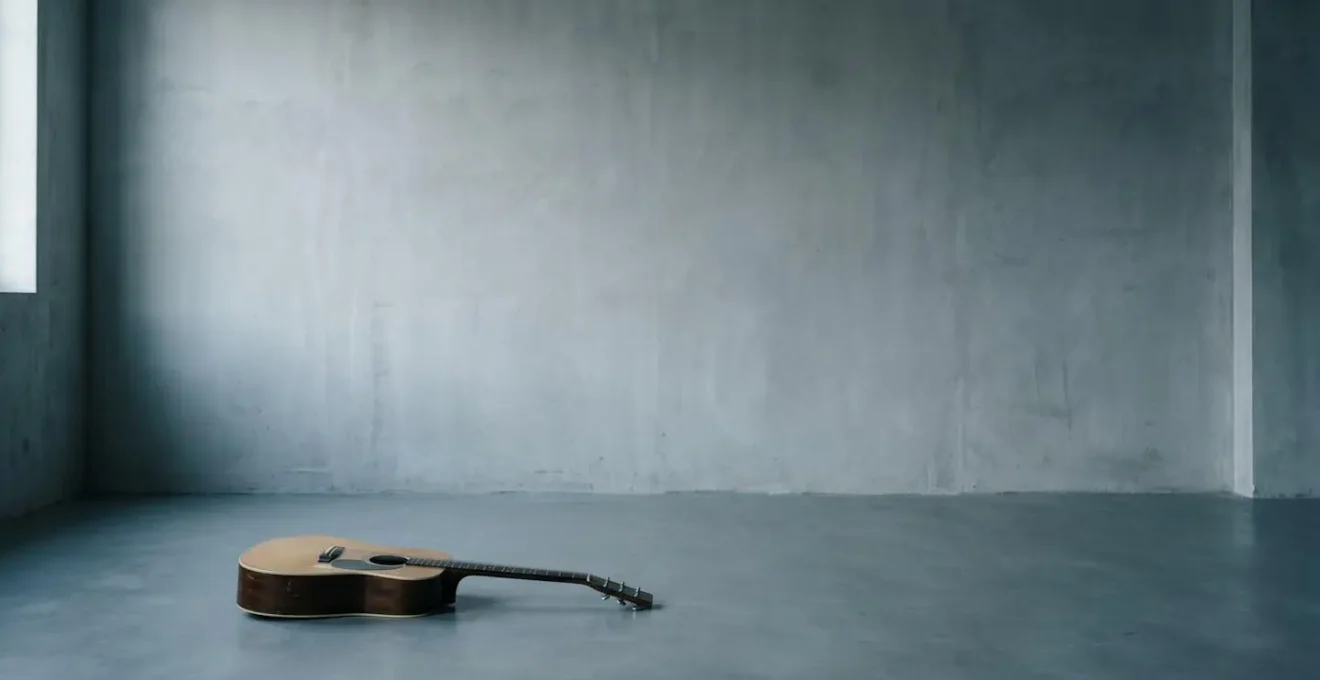
As you can see in this visual metaphor, the vast empty space is what draws your attention to the instrument itself. The same principle applies to your music. Challenge yourself to play less. Try playing a short phrase, then deliberately pause for a full measure. Listen to how the band continues without you. Feel the space, then choose your next entry point with intention. You will quickly find that your ideas become clearer, your statements more powerful, and your solos more compelling.
It’s the confidence to say something meaningful, and then have the courage to stop and let it resonate before saying something more.
The « Potato » Method: Taking One Idea and Changing It slightly
Once you’ve learned to say something meaningful and give it space, the next challenge is creating coherence. A great solo isn’t just a collection of random good ideas; it’s a story where one idea logically flows from the next. The most effective way to achieve this is through motivic development. A « motif » is simply a short, memorable melodic or rhythmic idea—a musical seed. The « Potato » method, a term for this process, is about taking one simple idea (the « potato ») and then slicing, dicing, and cooking it in various ways throughout your solo.
This is how you build a narrative. Instead of desperately searching for a new lick for every chord, you focus on developing a single, strong theme. This makes your solo sound intentional and unified, giving the listener a thread to follow. The beauty of this approach is its simplicity and power. Your source motif can be just a few notes from the song’s original melody or a simple rhythmic pattern.
Case Study: Motivic Development in Jazz Improvisation
A detailed analysis of effective motivic development shows that a short, 3-note motif taken from a song’s melody provides perfect source material. The study highlights key transformation techniques like moving the motif to fit new chords (transposition) or altering its rhythm. This systematic yet creative approach allows a musician to build an entire, engaging solo from a single, memorable fragment, ensuring the improvisation always feels connected to the source tune.
By transforming this single idea, you create both familiarity and surprise. The listener recognizes the core element, which provides a sense of cohesion, but is kept engaged by the clever variations. It’s a powerful technique for moving beyond pre-rehearsed licks and into the realm of true on-the-fly composition. The following table breaks down some of the most common techniques for transforming your « potato. »
| Technique | Description | Musical Effect | Difficulty Level |
|---|---|---|---|
| Transposition | Moving motif to different pitch levels | Maintains recognizability while exploring harmonic terrain | Beginner |
| Inversion | Flipping intervals upside down | Creates mirror image, subtle variation | Intermediate |
| Retrograde | Playing motif backwards | Unexpected twist on familiar material | Intermediate |
| Rhythmic Augmentation | Lengthening note values (making slower) | Builds tension, creates spaciousness | Beginner |
| Rhythmic Diminution | Shortening note values (making faster) | Increases energy and forward momentum | Beginner |
| Fragmentation | Using only portion of original motif | Creates new thematic material from existing idea | Advanced |
Start your next solo by finding a simple 3 or 4-note motif. Your only goal for the first chorus is to play that motif and variations of it. You’ll be amazed at how much music you can create from so little.
Target Notes: Landing on the 3rd or 7th to Outline the Harmony
While we want to move beyond purely technical playing, a deep connection with the underlying harmony is essential. The key is to make that connection sound melodic, not academic. The most direct way to do this is by focusing on guide tones. In any given chord, the most defining notes are usually the 3rd and the 7th. These are the notes that give a chord its essential quality—major, minor, or dominant. Landing on these « target notes » at key moments is like using bold lettering in a sentence; it clarifies the meaning and structure of what you’re saying.
Many improvisers get lost running scales, hoping to land on a « good » note by chance. A guide tone approach is the opposite: it’s intentional. You identify the most important harmonic colors in the progression and use them as your melodic anchor points. Your lines might wander and explore other notes of the scale, but they always have a clear destination. According to jazz theory analysis, the 3rds and 7ths define the difference between the three most common jazz chord types, making them powerful signposts.
This technique instantly makes your solos sound more sophisticated and connected to the changes, because you are actively outlining the harmonic movement. Instead of sounding like you are playing « over » the chords, you will sound like you are playing *through* them. This is the secret to creating those long, flowing lines that seem to weave effortlessly through a chord progression.
Your Action Plan: Guide Tone Line Construction
- Identify the shells: Take a chord progression and, for each chord, write down only its 3rd and 7th. This is the chord’s essential « shell. »
- Voice-lead smoothly: Connect the guide tones from one chord to the next using the smoothest possible motion—ideally holding a common note or moving by a small step.
- Create the melodic skeleton: Play only this connected line of 3rds and 7ths over the progression. This is the melodic skeleton of your solo. It won’t be fancy, but it will be perfectly harmonically correct.
- Embellish with approach tones: Now, decorate your skeleton. Add notes from the scale or chromatic notes just before you land on your target guide tones. This is how you create classic, flowing bebop-style phrases.
By focusing on the journey between these crucial harmonic landmarks, your improvisations will gain a powerful sense of direction and purpose.
Start Low, End High: Building Intensity in a 32-Bar Solo
A truly great solo has a narrative arc. It takes the listener on a journey, with a clear beginning, a developing middle, and a satisfying climax. One of the simplest yet most effective ways to structure this journey is by managing intensity. Think of a 32-bar solo not as 32 measures to fill, but as a short story to tell. A common and powerful arc is to « Start Low, End High. » This means starting your solo with simpler ideas, more space, and a lower register, and gradually building towards more complex rhythms, higher pitches, and greater emotional intensity.
This approach prevents you from playing all your best ideas in the first eight bars. It shows restraint and maturity. By starting calmly, you give yourself room to grow. The listener is drawn in by the gentle opening and becomes invested in the journey, anticipating where you will take them next. This gradual build creates a powerful sense of forward momentum and makes the eventual peak of your solo feel earned and exhilarating.

The visual of a gradual textural shift perfectly illustrates this musical concept. Your solo can evolve from something smooth and simple to something rich, complex, and intense. This dynamic shaping is a hallmark of masterful improvisers.
Case Study: The Phrasing Architecture of Miles Davis
An analysis of Miles Davis’s classic 1950s recordings reveals his genius wasn’t in harmonic complexity, but in phrasing architecture. He demonstrated that mature improvisation is about resisting the urge to deploy every practiced pattern. Instead, he controlled five key variables to shape his solos: rhythmic density (how many notes), dynamic level (volume), harmonic tension, pitch range, and timbral texture (the tone color). By manipulating these elements, he could build or release tension at will, creating a masterclass in musical storytelling in every solo.
In your next solo, consciously divide it into sections. For the first section, limit yourself to a narrow pitch range and simple rhythms. In the middle, start introducing more rhythmic complexity. For the final section, allow yourself to explore the higher register and increase the dynamic energy. Tell a story.
The Feedback Loop: Connecting Your Throat to Your Instrument
We began this journey by talking about singing as a way to find your musical ideas. Now, let’s take that concept a step further by creating a real-time feedback loop between your voice and your instrument. This means humming or gently singing the notes *as you play them*. This practice does something remarkable: it forces a direct, physical synchronization between your internal sense of pitch and the external sound you are producing. It forges a powerful connection between the vibration in your throat and chest and the vibration of the string, reed, or air column of your instrument.
This technique can be a humbling revelation. You may discover that many of the « cool » licks you play are impossible to sing, exposing them as mere finger exercises devoid of true melodic content. This is a good thing. It’s an honest audit of your playing that reveals the gap between what you think you hear and what you actually, deeply, aurally comprehend.
The goal is to close that gap until there is no perceptible difference between the line you sing and the line you play. When this connection is strong, you stop « thinking » in terms of scales and patterns and start « feeling » your way through the music. Improvisation becomes as intuitive as speaking, a direct expression of an internal feeling that manifests simultaneously in your voice and through your instrument.
Case Study: The Gap Between Ears and Instrument
A self-experiment documented by a jazz musician on JazzAdvice starkly revealed this disconnect. The musician, a proficient trumpet player, found that while he could execute complex harmonic devices on his horn, he couldn’t sing them. When forced to improvise vocally, he could barely outline the basic chord tones. This exposed that his instrument was acting as a « crutch, » with memorized patterns masking an underdeveloped ear. The solution was to hum while playing, forcing a proprioceptive synchronization that bypasses the analytical brain and fosters authentic melodic hearing.
It’s a pathway to a more organic, embodied form of musical expression, where you are not just playing an instrument, but becoming one with it.
Dorian vs Aeolian: Hearing the Mood Difference in Minor Scales
Scales are not just a series of notes; they are palettes of emotion. Once you move beyond seeing them as technical exercises, you can begin to hear their unique emotional character. A perfect place to start is by comparing two common minor modes: Dorian and Aeolian (the natural minor scale). On paper, they differ by only one note—the 6th degree. The Aeolian mode has a minor 6th, while the Dorian mode has a major 6th. This single note, however, completely changes the emotional color of the scale.
The Aeolian mode, with its minor 6th (like the note ‘Ab’ in C minor), often feels darker, more melancholic, or dramatic. It’s the sound of classical tragedy or heavy rock. The Dorian mode, with its major 6th (like the note ‘A’ natural in C minor), feels brighter, more hopeful, introspective, or even « funky. » It has a lift that the natural minor lacks. Learning to hear and deploy these distinct moods is a huge step toward intentional improvisation.
Instead of just thinking « I’ll play a minor scale here, » you can ask yourself, « What feeling do I want to create? Do I want the introspective coolness of Dorian or the dark drama of Aeolian? » This is how you start painting with sound, making conscious choices about the emotional character of your solo.
Case Study: Modal Archetypes as Emotional Anchors
Pedagogical research shows that associating modes with iconic songs or feelings provides an essential framework for improvisation. A powerful exercise involves improvising over a static minor chord but restricting yourself to only the root and the characteristic note of each mode—the major 6th for Dorian or the minor 6th for Aeolian. This « single-note storytelling » forces you to explore the full emotional weight of that one defining note through rhythm and phrasing alone, deeply internalizing its unique flavor.
To practice this, try the following:
- Assign associations: Deliberately link each mode to an emotion or color. For example, Dorian is « cool blue, » while Aeolian is « deep red. »
- Practice with intention: Play over a minor backing track and try to evoke your chosen emotion using only the notes of the corresponding mode.
- Modal substitution: While playing in Aeolian, try briefly borrowing the major 6th from Dorian to inject a moment of brightness, then return. This small change can have a huge emotional impact.
This is where theory transforms into artistry, giving you the tools to consciously shape the emotional journey of your listener.
Key takeaways
- Your most authentic musical ideas come from your inner voice; learn to sing them before you play them.
- A solo is a story. Use silence for punctuation and develop small melodic motifs to create a coherent narrative.
- Scales and modes are palettes of emotional color. Learn their unique moods to paint with sound intentionally.
How to master scales not just as exercises, but as musical tools?
We have come full circle. We began with the problem of scales feeling like exercises, and we end by reimagining them as the very toolkit for expression. The ultimate goal is to master scales so completely that you forget you are using them. They should be as automatic and invisible as the grammar you use when you speak. This mastery doesn’t come from playing them up and down faster; it comes from breaking them apart and reassembling them in creative ways.
The key is to apply creative limitations. By restricting yourself in one area (e.g., using only three notes), you force your brain to become incredibly creative in another (e.g., rhythm and phrasing). These limitations are the antidote to falling back on muscle memory and pre-learned patterns. According to guitar improvisation methodology, using different note lengths, rhythmic ideas, and space are crucial to improving your phrasing with scales.
True mastery means you own the scale, it doesn’t own you. You can start anywhere, end anywhere, and leap between notes with confidence because you have an intuitive map of its sound and structure in your mind. This is how scales transform from a cage into a playground, a set of ingredients you can use to cook up any musical flavor you can imagine.
Here are some drills to turn your scales into creative tools:
- Three-Note Vocabulary: Improvise using only three notes from a scale. This forces extreme melodic creativity.
- Single-String Exploration: Create entire melodies on just one string, breaking pattern-based habits.
- Directional Constraint: Play phrases that only go up, or only go down. This challenges your melodic thinking.
- Rhythmic Filter: Take the rhythm from a famous melody and apply it to a scale you are practicing. This separates pitch from rhythm in your brain.
- Random Noodling: Jump around the scale shape unpredictably instead of running it sequentially. This helps you master the geography of the scale, not just the sequence.
The journey from scales to stories is not a technical one, but a personal one. It’s about connecting with your inner voice, learning the craft of storytelling, and finally giving yourself permission to speak. The tools are in your hands. Now, go tell your story.