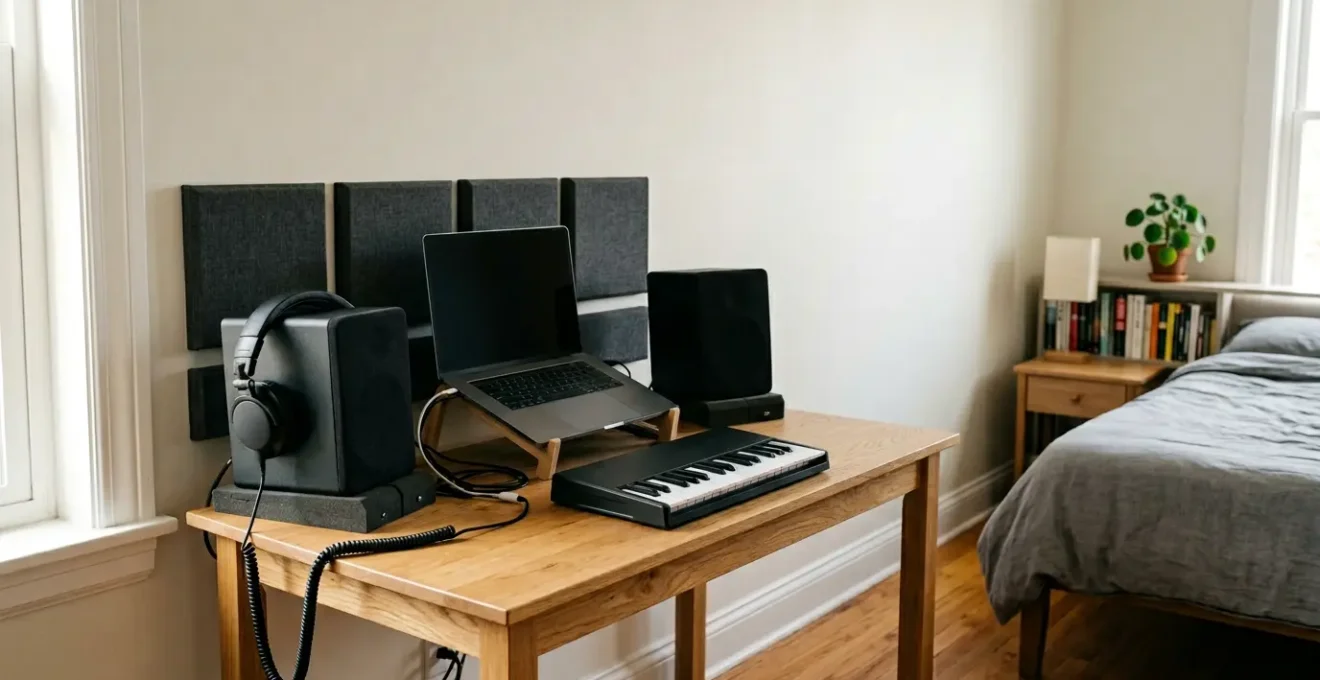
The path to professional tracks isn’t paved with new gear, but with embracing creative limitations.
- Restricting yourself to fewer tracks and tools forces stronger arrangement and mixing decisions from the start.
- Your unique sonic signature can be crafted by sampling your immediate environment, not by buying generic sample packs.
Recommendation: Stop chasing the next plugin and start mastering the art of subtraction; your best music will emerge from the space you create.
Staring at your laptop, a single microphone, and an overwhelming sense of limitation? You scroll through social media and see producers in studios that look like starship cockpits, filled with flashing lights and racks of expensive hardware. The common advice echoes in your mind: you need better gear, more plugins, expensive acoustic foam. This is the narrative that fuels Gear Acquisition Syndrome (GAS), a cycle of consumerism that promises a « professional sound » with every new purchase. It suggests that your current setup is the only thing holding you back.
But what if that’s fundamentally wrong? What if the secret to a professional sound isn’t addition, but creative subtraction? The true path to sonic innovation isn’t found in a bigger plugin folder, but in a minimalist mindset that turns limitations into your greatest strength. This isn’t about making do with less; it’s about achieving more *because* you have less. It’s a philosophy of sonic scarcity, where every sound has a purpose and every decision matters.
This guide will dismantle the myth that you need a fortune to make great music. We will explore a series of counter-intuitive strategies that will force you to become a more resourceful, innovative, and ultimately, a better producer. We’ll treat our rooms with blankets, write better songs with fewer tracks, and build drum kits from the objects in our kitchen. Prepare to unlearn what you think you need and discover the power you already have.
This article provides a complete roadmap to shift your perspective from what you lack to what you can create. The following sections break down tangible techniques to help you unlock a professional sound with minimal gear.
Summary: A Minimalist’s Guide to Professional Bedroom Production
- Blankets vs Foam: Treating Your Room for Mixing Under £50
- Why Using Only 4 Tracks Forces You to Write Better Songs
- Sampling Your Kitchen: Creating Unique Drum Kits form Household Objects
- The Gear Acquisition Syndrome Trap: Why New VSTs Won’t Fix Your Mix
- Silence and Drops: Creating Energy Without Adding More Instruments
- The Fader-Only Mix: Why You Don’t Need EQ Yet
- Why Logic’s Compressor Might Be All You Need
- How to achieve a clear mix without being an audio engineer?
Blankets vs Foam: Treating Your Room for Mixing Under £50
Before you even think about EQs and compressors, you have to address your listening environment. The biggest problem in most small, untreated rooms isn’t a lack of expensive monitors; it’s early reflections. These are sound waves that bounce off your walls, floor, and ceiling, reaching your ears milliseconds after the direct sound from your speakers. This creates phase issues and a « smeared » stereo image, making it impossible to judge your mix accurately. The pro audio world sells a solution: expensive, precisely cut acoustic foam. But the core problem is simply sound bouncing off flat surfaces, and the core solution is absorption.
This is where toolbox minimalism shines. What’s a thick, heavy, sound-absorbing material you already have? Blankets, duvets, and old comforters. For a home studio, absorption takes priority over diffusion, and thick, dense fabric is an incredibly effective absorber of the mid and high frequencies that cause the most reflective chaos. Forget complex calculations; identify your « first reflection points »—the spots on the walls to your left, right, and behind you where sound from your monitors would bounce directly to your ears. Hanging a heavy duvet in these locations can have a more dramatic and positive impact on your mix clarity than a new EQ plugin.
The goal isn’t to make your room perfectly anechoic; it’s to make it usable. Strategically placed furniture, a full bookshelf, or even bags stuffed with old clothes in the corners can act as natural diffusers and bass traps. It’s about being a resourceful problem-solver. A £20 heavy-duty blanket from a charity shop is a better investment than a £200 « magic » mixing VST if your room sounds like a bathroom. Your creativity starts with controlling your environment, and you can do it with what’s around you, as many acousticians and musicians will attest.
By taming your room’s reflections with simple materials, you build a trustworthy foundation for every mix decision you’ll make moving forward.
Why Using Only 4 Tracks Forces You to Write Better Songs
In an age of unlimited track counts, the idea of restricting yourself to just four tracks feels like a step backward. It’s a limitation that modern DAWs have fought hard to eliminate. Yet, this very constraint can be the most powerful songwriting tool you have. When you have infinite space, you’re tempted to fill it. You add layer after layer, hoping that density will create impact. The result is often a cluttered arrangement where no single element can breathe, leading to a muddy mix and a song with no focus. This is creative paralysis disguised as freedom.
Committing to a 4-track mindset forces you to make decisions. Every part must justify its existence. Is that synth pad truly essential, or is it just masking a weak melody? Does the song need a third guitar part, or should the main guitar be played with more intent? This is the essence of creative subtraction. You’re forced to focus on the core components of your song: the rhythm, the harmony, the melody, and the lead vocal or instrument. If a song doesn’t work with just these essential elements, 100 tracks of production tricks won’t save it.
This isn’t just theory; it’s proven history. The Beatles, on what are now considered iconic albums, operated within this exact limitation. According to their well-documented recording methodology, they used four-track machines to their absolute limit, employing « bouncing » techniques to combine tracks and free up space. Their legendary producer, George Martin, believed this limitation was a key ingredient to their genius, stating that their work wouldn’t have been as good with more tracks. The constraint didn’t hinder their creativity; it fueled it by forcing them to innovate with arrangement and recording techniques. It’s a powerful lesson in how sonic scarcity can lead to artistic abundance.
By imposing this limit, you’re not weakening your production; you’re strengthening your songwriting at its very foundation.
Sampling Your Kitchen: Creating Unique Drum Kits form Household Objects
The quest for the perfect drum sound can lead producers down a rabbit hole of expensive sample packs and VSTs, all promising « phat » kicks and « crispy » snares. The problem? Thousands of other producers are using those same sounds, leading to a sea of sonic sameness. Your unique voice as a producer won’t be found in a commercial sample library; it might just be found in your kitchen drawer. The concept of « found percussion » is about turning the mundane into the musical, creating a drum kit that is 100% yours.
Your environment is a goldmine of unique transients and textures. The sharp click of a salt shaker can be a perfect hi-hat. The resonant thud of a wooden spoon hitting a plastic container can be layered into a kick drum. The metallic clang of two pans hitting each other can be pitched and processed into a powerful snare. Using your phone’s voice memo app or a single microphone, you can build a library of sounds that no one else has. This isn’t a gimmick; it’s about training your ear to hear the sonic potential in everyday objects.

The beauty of this approach lies in the imperfections. The slight variations in each hit, the natural room reverb, the unexpected rattles—these are the elements that give your drums character and life. Once you have these raw recordings in your DAW, the real fun begins. A key technique, as highlighted in found sound production guides, is to layer these organic sounds with digital ones. For instance, combine the sharp transient of a sampled spoon with the deep, low-end body of a stock 808 kick. The result is a hybrid sound that is both powerful and uniquely yours. You are no longer just a music producer; you are a sonic architect, building your sound from the ground up.
This practice not only saves you money but connects you more deeply to your creative process, ensuring your rhythm tracks are anything but generic.
The Gear Acquisition Syndrome Trap: Why New VSTs Won’t Fix Your Mix
Gear Acquisition Syndrome (GAS) is a well-known affliction among creatives. It’s the persistent feeling that the only thing standing between you and a masterpiece is one more piece of gear—a vintage compressor, a boutique microphone, or, most commonly for bedroom producers, the latest VST plugin. Marketers are brilliant at exploiting this insecurity. They present new software with slick interfaces and celebrity endorsements, promising that their tool holds the secret to a « professional sound. » You buy it, get a brief dopamine hit, use it a few times, and then the cycle repeats when the next « game-changing » plugin is released.
Here’s the hard truth: a new VST will not fix your mix. It will not fix a poor arrangement, a bad recording, or a weak song. More often than not, GAS is a form of creative procrastination. It’s easier to spend hours watching plugin reviews on YouTube and convincing yourself you need a new tool than it is to sit down and do the hard work of finishing a track with the tools you already have. Every DAW comes with a suite of perfectly capable EQs, compressors, and reverbs. Mastering your stock compressor is infinitely more valuable than having a folder full of 50 different compressors you barely understand.
The minimalist producer understands that familiarity is a more powerful tool than novelty. When you deeply know the ins and outs of one EQ, you learn how it behaves, where its sweet spots are, and how to get the results you want quickly and intuitively. As producers often discuss when advising on budget setups, the real growth happens when you push your existing tools to their limits, not when you acquire new ones. Before you look for an external solution, ask yourself: have I truly exhausted the creative possibilities of what I already own? The answer is almost always no.
Resist the urge to buy, and instead invest your time in mastery. Your wallet and your music will thank you.
Silence and Drops: Creating Energy Without Adding More Instruments
When a chorus or a drop feels like it’s lacking energy, the intuitive response for many producers is to add more. More layers, more synths, more percussion—a « wall of sound » approach that aims to overwhelm the listener with density. But this often has the opposite effect, resulting in a noisy, fatiguing mix where nothing stands out. The minimalist producer knows a more powerful and effective secret to creating energy: silence. It is the art of arrangement by omission.
Energy in music is all about contrast and dynamics. A loud section only feels loud if it’s preceded by a quiet one. A dense arrangement only feels impactful if it follows a sparse one. Silence, even for a fraction of a second, is the most potent tool for creating this contrast. Think of the split-second of complete silence just before a massive bass drop in electronic music. It’s that moment of negative space that makes the subsequent impact feel monumental. It creates anticipation, a holding of breath, that makes the release ten times more powerful.
You can apply this principle in more subtle ways. Instead of adding a new instrument in the second verse, try taking one away. Mute the hi-hats for four bars. Drop out the bass for the last two beats of a phrase. These small pockets of space create movement and keep the listener engaged. They draw attention to the elements that *are* playing, making them feel more significant. A full arrangement can be created not just by what you put in, but by what you strategically take out. This approach requires confidence in your core musical ideas. You’re not hiding behind layers of sound; you’re letting each part shine.
Before you add another layer to your track, ask yourself a different question: what can I take away to make this moment bigger?
The Fader-Only Mix: Why You Don’t Need EQ Yet
For many aspiring producers, mixing is synonymous with EQ. They load up a parametric equalizer on every channel, immediately starting to boost and cut frequencies in search of clarity. This is like trying to decorate a house before the walls are built. The most crucial stage of mixing has nothing to do with fancy plugins; it’s about achieving a solid balance using only your faders and pan pots. This is the « Fader-Only Mix, » a foundational practice of minimalist production.
The goal is to get 80% of the way to a finished mix using only volume levels. This forces you to confront the most important aspect of mixing: the arrangement. If two instruments are clashing in the same frequency range, is the solution to carve them up with aggressive EQ, or is one of them simply in the wrong octave? Is the mix muddy, or is the bassline just too loud? A fader-only mix reveals these core issues. It trains you to listen to relationships between sounds rather than focusing on individual tracks in isolation.
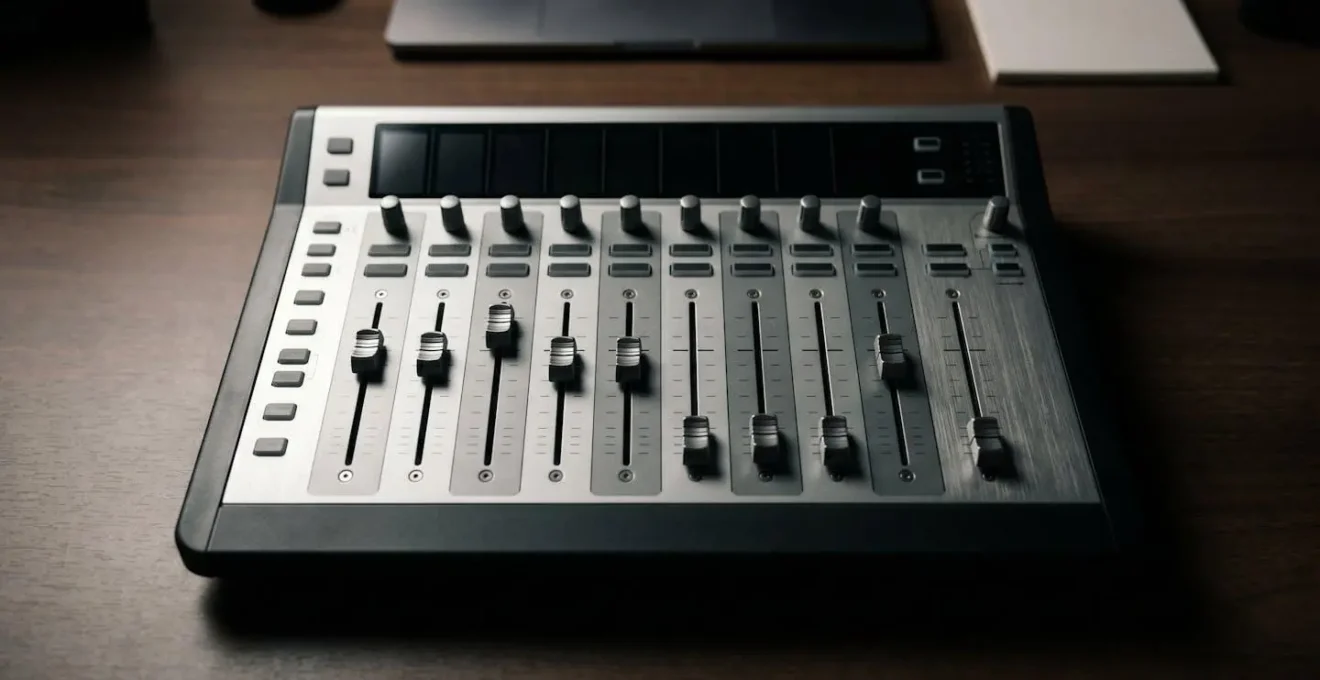
A highly effective technique to aid this process is mixing in mono with a pink noise reference. By taking panning out of the equation, you are forced to create separation with volume alone. The pink noise provides a consistent spectral reference. You bring up each track one by one until it’s « just audible » above the noise. This method bypasses emotional attachment to certain sounds and helps you achieve a spectrally balanced starting point with incredible efficiency. In fact, studies show that using this method, a 28-track level mix can be performed in four minutes. Once you have this solid foundation, any EQ you apply will be for gentle shaping and enhancement, not for life-saving surgery.
You’ll find that when your static balance is perfect, you need far less processing than you ever thought possible.
Why Logic’s Compressor Might Be All You Need
The world of compressor plugins is a classic GAS trap. There are countless emulations of legendary hardware units—FET, Opto, VCA, Vari-Mu—each costing hundreds of dollars and promising a unique « color » or « glue. » While these tools are wonderful, the idea that you need them to achieve a professional sound is a myth. For most producers, the stock compressor that comes with their DAW is an incredibly powerful and versatile tool. Logic Pro’s stock compressor is a prime example of this toolbox minimalism in action.
What makes a tool like Logic’s Compressor so powerful is that it’s not just one compressor; it’s a chameleon. It contains several different algorithms, each one modeling a different type of classic compression circuit. The « Platinum Digital » is a clean, transparent workhorse. The « Studio FET » emulates the fast, aggressive character of a classic 1176, perfect for adding punch to drums. The « Studio VCA » mimics the behavior of a console bus compressor, ideal for « gluing » a mix together. The « Classic Opto » provides the smooth, gentle compression of an LA-2A, perfect for vocals and bass. You don’t have a single, boring stock plugin; you have an entire history of compression technology inside one window.
The secret is to stop thinking of it as « the stock compressor » and start learning its different personalities. Instead of buying a new plugin to get a « VCA sound, » spend an afternoon learning how the VCA mode in your stock plugin reacts to different material. By mastering the tool you already have, you develop a deeper understanding of the fundamentals of compression itself. You learn what attack and release times actually *do* and how different circuit types change the sonic character of a sound. This knowledge is transferable to any compressor, but you can gain it for free, without ever leaving your DAW.
This single, often-overlooked plugin can handle 95% of the dynamic challenges you’ll face in a mix, proving that mastery always trumps acquisition.
Key takeaways
- Effective room treatment is about smart absorption with everyday materials, not expensive foam panels.
- Creative limitations, like restricting track counts, are a catalyst for stronger songwriting and arrangement.
- Your unique sonic identity is waiting to be discovered in your immediate environment, not in a commercial sample store.
How to achieve a clear mix without being an audio engineer?
Achieving a clear mix without being a formally trained audio engineer is about adopting a simple, methodical workflow that prioritizes balance and arrangement over complex processing. It’s about trusting your ears and a few key principles rather than getting lost in technical jargon. The core idea is that a great mix is born from a great arrangement. If your sounds are well-chosen and occupy their own space in the frequency spectrum and stereo field, the mix will practically fall into place. Clarity isn’t added at the end with a magic plugin; it’s preserved from the beginning.
This means embracing the concepts we’ve discussed: getting a solid fader-only balance first, using space and silence to create impact, and ensuring every part has a reason to be there. One of the most powerful and non-technical methods to achieve a balanced mix is the pink noise technique. It removes guesswork and emotional bias, allowing you to set levels based on a purely objective spectral reference. It’s a simple process that anyone can follow to get a fantastic starting point for their mix in minutes, ensuring no single instrument is overpowering the others.
Action Plan: The Pink Noise Mixing Technique
- Generate pink noise on a new track and set its level to around -18dB RMS for a healthy reference point.
- Switch your entire mix to mono to eliminate panning influences and focus purely on level and frequency balance.
- Start with all your instrument tracks muted and only the soloed pink noise playing.
- One by one, unsolo each instrument track and slowly raise its fader until you can just barely hear it above the hiss of the pink noise.
- Once every track is set this way, mute the pink noise track, switch your mix back to stereo, and listen. You will have a remarkably well-balanced starting mix.
This technique, combined with a minimalist philosophy, is the key. You don’t need to know the exact frequency of a muddy kick drum if your arrangement and initial balance prevent it from clashing with the bass in the first place. You achieve clarity not by being a technical wizard, but by being a thoughtful and deliberate musical architect. It’s a shift from fixing problems to preventing them from ever happening.
Start applying these minimalist principles today, and you will discover that the power to create professional-sounding tracks has been in your hands all along.