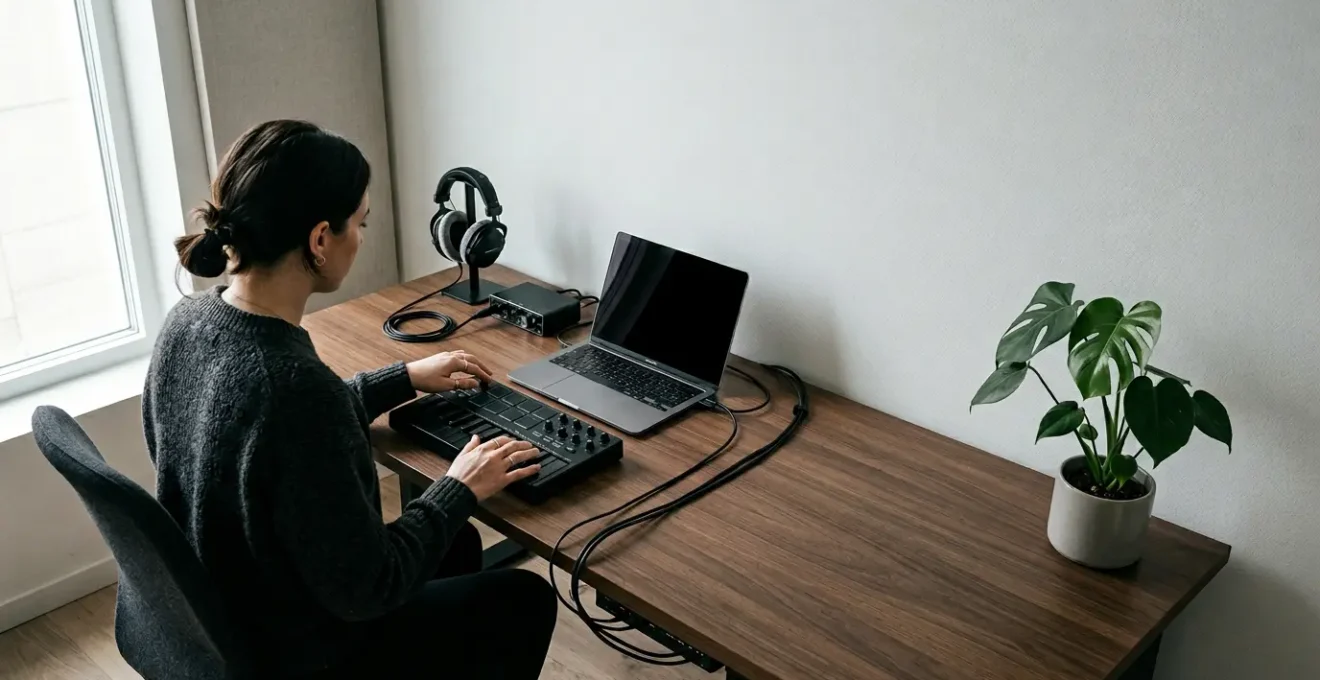
The solution to a bloated sample library isn’t better organization, but a radical shift in mindset from collector to creator.
- Endless browsing stems from a « librarian » mentality; the key is to become a « sonic alchemist » who transforms existing sounds.
- Techniques like micro-sampling, randomization, and layering turn any sample into a unique, signature element, eliminating the need to search for the « perfect » sound.
Recommendation: Instead of downloading another sample pack, pick one sound you already own and creatively misuse it using the methods in this guide.
You know the feeling. Terabytes of pristine samples are at your fingertips, a digital Fort Knox of kicks, snares, and synths. Yet, when inspiration is meant to strike, you spend hours scrolling through folders, auditioning the 347th kick drum, only to end up with a blank project. This is sample paralysis, the modern producer’s curse where an abundance of choice leads to a poverty of creation. You’ve become a librarian of sounds, not a maker of music.
The common advice is to get organized: create meticulous folder structures, tag every file, and buy a dedicated sample manager. While these steps have their place, they often reinforce the core problem. They optimize the act of searching, but the ultimate goal is to eliminate the search altogether. What if the path out of this digital labyrinth isn’t about finding the perfect sound, but about realizing you already have it? It’s about learning to see a single sample not for what it is, but for what it could become.
This guide offers a different path. It’s about shifting your perspective from a passive collector to an active sonic alchemist. We will not focus on building a better library, but on developing the skills to creatively misuse, deconstruct, and reinvent the sounds you already possess. By embracing a little intentional chaos and transformative sound design, you can turn your burdensome library into an infinite well of unique, signature material. This is how you stop browsing and start creating.
This article provides a complete roadmap to shift your workflow. We will explore how to curate with purpose, inject life into robotic patterns, and master the transformative tools that turn any audio file into a new instrument. Here is what we’ll cover.
Summary: Mastering Your Digital Sound Library Without Getting Lost
- The « Favorites » Folder: Why You Only Need 5 Kick Drums
- Happy Accidents: Using Randomizers to Break Writer’s Block
- Micro-Sampling: Turning a Vocal Chop into a lush Pad
- Humanizing Drums: Why Quantizing 100% Sounds Robotic
- The Best of Both Worlds: Mixing Real Violin with Synth Strings
- The « Final_Final_V3 » Nightmare: Naming Conventions That Save Sanity
- Morphing Sounds: Why Wavetables Are the Future of EDM Bass
- Demystifying synthesizers: Analog vs Digital vs FM for beginners
The « Favorites » Folder: Why You Only Need 5 Kick Drums
The first step away from sample paralysis is a counter-intuitive act of limitation. Instead of organizing your entire multi-terabyte library, focus on curating a tiny, powerful, and highly personal palette. A « Favorites » folder isn’t just a bookmark; it’s a declaration of intent. It’s your desert-island toolkit. The truth is, you don’t need 500 kicks for your next track; you need one great one. By pre-selecting a handful of your absolute best sounds—perhaps five kicks, five snares, and five hi-hats—you eliminate 99% of the decision fatigue before you even start producing.
This approach transforms your workflow from a scavenger hunt into a focused creative session. The goal is to build a core library of go-to sounds that you know inside and out. These become the bedrock of your sonic signature. Rather than searching for a « subby kick » in a sea of generic file names, you reach for one of the two you’ve already vetted and tagged for that specific purpose. This isn’t about deletion; your main library can remain as a vast archive for occasional exploration. This is about building a small, accessible front-line arsenal.
The impact on workflow is immediate and profound. As one producer found after curating a core collection in Ableton Live, having pre-selected favorites made the creative process faster and more fluid. The resulting track, born from efficiency rather than endless searching, demonstrated that a well-organized workflow directly impacts creative quality. The track went on to amass approximately 70,000 streams on Spotify, proving that less choice can lead to more success.
Action Plan: Your 5-Step Audit to a Leaner Sample Library
- Structure First: Create a clear folder structure that separates your CORE essentials (your new « Favorites ») from PROJECT-specific or archival sounds.
- Quick-Scan New Packs: Spend 5-10 minutes browsing new sample packs immediately after downloading to pull out the gems for your Favorites folder.
- Organize by Function: Structure your Favorites folder by sound type (e.g., Kicks, Snares, Pads) and sonic purpose (‘Subby Kick,’ ‘Tight Punchy Kick’) rather than by the original pack name.
- Audit Regularly: Once a month, review your Favorites. If you find sounds you’ve never actually used in a production, demote them back to the archive. Keep the toolkit sharp.
- Integrate Your System: Use your DAW’s built-in features (like Ableton’s Collections or FL Studio’s Browser) to make your Favorites instantly accessible without navigating file trees.
By consciously limiting your options, you force creativity and build a recognizable sound. Your favorite kick drum, processed in a new way, is infinitely more « you » than a random one pulled from a new pack.
Happy Accidents: Using Randomizers to Break Writer’s Block
Once you’ve curated your core library, the next step is to introduce intentional chaos. If curation is about control, randomization is about letting go. Writer’s block often stems from predictable patterns. Using randomizers in your DAW or with dedicated plugins is a powerful way to shatter those patterns and generate ideas you would never have conceived on your own. This isn’t about hoping for a lucky accident; it’s a deliberate technique to force your creativity into new territories.
This concept of using chance in music is far from new. It’s a technique with a surprisingly deep history. As the LANDR Blog team points out, the principle has been used for centuries:
Randomness in music has been around forever—even Bach was using it in the early 18th century. Bach’s version was called Musikalisches Würfelspiel. It means musical dice game in German.
– LANDR Blog Editorial Team, 7 Uncommon Ways To Make Your Tracks Better With Randomization
In a modern context, you can apply this « musical dice game » to almost any parameter: randomize the sequence of a MIDI pattern, the filter cutoff on a synth, or the selection of samples in a drum rack. The key is to set boundaries. For instance, randomize notes within a specific scale, or randomize sample start times within a narrow range. This is the difference between pure noise and an inspiring, unexpected starting point. You are not the gambler; you are the casino owner, designing the game to produce favorable outcomes.
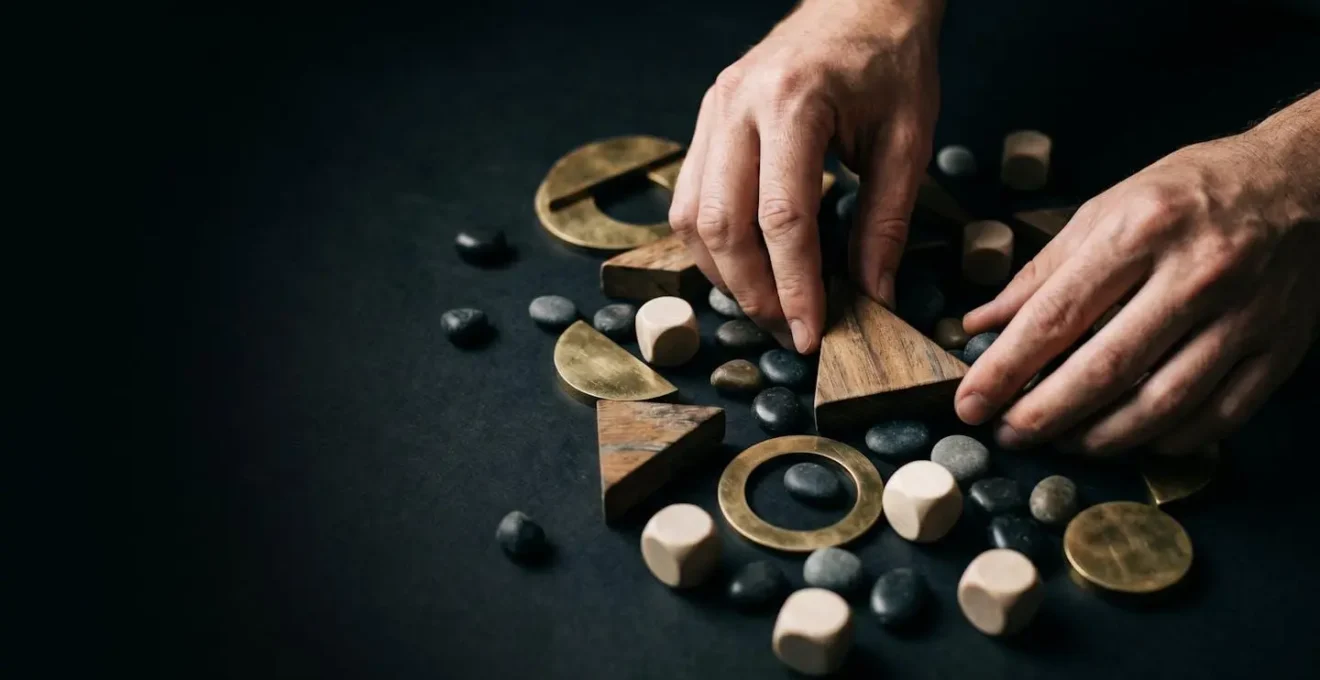
This visual metaphor of organized chaos perfectly captures the essence of the technique. It’s not about surrendering control but about creating a structured environment where serendipity can flourish. The most interesting results often come from applying randomization to your small, curated « Favorites » folder, blending the familiar with the unexpected to create something truly unique.
Ultimately, a randomizer’s best output isn’t a finished loop, but a single « happy accident »—a strange rhythm or an unusual melodic fragment—that becomes the seed for an entire track.
Micro-Sampling: Turning a Vocal Chop into a lush Pad
Here we enter the heart of sonic alchemy: granular synthesis. This technique is the ultimate expression of creative misuse, allowing you to take any sound and completely obliterate its original context to forge something new. Instead of searching for a pad, why not create one from the texture of a vocal chop, the attack of a snare, or a field recording of rain? Granular synthesis makes this possible by breaking audio into tiny fragments called « grains. »
These grains are minuscule audio snippets. According to granular synthesis principles, audio samples are split into tiny particles, which are typically 1 to 100 milliseconds in length. By manipulating the playback of these grains—stretching them, layering them, repitching them, and changing their density—you can create entirely new textures that retain a hint of the original source’s character but exist as a completely new sonic entity. This is how you can turn a percussive, transient-heavy sound into a smooth, evolving ambient pad.
Imagine taking a one-second vocal phrase. Load it into a granular synthesizer (like Portal by Output, or Ableton’s Granulator). Isolate a tiny, vowel-like portion of the vocal. Now, tell the synth to play that grain repeatedly, overlapping hundreds of copies with slight variations in pitch and pan position. Suddenly, the percussive chop has dissolved into a shimmering, ethereal chord. You haven’t « found » a pad; you have *transmuted* a vocal into one. This is the power of working at the micro-level of sound.
This process frees you entirely from a sample’s intended use. A drum loop is no longer just a rhythm; it’s a collection of percussive textures that can be melted down into a wobbly bassline. A guitar riff isn’t just a melody; it’s a source of harmonic content for an atmospheric drone. Mastering this technique means your existing library is not a finite collection of sounds but an infinite source of raw sonic material.
It’s a profound shift in thinking: you stop asking « What sound do I need? » and start asking « What sound can I create from what I already have? »
Humanizing Drums: Why Quantizing 100% Sounds Robotic
While sonic alchemy can create futuristic sounds, it’s equally powerful for breathing life into digital elements. A perfectly quantized drum pattern, locked to the grid with 100% rigidity, sounds sterile and lifeless because no human drummer plays with that level of mechanical precision. The secret to professional-sounding drums lies in subtle imperfections: tiny variations in timing and velocity that create a sense of groove and feel. This is the art of humanization.
Most DAWs have a « humanize » function, but applying it blindly is a mistake. Effective humanization is intentional. It’s about understanding the nuances of a real performance. For example, a real drummer might play snare hits slightly behind the beat to create a « laid-back » feel, while their kick drum remains tight and on the beat to anchor the rhythm. Similarly, not every hit has the same force. The main downbeats are often stronger (higher velocity), while « ghost notes » are played much softer (lower velocity) to add rhythmic complexity.
To humanize your MIDI drums effectively, focus on two key areas:
- Velocity Variation: Instead of having every snare hit at a velocity of 100, manually edit them. Try values like 100, 95, 102, 91. Add very soft ghost notes in the 30-40 velocity range. This dynamic variation is the number one factor in making programmed drums feel real.
- Micro-Timing: Nudge some notes slightly off the grid. Moving a snare a few ticks late can create a relaxed groove. But be selective. Keep foundational elements like the kick on beat one perfectly quantized to maintain the song’s rhythmic integrity. The key is to randomize note positions by just a few ticks (±10 is a good starting point) to add life without the timing sounding sloppy.

This close-up view of a percussion surface symbolizes where the magic happens: in the micro-details of texture and impact. Humanizing is about recreating this organic variation in the digital realm. It’s a craft that requires listening and subtlety, moving beyond the robotic perfection of the grid to create a rhythm that breathes.
By investing time in these small adjustments, you elevate your tracks from a static sequence of notes to a dynamic, compelling performance.
The Best of Both Worlds: Mixing Real Violin with Synth Strings
The « sonic alchemist » mindset extends to layering. One of the most powerful techniques for creating rich, professional-sounding arrangements is to combine organic, acoustic sources with their synthetic counterparts. A real violin recording, for example, has beautiful, complex texture, bow noise, and subtle imperfections that are difficult to replicate. However, it might lack the deep, powerful low-end of a well-designed synth pad. By layering the two, you get the best of both worlds: the realism and character of the real instrument combined with the weight and control of the synthetic one.
The key to successful layering is frequency slotting. You don’t want the two sounds to fight for the same space in the mix. Instead, you carve out a specific role for each. A common strategy is to use a high-pass filter on the organic sound to keep its brilliant highs and mid-range character, while using a low-pass filter on the synthetic sound to let it provide the warm body and sub-bass foundation. This way, they fit together like puzzle pieces instead of clashing.
This layering strategy, as shown in the comparative analysis, is a structured approach to creating a hybrid sound that is both realistic and powerful.
| Layer Type | Sonic Function | Frequency Focus | Processing Approach |
|---|---|---|---|
| Organic Source (Real Violin) | Attack, texture, realism, bow noise | High-pass filter to retain upper harmonics and character | Preserve natural imperfections and transients |
| Synthetic Source (Synth Strings) | Sustain, body, weight, sub-bass foundation | Low-pass filter for warm clean body without frequency clashes | Control dynamics with envelope follower for cohesion |
To further meld the two layers, you can use dynamic processing. For instance, applying a subtle sidechain compressor or an envelope follower to the synth strings, triggered by the real violin, can make the synthetic layer « breathe » in time with the organic performance. This creates a cohesive, unified sound that feels like a single, impossibly rich instrument rather than two separate elements stacked on top of each other.
This approach isn’t limited to strings. It works wonders for layering acoustic pianos with electric pianos, real brass with synth brass, or even a sampled kick drum with a synthesized sub-bass click.
The « Final_Final_V3 » Nightmare: Naming Conventions That Save Sanity
While the focus of the sonic alchemist is creative transformation, even the most chaotic laboratory needs a system of labeling. A consistent naming convention is not boring housekeeping; it’s the foundational grammar that makes creative freedom possible. The infamous « Final_Final_V3.wav » file name is a symptom of a workflow that wastes mental energy on detective work instead of creation. A scalable file naming system is your insurance against this chaos.
The goal is not to create a rigid, complex system, but a simple, descriptive one that you can apply consistently without thinking. A robust format includes several key pieces of information that tell you everything you need to know about the sound without having to listen to it. A great starting point is a structure like: [ProjectName]_[SoundType]_[Descriptor]_[Key/BPM]_[Version]. For example, `NeonSkies_Bass_SubbyMoog_Cmin_120bpm_01.wav` is instantly identifiable.
This system has two primary benefits. First, it makes your own created sounds—the results of your granular synthesis and layering experiments—reusable in future projects. That unique pad you morphed from a vocal chop is no longer a one-off happy accident; it’s a cataloged asset. Second, it drastically speeds up collaboration. When you send stems to a mixing engineer or another producer, they won’t have to guess what « Audio 27 » is. Clarity in naming is a sign of professionalism and respect for others’ time.
To make your system even more powerful, consider maintaining separate directories for different stages of work. A ‘Working Directory’ or ‘Sketchbook’ folder can be the messy sandbox for your experiments, free from any naming rules. Once you’ve sculpted a sound you love, you save a finalized version to your ‘Master Archive’ with the proper, descriptive name. This separates the chaotic process of creation from the organized result.
Think of it this way: a chef cleans and organizes their station (mise en place) not because they love cleaning, but because it allows them to cook with speed, precision, and creativity when it matters.
Morphing Sounds: Why Wavetables Are the Future of EDM Bass
If granular synthesis is about deconstructing sound, wavetable synthesis is about reconstructing it into a morphing, evolving instrument. A wavetable is essentially a collection of single-cycle waveforms, or « frames, » arranged in a series. The magic happens when you smoothly scan or « morph » through these frames, creating a sound that changes its timbre over time. This makes it an incredibly powerful tool for the modern producer, especially for creating the complex, dynamic bass sounds central to genres like EDM.
The real breakthrough, as highlighted in a case study on modern sound design, is the ability for synthesizers like Serum or Vital to create wavetables from *any* audio file. You can drag a drum loop, a vocal phrase, or a field recording directly into the synth’s wavetable oscillator. The synth analyzes the audio and converts it into a series of frames. Now, you can use an LFO or envelope to sweep through the complex harmonic landscape of your original sound. This turns your entire sample library from a collection of static sounds into a near-infinite source of unique wavetables.
This technique, which shares a conceptual lineage with granular synthesis, is about creating extraordinary evolving soundscapes from any source. As Sound on Sound notes, this technology is the core of modern sound manipulation. This effectively solves the « I need a new sound » problem forever. You don’t need a new preset; you can generate a thousand unique bass timbres from a single recording of a passing car.
For example, take a complex, metallic percussion hit. Drag it into a wavetable oscillator. The start of the wavetable will contain the sharp, transient attack, while the end will hold the tonal, ringing decay. By modulating the wavetable position, you can create a bass that starts with a percussive click and morphs into a sustained, metallic growl—a sound that would be impossible to find in any sample pack because you just invented it.
This is the pinnacle of the sonic alchemist’s toolkit: turning lead into gold, or in this case, any audio file into a dynamic, signature bassline.
Key Takeaways
- Curation over collection: A small, powerful « Favorites » palette is more creative than a massive, unorganized library.
- Embrace creative misuse: Use techniques like randomization and micro-sampling to transform sounds instead of just searching for them.
- Layering is alchemy: Combine organic and synthetic sources using frequency slotting to create rich, hybrid sounds that are greater than the sum of their parts.
- Sound design is faster than searching: Mastering basic synthesis and transformative tools like wavetables eliminates option paralysis and helps forge a unique sonic signature.
Demystifying synthesizers: Analog vs Digital vs FM for beginners
For many producers, the word « synthesizer » conjures an intimidating image of complex knobs and impenetrable jargon. The debates over analog warmth, digital clarity, and the arcane mathematics of FM synthesis can feel like a barrier to entry. But here is the secret: you don’t need to understand everything to create your own unique sounds. In fact, a simple, « 80/20 » approach to synthesis is often faster and more musically rewarding than searching through thousands of presets.
Instead of getting lost in the type of synthesis, focus on the three parameters that deliver the most dramatic sonic results with the least effort:
- The Filter Cutoff: This is the most powerful control on almost any synth. It controls the brightness and tone of the sound. Sweeping the filter is the easiest way to add movement and expression.
- The Amp Envelope (ADSR): This shapes how the sound’s volume evolves over time. A short attack and decay create a percussive, plucky sound. A long attack and release create a soft, evolving pad. Mastering the ADSR is fundamental to defining a sound’s character.
- The LFO: A Low-Frequency Oscillator creates rhythmic movement. Assigning a single LFO to modulate the filter cutoff or pitch is the simplest way to turn a static sound into a living, breathing one.
Armed with just these three controls, you can take any basic preset and make it your own. This is the ultimate antidote to the « preset-scrolling » nightmare. Rather than looking for a « Deep Wobble Bass » preset, you can create your own version in seconds by taking a simple bass patch, applying an LFO to the filter, and shaping the amp envelope. This « anti-library » mindset, where creating from scratch is the default, is the final step in becoming a true sonic alchemist.
Whether you’re using an analog, digital, or FM synth, these core principles apply. Stop worrying about the technical specifications and start twisting the knobs. The goal isn’t to become a synthesis expert overnight, but to become comfortable enough to build sounds that are uniquely yours, freeing you forever from the paralysis of the infinite sample library.
Stop searching, start creating. Open your DAW, pick a single sound you’ve never used, and apply one of these techniques to transform it. Your next signature sound isn’t in a new sample pack; it’s waiting to be sculpted from what you already own.