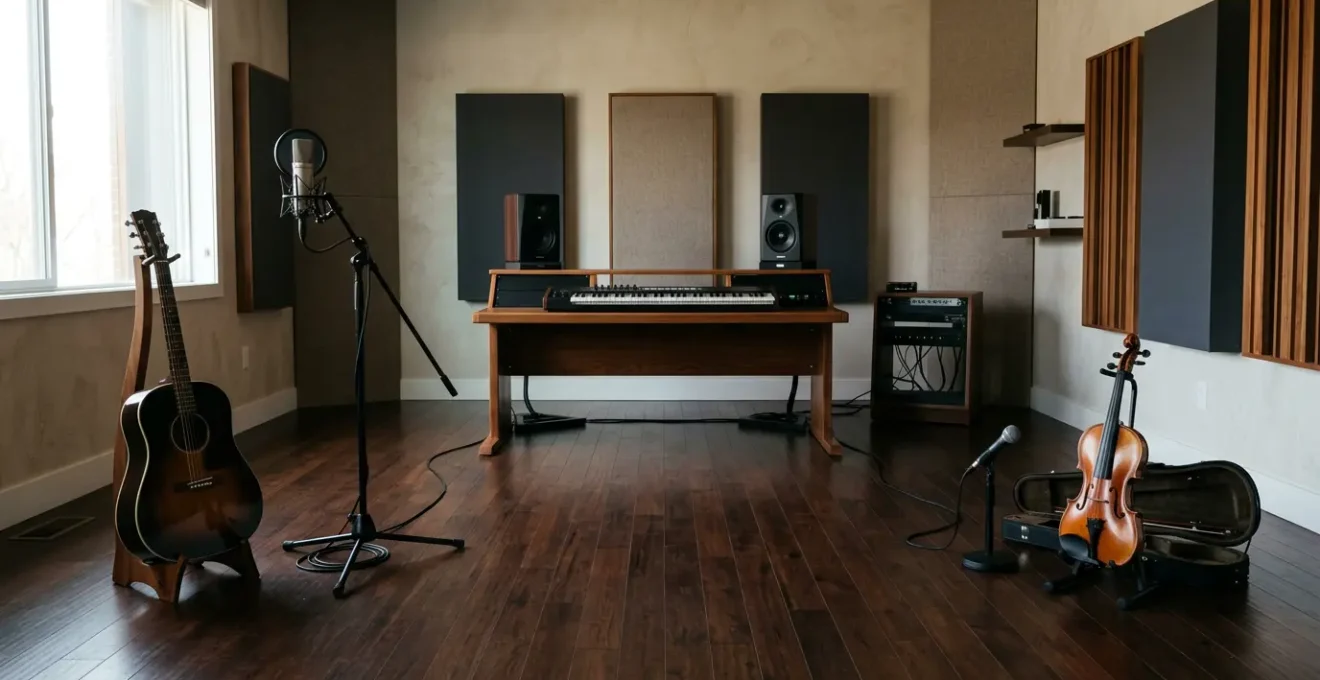
The secret to a clean, powerful arrangement isn’t adding more effects; it’s choreographing a musical conversation where every instrument knows its role.
- Clarity comes from subtraction, not addition. Muting redundant parts makes the remaining ones sound bigger.
- Define a clear « focal point » for each section of your song, allowing other instruments to support, not compete.
Recommendation: Start thinking of your arrangement in terms of space—frequency, time, and stereo width—before you even touch an EQ or compressor.
As a band leader or producer, you know the feeling. You have a collection of great parts—a powerful bassline, a driving guitar riff, a soaring vocal melody—but when you put them all together, the result is a crowded, muddy mess. Instruments clash, frequencies fight for dominance, and the emotional impact of the song gets lost in the noise. This is one of the most common frustrations in music production, a sign that the arrangement isn’t working.
The typical advice involves diving into technical fixes: carving out EQ, applying sidechain compression, or using complex processors. While these mixing tools are essential, they are often used as a cure for a problem that starts much earlier: in the arrangement itself. The real issue is that your instruments aren’t listening to each other. They’re all trying to be the star of the show at the same time.
But what if the solution wasn’t about technical separation, but about artistic conversation? This is the perspective of a musical director. We’re going to stop thinking like audio engineers fighting for sonic space and start thinking like choreographers guiding a dynamic dialogue. The key is to treat each instrument as a voice in a conversation. Some voices lead, some support, some ask questions, and some know the profound power of staying silent.
This guide will walk you through a structural approach to arranging. We will explore how to define roles for the low end, create dialogue between melodic elements, use subtraction to create size, build energy strategically, and leverage the power of silence and stereo placement. By the end, you’ll have a framework for creating arrangements where every instrument has its own space, not because you forced it with plugins, but because you designed it that way from the start.
To help you navigate these concepts, this article is structured to build from foundational principles to specific, impactful techniques. Explore the sections below to learn how to transform your arrangements from crowded arguments into compelling conversations.
Summary: How to build arrangements where every instrument shines
- Bass vs Kick: Who Owns the Low End in Your Arrangement?
- The Conversation: Creating Dialogue Between Vocal and Guitar
- Beyond Unison: Writing a Violin Line That Complements the Voice
- Why Muting 30% of Your Tracks Makes the Song Bigger
- Building the Chorus: Adding Elements Strategically for Impact
- Silence and Drops: Creating Energy Without Adding More Instruments
- LCR Mixing: Creating Width by Being Bold with Pan Knobs
- Why playing in ensembles teaches you skills you can’t learn alone?
Bass vs Kick: Who Owns the Low End in Your Arrangement?
The eternal battle in any mix is fought in the low frequencies. The kick drum provides the pulse, the heartbeat of the track. The bass provides the harmonic and melodic foundation. The problem is they both want to occupy the same sonic territory. Technical research confirms that the critical range of 20 Hz–160 Hz is where both instruments have their fundamental power. When they overlap without a clear plan, you get mud, flabbiness, and a loss of punch. The solution isn’t to pick a winner; it’s to make them collaborators.
Think of the kick and bass as two dancers who need to share a small stage. They can’t perform the same moves at the same time. The arrangement decision starts here. One of the most effective strategies is rhythmic separation. If the kick is playing a busy pattern on the 16th notes, let the bass hold longer, simpler notes. Conversely, if the bass has a syncopated, active part, the kick should be simpler, perhaps just hitting on the downbeats. This is « call and response » at a foundational, rhythmic level.
Another powerful arrangement technique is tonal separation. Decide which instrument will own the sub-bass frequencies (typically below 60-80 Hz) and which will focus on the low-mids. For example, a punchy, tight kick with a strong attack can be the focus, while the bassline is written or processed to have its energy slightly higher up. A classic approach is to have a sub-bass synth double the bass guitar line but only play the fundamental tones, while the kick is high-passed to focus on its « click » and punch around 100-150 Hz. These are arrangement choices, not just mixing fixes.
Ultimately, the goal is for the kick and bass to form a single, cohesive low-end engine. Every note from one should acknowledge the presence of the other. By defining their rhythmic and tonal roles during the writing and arranging phase, you create a powerful foundation that feels both full and clear, without needing surgical EQ to fix it later.
The Conversation: Creating Dialogue Between Vocal and Guitar
Once the foundation is solid, the real storytelling begins in the midrange, most often between the lead vocal and a primary melodic instrument like a guitar. Treating this relationship as a literal conversation is the single most effective way to create an engaging arrangement. If the vocal is speaking, the guitar should be listening—or offering a thoughtful response. When they both talk at the same time, the listener can’t focus on either.
This paragraph introduces a complex concept. To well understand it, it is useful to visualize its main components. The illustration below breaks down this process.

As this image suggests, the relationship is about proximity and space. A classic technique is « call and response. » The singer delivers a line, and in the pause that follows, the guitar plays a short melodic fill or riff. This creates a natural back-and-forth that keeps the listener engaged. The guitar isn’t just strumming chords; it’s an active participant in the narrative, commenting on or reinforcing the singer’s emotional message.
The texture of the guitar part is also crucial. During a vocal phrase, the guitar might simplify its part, moving to muted strums, sparse arpeggios, or long, sustained notes. This is the musical equivalent of nodding along while someone else is talking. It provides harmonic support without cluttering the sonic space. When the vocal pauses, the guitar can step forward with a more complex or prominent part. This dynamic interplay creates a sense of movement and prevents the arrangement from feeling static.
Beyond Unison: Writing a Violin Line That Complements the Voice
When adding a string instrument like a violin to an arrangement with a lead vocal, the most common mistake is to simply have it double the vocal melody. While this can work for emphasis in a powerful chorus, it’s often a missed opportunity. To truly elevate the track, the violin line should function as a separate, complementary character in the musical story, not as the vocalist’s shadow.
Instead of unison, think about counter-melody. A counter-melody is a secondary melodic line that weaves around the main vocal melody. It has its own melodic contour but is harmonically compatible. A well-written counter-melody can add a new layer of emotion or a contrasting perspective. If the vocal melody is descending and somber, a rising, hopeful violin line can create a beautiful, poignant tension. The key is that the two melodies move independently but harmoniously, like two people in a dance.
Another powerful role for the violin is to provide textural and harmonic support through pads and swells. During a vocal phrase, the violin can hold a long, sustained note or a simple two-note harmony that sits underneath the vocal. It can swell in volume to emphasize a key word or fade away to create a sense of space. In this role, the violin isn’t competing for melodic attention; it’s creating the atmospheric bed on which the vocal can rest. It’s the « listening » part of the conversation, providing emotional context.
Finally, consider the violin’s rhythmic role. It can provide short, sharp, rhythmic stabs (pizzicato or arco) in the gaps left by the vocal, adding energy and drive without adding clutter. These rhythmic « answers » can be more effective than a full-blown melodic fill, adding punctuation and forward momentum. By thinking beyond unison, you unlock the violin’s potential to be a dynamic and expressive partner to the voice.
Why Muting 30% of Your Tracks Makes the Song Bigger
It sounds counter-intuitive, but one of the fastest ways to achieve a bigger, more impactful sound is to start muting tracks. In modern production, it’s easy to layer dozens of instruments, thinking that more layers equal more power. The opposite is often true. A dense arrangement full of redundant parts creates a sonic fog where nothing can truly stand out. Clarity is born from subtraction.
The principle at play is psychoacoustics. Our brains can only focus on a few elements at once. When you present the listener with a sparse, well-defined arrangement, each element is perceived with greater weight and importance. A single, perfectly placed piano note has more emotional impact in a quiet verse than a dozen synth pads playing at once. This philosophy of minimalism has been brought to the forefront of pop music, proving its commercial and artistic power.
Case Study: Billie Eilish’s ‘bad guy’ – Minimalist Production Philosophy
Billie Eilish’s production with FINNEAS brought a minimalist space philosophy to mainstream pop. According to a detailed analysis of their production style, the track ‘bad guy’ is essentially a bassline and vocals with minimal drums—kick, snare, and almost no hi-hats. Space exists deliberately between every element. Mixing engineer Rob Kinelski noted that they didn’t even use consistent reverb on the vocals, sometimes leaving them dry and sometimes with space, always serving the song rather than following production rules. The track sounds enormous despite having very few elements.
So, how do you apply this? During your arrangement process, perform a « mute audit. » Go through your tracks and ask for each one: « What is this part’s unique job? » If two guitar parts are playing the same rhythm in the same register, try muting one. If you have three synth pads providing a similar harmonic function, choose the one that does it best and mute the others. You’ll often find that removing an element makes the remaining ones feel more intentional and powerful. The « 30% » is a guideline, but the principle is universal: make every part earn its place in the arrangement.
Building the Chorus: Adding Elements Strategically for Impact
The chorus is the peak of your song; it’s the moment you want the listener to remember. The goal is to create a lift in energy and impact from the verse. A common approach is to just add more instruments, but a truly great arrangement builds this lift across multiple dimensions. It’s not just about getting louder; it’s about getting wider, fuller, and more rhythmically dense.
Think of the verse as a black-and-white photograph and the chorus as the moment it bursts into full color. This transition needs to be built strategically. One dimension is the stereo field. Keep your verse arrangement relatively narrow, with most key elements near the center. When the chorus hits, you can introduce new elements panned hard left and right—like doubled rhythm guitars, harmony vocals, or percussion—to create an explosive sense of width.
Another dimension is the frequency spectrum. The verse might occupy a limited frequency range. For the chorus, you can add elements that extend this range both up and down. A bright shaker or tambourine can add high-frequency energy and excitement, while a low sub-bass or a deep synth pad can add weight and power at the bottom. This expansion of the frequency « footprint » makes the chorus feel physically larger.
Finally, consider harmonic and rhythmic density. A verse might feature a single vocal line, but the chorus can introduce stacked vocal harmonies to create harmonic richness. A simple eighth-note drum beat in the verse can be reinforced with a driving 16th-note tambourine or shaker in the chorus, increasing the rhythmic energy. Each of these additions has a specific purpose: to elevate the chorus in a measurable way.
Your blueprint for a bigger chorus: Multi-dimensional lift checklist
- Widen the stereo field by panning elements hard left and right to create spatial expansion.
- Expand the frequency spectrum by adding high-end elements (shakers, cymbals) and low-end depth (synth bass, sub frequencies).
- Increase rhythmic density with driving 16th-note patterns, tambourine, or additional percussion layers.
- Thicken the harmony by adding vocal stacks, string pads, or layered instruments to increase harmonic richness.
Silence and Drops: Creating Energy Without Adding More Instruments
In the quest for energy, our first instinct is to add. More drums, more synths, more volume. But some of the most energetic moments in music are created by taking things away. Silence, or negative space, is one of the most powerful tools in an arranger’s arsenal. It creates tension, anticipation, and makes the moment the music returns feel exponentially more impactful.
This is a principle that electronic dance music has mastered, but it applies to all genres. A « drop » is a perfect example. The energy of a drop doesn’t come from the drop itself, but from the contrast with the build-up and the moment of near-silence that often precedes it. By stripping away the drums, the bass, and most melodic elements for just a beat or two, you create a vacuum that makes the return of the full arrangement feel like an explosion.

As the visual metaphor above shows, the impact is all about contrast. In rock or pop, this could be a full band « stop » just before the final chorus hits. The sudden absence of sound grabs the listener’s attention and puts them on the edge of their seat. For a solo artist, it could be letting the final chord of a song ring out into complete silence for a few seconds before it fades, allowing the emotional weight of the performance to settle.
Case Study: Martin Garrix ‘Animals’ – The power of the minimalist drop
In the world of electronic music, few tracks demonstrate this principle better than Martin Garrix’s ‘Animals’. An analysis of iconic EDM drops highlights how the track’s effectiveness comes from the stark contrast between the massive, reverb-drenched build-up and the stark, percussive, and relatively minimalist drop that follows. The moment of impact is defined by what’s been taken away, allowing a simple, powerful synth lead and kick to command complete attention.
LCR Mixing: Creating Width by Being Bold with Pan Knobs
Once you’ve arranged your parts to have their own space in time and frequency, the final dimension to conquer is the stereo field. « LCR » stands for Left, Center, Right. It’s a minimalist but powerful panning philosophy that forces you to make bold, clear decisions. Instead of placing instruments at various points in the stereo field (e.g., 30% left, 65% right), you are limited to only three positions: hard left, dead center, or hard right.
This limitation might seem restrictive, but it forces a clarity that translates into a wide, powerful, and uncluttered mix. Elements that form the foundation of the track—like the lead vocal, kick drum, snare, and bass—are almost always placed in the center. This creates a solid, mono-compatible core. Then, other elements are placed hard left or hard right to create maximum width and separation.
For example, if you have two distinct rhythm guitar parts, panning them hard left and right creates a huge, immersive guitar sound while leaving the center completely open for the vocal to shine. The same goes for backing vocals or a stereo piano recording. This technique prevents the « clump in the middle » problem where too many elements are competing for a similar spatial position. The result is a mix that sounds open and detailed on headphones and translates powerfully on speakers.
The following table provides a common starting point for LCR panning decisions, as outlined by a guide on LCR mixing strategies.
| Instrument Type | Recommended LCR Position | Reason |
|---|---|---|
| Lead Vocals | Center (100%) | Primary focus element, direct and stable |
| Kick Drum | Center (100%) | Low-end anchor, must remain mono for power |
| Snare Drum | Center (100%) | Rhythmic anchor alongside kick |
| Bass Guitar/Synth | Center (100%) | Low frequencies need mono positioning |
| Rhythm Guitars (doubled) | Hard Left + Hard Right (100% each) | Creates width and classic hard rock sound |
| Piano/Keys | Left or Right (100%) | Atmospheric detail, complements center elements |
| Cymbals/Hi-Hats | Left or Right (100%) | High-frequency detail sits well panned wide |
| Harmonies/Backing Vocals | Hard Left + Hard Right (100% each) | Separation from lead vocal while supporting |
This approach isn’t just a technical trick; it’s a creative philosophy. It’s about making deliberate choices that serve the song, and as one publication famously put it, it connects with the audience on an intuitive level.
LCR panning guides you to make the kinds of decisions that matter to untrained ears — to your audience, in other words.
– Sound on Sound, LCR Panning Pros And Cons
Key takeaways
- Treat arrangement as a conversation: every instrument must either speak, listen, or respond.
- Create impact through subtraction: removing redundant parts makes the remaining ones sound bigger and more intentional.
- Define roles in every dimension: assign specific ranges in frequency (low/mid/high), time (rhythm), and space (panning) for each instrument.
Why playing in ensembles teaches you skills you can’t learn alone?
We’ve explored the techniques of arranging—the separation of frequencies, the creation of dialogue, and the strategic use of silence and space. But all these technical rules are simply trying to codify something that great musicians learn organically when they play together in a room: musical empathy. An arrangement is, at its heart, a captured performance, and the best arrangements feel like a group of humans connecting.
Playing in an ensemble teaches you to listen more than you play. You learn to feel the subtle push and pull of the rhythm, to notice when the singer is about to take a breath, and to instinctively leave space for the guitarist’s fill. You develop a sixth sense for dynamics, knowing when to back off to let a delicate moment breathe and when to dig in to support a crescendo. These are not skills that can be learned from a plugin or a tutorial video; they are learned through real-time interaction.
This is the ultimate goal of a great arrangement: to sound like a cohesive band, even if it was built one track at a time in a studio. Each decision we make—from the rhythmic interplay of the kick and bass to the conversational gaps between the vocal and guitar—is an attempt to recreate that lightning-in-a-bottle chemistry. It’s about building a virtual ensemble where every member is acutely aware of the others.
By adopting this mindset, you move beyond being a technician assembling parts and become a true musical director, guiding a performance. Your focus shifts from « How do I fix this clashing frequency? » to « What is this instrument trying to say, and how can the others help it be heard? » This human-centric approach is what separates a technically correct arrangement from one that is truly moving and memorable.
Now that you have the framework, the next step is to apply it. Open up your latest session, mute everything, and bring in your instruments one by one, asking at each step: « What is this part’s role in the conversation? »